
The three major credit rating agencies were all “negative,” and S&P made up the final blow: France faces the election, and fiscal recovery may become empty talk
S&P Global Ratings downgraded France's sovereign credit rating outlook to “negative” as the economic downturn exacerbated pre-election political and budget turmoil.
The agency kept France's A+ rating unchanged — six levels higher than the “junk” rating and at the same level as Spain, Japan, etc. — but said that this rating now tends to be downgraded at some point in the future.
S&P said in a statement on Friday: “France's rating outlook has turned negative, reflecting the continued rise in government debt against a backdrop of sluggish economic growth prospects and lack of political consensus among all parties on how to deal with huge structural budget deficits.”
This statement means that France's outlook in the three major rating agencies is “negative.” Among them, Fitch Ratings took the lead in shifting to a negative outlook in an unconventional action last month.
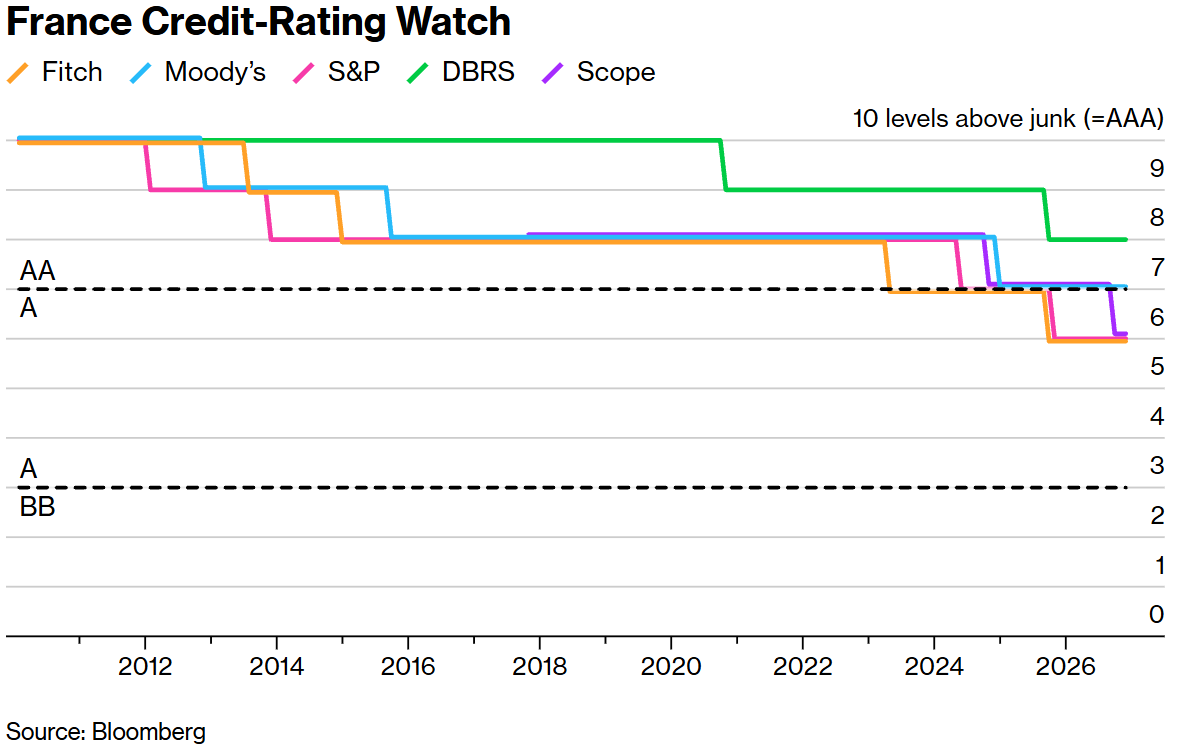
French Credit Rating Watch
As the political turmoil of the past two years undermines efforts to cope with an ever-expanding budget deficit, France's credit rating rankings are declining. In recent months, the outlook for French public finance has deteriorated further as economic growth slows and bond market sell-offs push up government borrowing costs.
For 2026, the French government's initial goal was to reduce the budget deficit slightly to 5% of gross domestic product (GDP). Even this goal has become unattainable, and the deficit gap is now expected to widen to 5.4%, and possibly even higher if the economy approaches recession.
The prospects for next year's fiscal recovery are uncertain, and minority governments are at risk of collapse as they try to get the divided parliament to approve austerity spending. Even if the 2027 budget comes out of disagreement, it is likely to be revised when President Emmanuel Macron leaves office after the May election.
To make matters worse, France has also experienced social unrest. Protests triggered by rising living costs got out of control for a while and turned into riots and robberies. Both business and consumer confidence have declined, and recent data shows that the private sector is shrinking.
France's budget deficit is expected to account for about 5.3% of GDP next year, as austerity efforts are likely to be “largely offset” by rising debt financing costs, according to S&P. The agency also expects France's economic growth rate to fall short of the government's expectations, at only 0.6%.
S&P downgraded France's rating just a year ago. At the time, it already believed that concerns about France's public finance had “intensified,” and described the political turmoil in France at the time as the worst period since the establishment of the French Fifth Republic in 1958.
Since then, France has experienced another series of setbacks. Before Fitch turned to a negative outlook, Morningstar DBRS had already taken the same action in September, while Scope Ratings downgraded France's rating. Despite this, Moody's Ratings chose not to downgrade its assessment last month, and it gave a rating that was one level higher than several other major agencies.
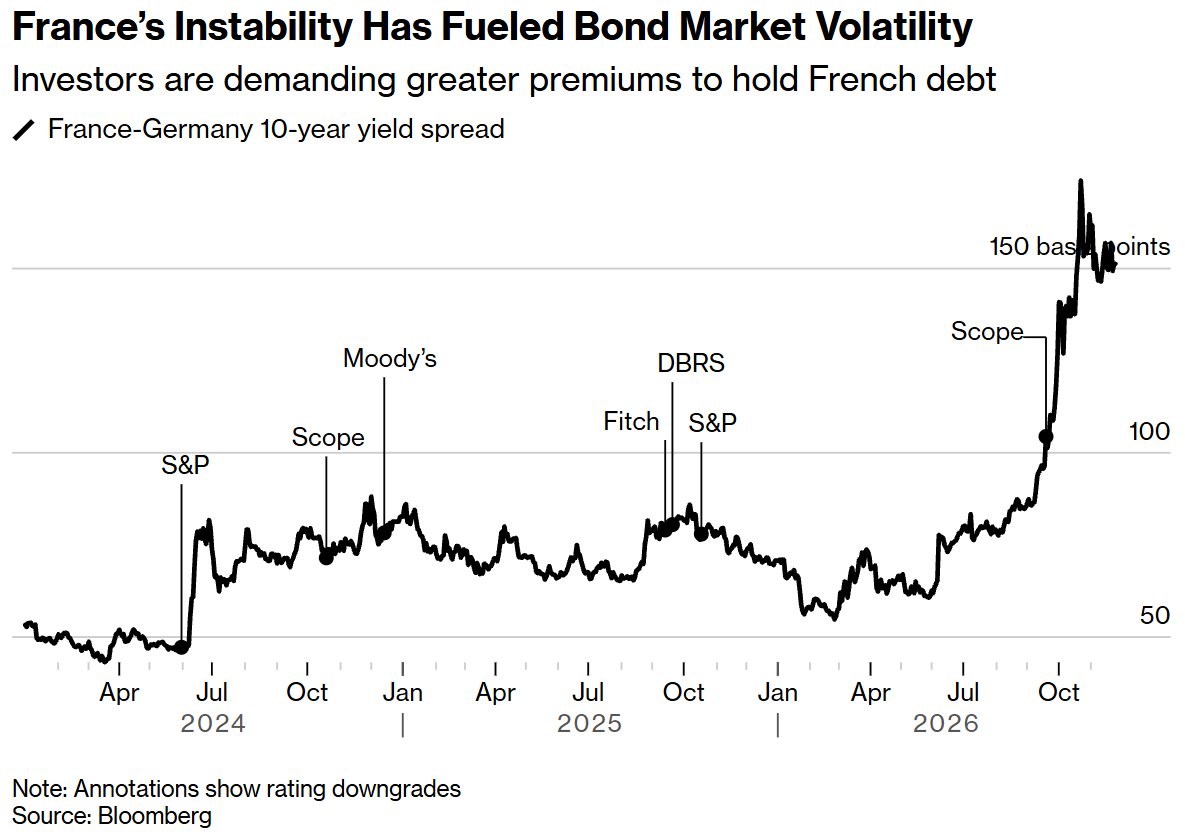
The volatile situation in France has increased the volatility of the bond market
S&P said in a Friday report that if France's budget deficit does not drop significantly, or if the economic growth rate falls short of its forecast for a long time, it may downgrade France's rating.
Finance Minister Roland Lescure said in a statement that the S&P decision shows that it is necessary to quickly pass a budget to reduce the deficit to no more than 5%.
He said, “The French government will continue to unswervingly follow the path of fiscal consolidation. As the global economic outlook remains uncertain, economic actors must be given the certainty they need.”
France's budget dispute will reach its climax when the bill returns to the National Assembly next month. Prime Minister Sébastien Le Corney said in a letter to lawmakers earlier this week that the preliminary draft submitted in early October should be revised to include more measures to reduce the deficit, as well as promises of additional spending for agriculture and coping with student and cost of living protests.
Since there is no majority, the government may use section 49.3 of the Constitution — a constitutional tool that has recently been used many times in fiscal legislation — to pass the revised bill. However, if a subsequent vote of no confidence wins a majority, this approach may fail.
If the government considers it impossible to pass section 49.3 of the budget, several ministers said that the government may resort to an untested executive order, the so-called “ordonnance” (ordonnance). The downside of this tool is that it will directly apply the draft budget, without including the necessary modifications Le Corney said.
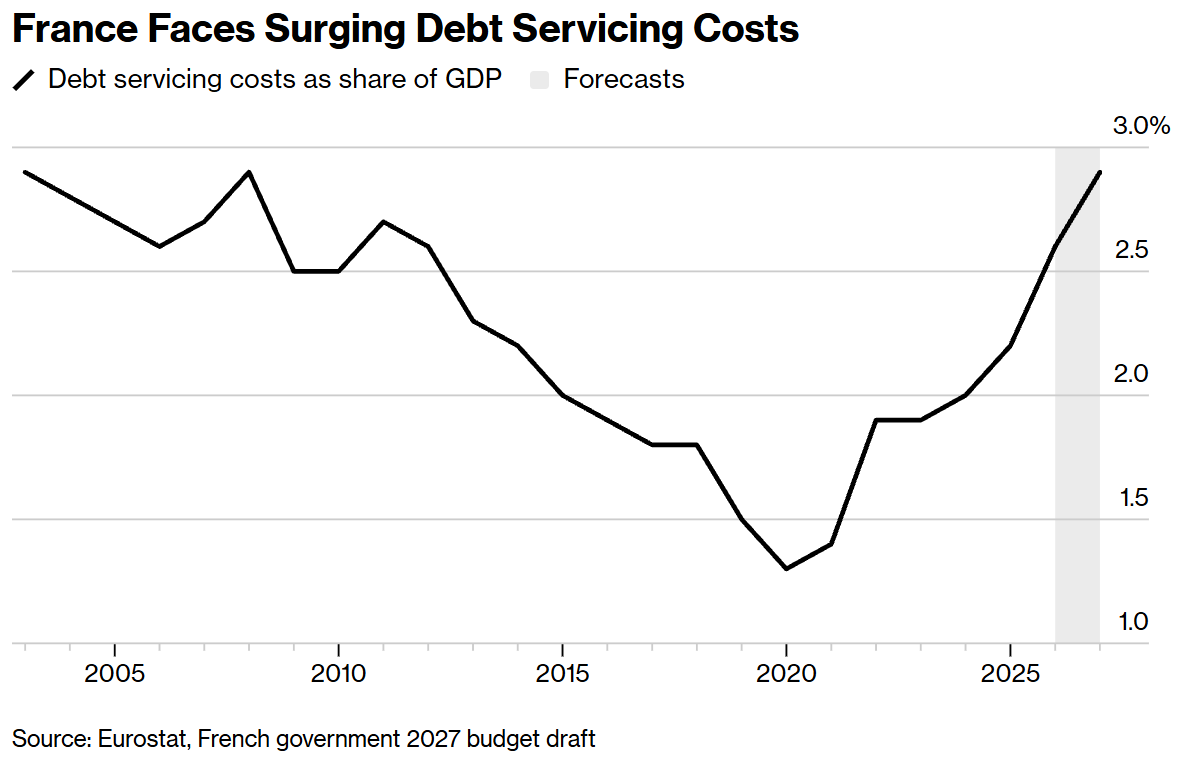
France faces soaring debt repayment costs
Since the early 2024 general election, France's political divisions have also hindered progress on other economic reforms, and even caused Macron's plans to raise the minimum retirement age to be shelved.
Leading presidential candidates in the polls — including frontrunner Marina Le Pen — promised to fix the finances, but also overturn many of Macron's pro-business reforms.
S&P said that post-election policy uncertainty is already dragging down private investment and may eventually limit economic growth and debt stability.
In addition to the presidential election, S&P also said that there is still a risk of political division after France elects a new leader and a possible parliamentary election.
S&P said, “In addition to the budget process, we believe that political divisions are likely to continue after the 2027 presidential election and will continue to limit the effectiveness of policies.”