
How Is Johnson & Johnson’s Stock Performance Compared to Other Pharma Stocks?
For nearly 140 years, Johnson & Johnson (JNJ) has been working on something far more important than simply selling products – helping people live healthier lives. Founded in 1886 and headquartered in New Brunswick, New Jersey, the company has grown from its early healthcare roots into one of the world's biggest names in the medical industry.
Today, its business revolves around two major pillars – Innovative Medicine and MedTech. The first develops prescription treatments for serious conditions, including cancer, immune disorders and cardiovascular diseases. The second brings medical technology to hospitals and healthcare professionals, covering everything from surgical equipment and orthopedic products to vision care and robotic-assisted procedures.
That broad reach has helped J&J build a healthcare empire valued at around $659.5 billion. With a market capitalization well above $200 billion, it comfortably belongs to the “mega-cap” club. Decades of research, product development, medical innovation and a global commercial network have helped the company earn this stature and maintain a powerful position in the healthcare industry.
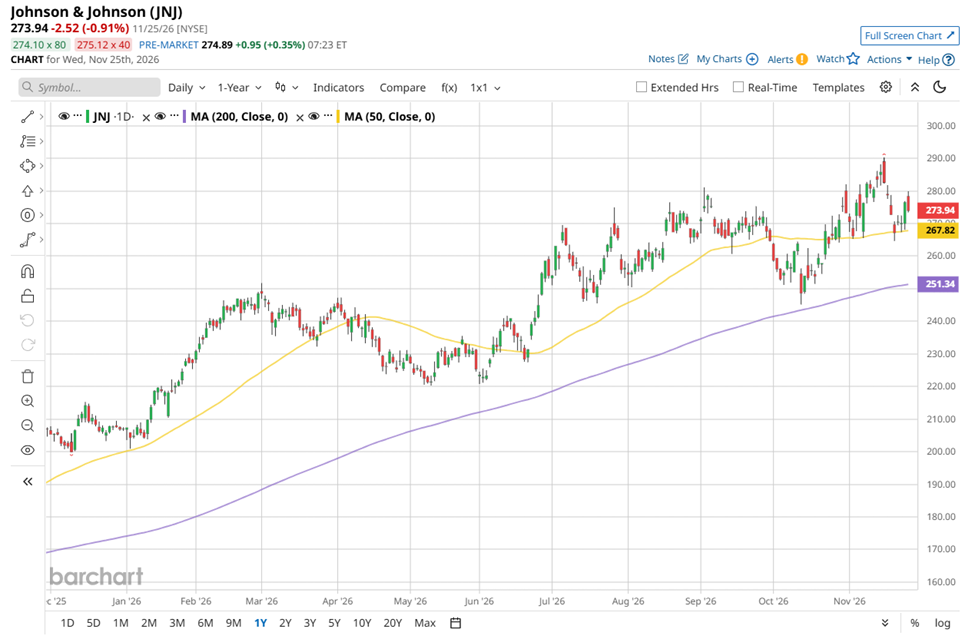
Its stock performance has been equally impressive over the longer run. JNJ touched an all-time high of $290.25 on Nov. 16 and currently sits about 5.6% below that peak. However, the past three months have been relatively quiet, with shares posting only a marginal gain and trailing the iShares U.S. Pharmaceuticals ETF (IHE), which climbed 1%.
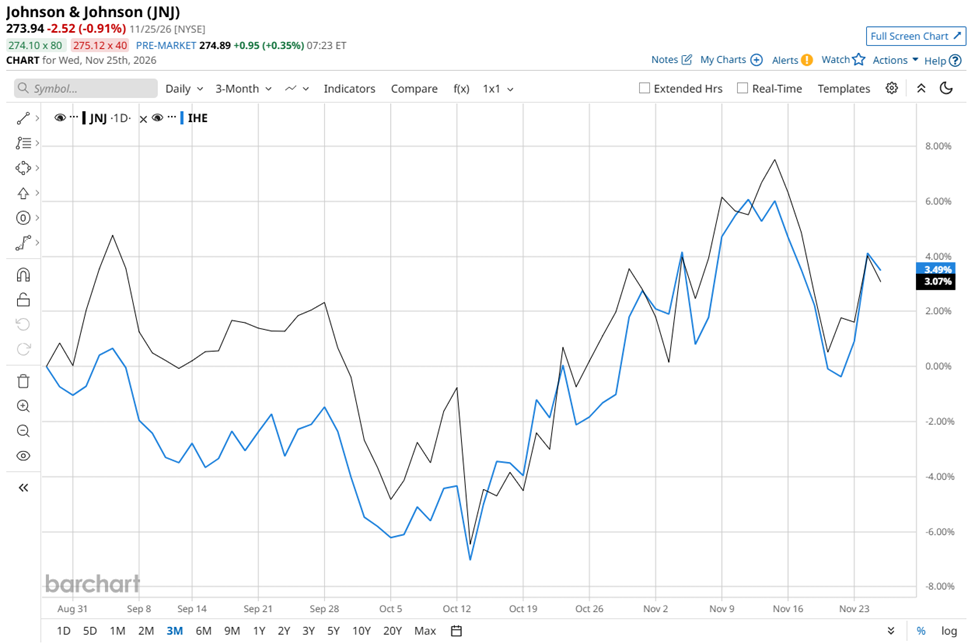
Zooming out paints a much stronger picture. JNJ has climbed 32.4% in 2026 and 32.6% over the past 52 weeks, beating IHE's respective gains of 27.8% and 26.2%.
Technically, the trend remains encouraging. Shares have stayed above their 200-day moving average over the past year and have traded above their 50-day average since October, pointing to sustained long-term strength despite the recent pause.
Johnson & Johnson’s share price rally in 2026 has been supported by strong demand for its Innovative Medicine portfolio, encouraging clinical and regulatory developments, and progress across its drug pipeline. New treatment opportunities have helped offset pressure from competition against its blockbuster drug Stelara, while strategic portfolio moves have strengthened its long-term growth story. Its reputation as a dependable dividend payer has also attracted investors looking for stability. After all, J&J is a “Dividend King,” having raised its dividend for 64 consecutive years.
That said, the recent momentum has cooled somewhat. On Oct. 13, shares fell more than 6% after its MedTech business missed sales expectations for the second consecutive quarter. Management pointed to geopolitical tensions in the Middle East, European austerity measures and pricing pressure in China as factors weighing on international sales.
Still, JNJ has held up better than its pharmaceutical rival AbbVie Inc. (ABBV). AbbVie's shares have gained 28.7% over the past year, trailing J&J’s climb over the same period.
Looking ahead, Wall Street remains moderately optimistic about JNJ. Among the 25 analysts covering the stock, the consensus rating is “Moderate Buy.” The average price target of $284.24 indicates potential upside of 3.8% from current levels, suggesting analysts see some room for further gains, although expectations remain measured.
On the date of publication, Sristi Suman Jayaswal did not directly have a position in any of the securities mentioned in this article. All information and data in this article is solely for informational purposes. For more information please view the Barchart Disclosure Policy here.