
Taimei Medical Technology (02576): Bulls are betting on long-term fundamental improvements, and repurchases are a key supporting signal in the market
On the evening of November 26, Taimei Medical Technology issued an announcement announcing that the company spent approximately HK$1.7651 million to repurchase 405,000 shares on the same day. Although this is only the company's 2nd repurchase in November of this year, it is its 50th repurchase this year.
According to data from the Zhitong Finance App, since the beginning of this year, Taimei Medical Technology has repurchased shares 50 times. The cumulative number of shares repurchased has reached 11.208 million shares, and the corresponding amount has reached HK$59.2439 million.
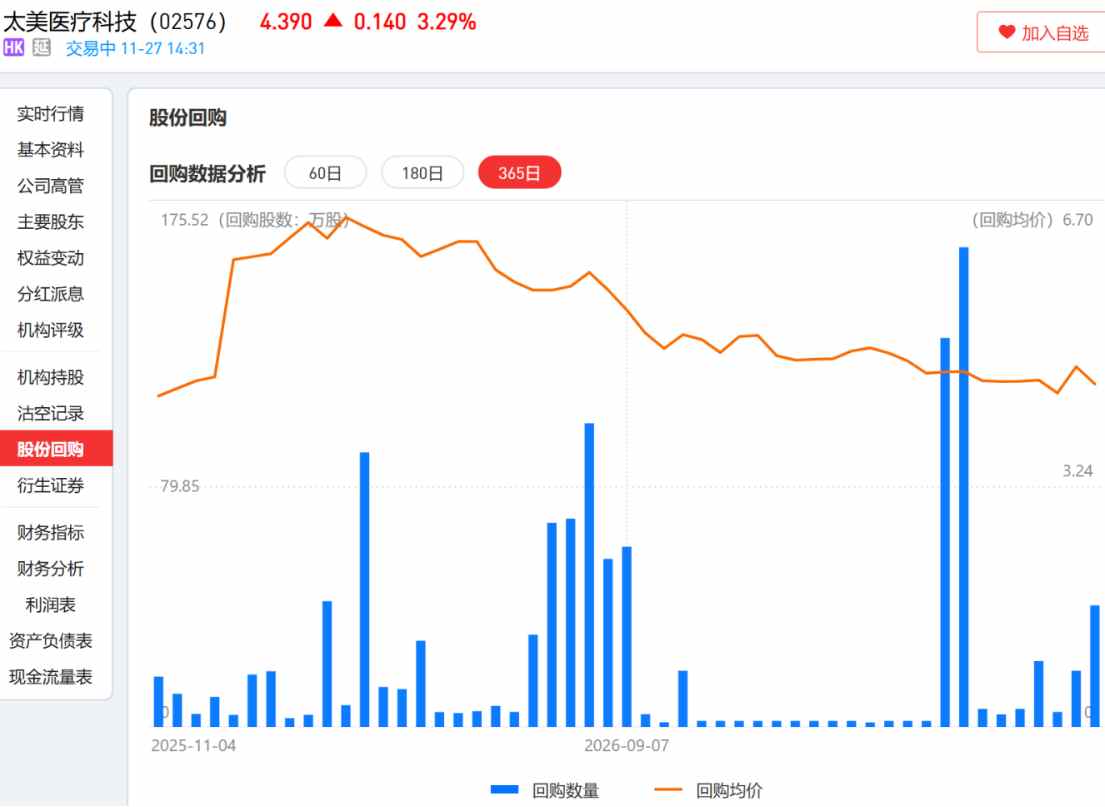
The reason behind active repurchases also has a certain relationship with its performance in the secondary market. Since the stock price hit a two-year high of HK$7.50 on July 6 this year, Taimei Medical Technology's stock price has entered a correction cycle of nearly 5 months. On November 26, the company's stock price dropped to a low of HK$3.99, down 46.8% from its high point.
However, in reality, the company's financial report for the first half of this year shows that its core Wiz.AI Wiz.AI intelligent platform has accelerated the commercialization process, driving the company's overall fundamentals to improve. In this context, the company's management clearly wants continued repurchases to regain market confidence.
Underlying signals weaken, and continued repurchases are the key to reversing bears?
Judging from market performance, during this period of nearly 5 months of stock price correction, October 12-13 was undoubtedly a watershed moment for Taimei Medical Technology.
After withstanding the fall in stock prices brought about by market selling pressure in July-August, Taimei Medical Technology's stock price entered a phase of sideways fluctuation after the second half of September. The contraction in volume energy during this period indicates that the market selling pressure will gradually ease. The company's management also began a gradual buyback period during this window to calm market sentiment.
As a result, after September 28, Taimei Medical Technology announced the repurchase for 14 consecutive trading days, and spent HK$14.4017 million to repurchase a total of 3.778,200 shares. In particular, on October 12 and 13, the company repurchased 1.259 million shares and 1.297 million shares respectively within the two trading days, accounting for 67.65% of the cumulative number of shares repurchased by the company within this range.
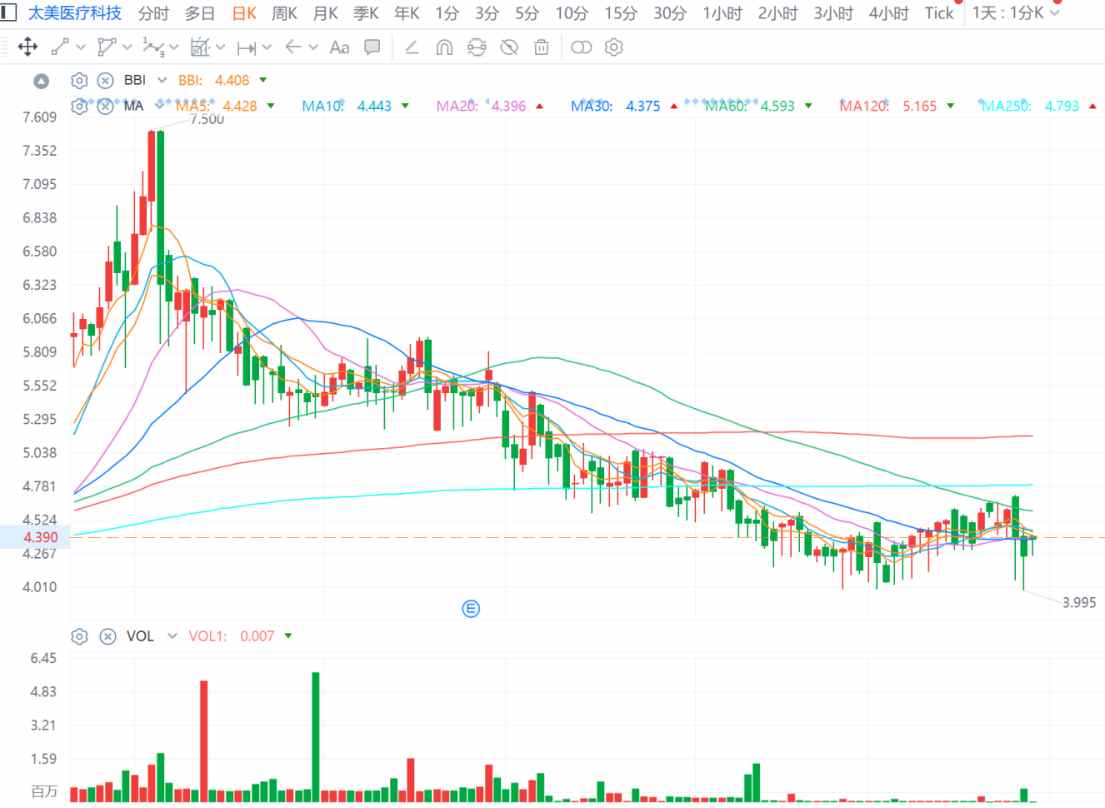
It's easy to see that on October 12 and 13, Taimei Medical Technology saw sales for two consecutive trading days, with daily turnover reaching 1.352,200 shares and 1.866,600 shares, respectively. Judging from the company's repurchase announcement, it is easy to find that almost all of the sales volume on October 12-13 was made up of the company's repurchase orders, and the number of shares repurchased accounted for 90% of the total turnover over the two days. However, in fact, actual sales on the market were not active at the time, so the company's stock price naturally contracted and stabilized later.
However, after spending a month and a half like this, Taimei Medical Technology experienced another drop in volume on November 26. However, this time it is different from the “repurchase and absorption volume” of October 12-13. This time, it tends to “throw out the volume of the shipping model.”
The Zhitong Finance App observed that previously, from October 12 to 13, the buyback itself was the main force in buying. The “volume” reflected the strength of the repurchase rather than selling pressure: the company's repurchase volume of more than 2.5 million shares for two consecutive days had swallowed up most of the circulation chips, and the non-repurchase volume was less than 50,000 shares. To a certain extent, Taimei Medical Technology's market supporters at the time had a strong wait-and-see attitude and did not choose to concentrate and flee, so subsequent stock price stability can be expected.
However, the company's stock volume logic on November 26 is not the same as before. Although the company also repurchased 405,000 shares, it only accounted for 62.51% of its total trading volume on the same day — meaning that about 243,000 shares were actually traded on the same day. The stock price closed down 3.41% on the same day, which indicates that the non-repurchase sale far exceeded the purchase.
Meanwhile, Taimei Medical Technology's OBV index fell from 717,400 cliff-style to 246 on November 26, showing a typical pattern of loose chip shipments, in stark contrast to its flat OBV index on October 12-13.
Market concerns about the subsequent repurchase pace of Taimei Medical Technology may be one of the reasons for the recent fluctuations in the volume and price of the company's stock.
On the one hand, after more than 10 consecutive trading days of repurchases in October this year, Taimei Medical Technology's repurchase pace slowed markedly in November. The company only repurchased 187,000 shares and 405,000 shares on November 19 and 26, respectively. The interval was lengthened and the number of shares repurchased decreased. The back-up signal was far less strong than in October.
On the other hand, data shows that as of November 26, the company's treasury stock had reached 11.375,400 shares, accounting for 5.67% of the company's total share capital, and all of them were held in inventory rather than cancelled after repurchase. In a situation where the Hong Kong stock repurchase rules stipulate that treasury shares can be sold after the suspension period, although the company has no plans to sell, the 5.67% share of treasury shares still constitutes a potential dilution expectation to a certain extent. Therefore, with the support of expectations that the suspension period expires on December 26, some investors may choose to reduce their positions early to avoid potential uncertainty.
In fact, there was a leading signal the day before November 26th. On November 25, when Taimei Medical Technology closed down 4.35%, the daily trading volume of 69,400 shares tripled from the recent average. There were signs of a decline in volume, leading to the acceleration of fears in the market the next day and the collapse of the market at the end of November 27.
The commercialization of AI platforms has accelerated into the core logic of multiple betting
For investors on and off the market, the core significance of Taimei Medical Technology's continuous buyback is not only to support in-market liquidity, but also to continue to send a signal of confidence from management to the market in the HK$4.2-4.6 range.
Meanwhile, the average repurchase price for the company's management on November 26 was HK$4.36, which happened to be near the 20-day EMA and BOLL mid-track on the same day, thus forming a “technical support+fundamental support” resonance zone, which has become an important force supporting the bulls in the recent long and short differences within the Taimei medical technology market.
From a fundamental perspective, this year's interim report shows that Taimei Medical Technology achieved total revenue of 264 million yuan in the first half of this year, up 8.0% year on year; corresponding gross profit of 118 million yuan, up 17.5% year on year; overall gross margin increased from 41.0% to 44.7% in the same period in 2025. As a leading business indicator, Taimei Medical Technology added 364 million yuan in the first half of the year, an increase of 15% over the previous year, reflecting the continued increase in market demand for AI drug clinical development platforms.
In terms of revenue composition, the two major business divisions of Taimei Medical Technology showed a trend of structural differentiation — the AI clinical development platform maintained rapid growth, with revenue of 159 million yuan in the first half of the year, an increase of 22%; the additional contract amount was 266 million yuan, a sharp increase of 47% over the previous year, and the gross margin reached 63.6%.
Among them, the commercialization process of the core Wiz.ai Wiz.ai intelligent platform accelerated. In the first half of the year, an additional contract amount of 124 million yuan was added, an increase of 67% over the previous year, and achieved revenue of 61.83 million yuan, an increase of 48% over the previous year. It is worth mentioning that there is still a clear scissor gap between the contract growth rate and revenue growth rate of the Wiz.AI platform, which means that it may have considerable revenue recognition flexibility between the 2026H2 and 2027H1 fiscal year.
Furthermore, as of June 30, 2026, Taimei Medical Technology had sufficient cash asset reserves, a net current asset value of about 1.06 billion yuan, a current ratio of 4.39, and a steady financial situation. With the company's PB (TTM) and PS (TTM) valuations currently at around 30% since listing, betting on valuation restoration after improving the company's fundamentals is clearly a good option for some long-term investors.