Silicon Industry Branch: This week's sharp shock in industrial silicon futures made up for the decline, and expectations of major manufacturers in Xinjiang to resume production suppressed the market
The Zhitong Finance App learned that the Silicon Industry Branch published an article stating that this week the industrial silicon market showed a pattern of “sharp fluctuations in futures and full compensation for the decline in spot goods.” In the first half of the week, the market declined rapidly due to market rumors that a major factory in Xinjiang was planning to resume work, and market concerns about increased supply heated up; in the second half of the week, the spot market chose to make up for the decline after several weeks of standoff. Although the plan to resume production is still in the accounting stage, the rumor has fully reflected the current market's highly sensitive and vulnerable mentality to increased supply.
Market performance: Futures fell sharply, and spot stocks made up for the overall decline
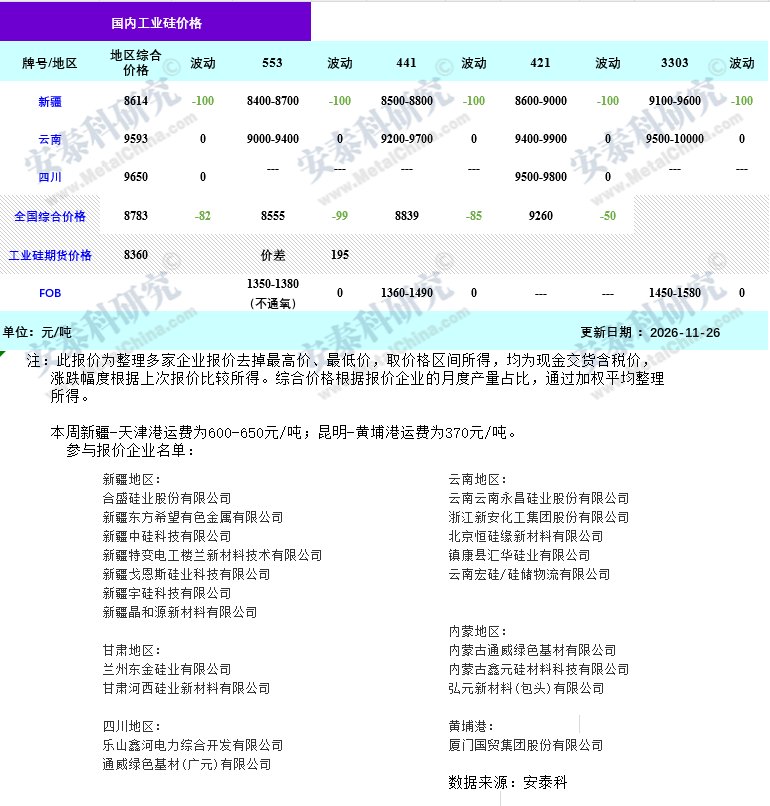
In terms of futures, the main 2,701 contract fluctuated sharply this week, and the focus was drastically lowered. At the beginning of the week, the market dived rapidly due to news that a major factory in Xinjiang was planning to resume work; according to Guangji Institute data, the main contract once reached a low level of around 8,260 yuan/ton on November 25. On November 26, although there was a slight restorative rebound in the market, closing at 8,360 yuan/ton, the overall weak pattern remained unchanged.
On the spot side, according to Antec's November 26 price, the national comprehensive price was 8,783 yuan/ton, down 83 yuan/ton from last week. By specification, 553 #报8555元 /ton, 441 #报8839元 /ton, and 421 #报9260元 /ton were down 99 yuan/ton, 85 yuan/ton, and 50 yuan/ton, respectively, from last week. Looking at the subregion, Xinjiang dropped 100 yuan/ton from last week to 8,614 yuan/ton, while prices in Yunnan and Sichuan were 9,593 yuan/ton and 9,650 yuan/ton respectively, all the same as last week. In terms of export FOB, prices are the same as last week.
Judging from the transaction situation, there has been an increase in inquiries in the spot market, but actual transactions are still mainly small orders that are just needed. Affected by the sharp drop in futures and rumors about the resumption of production, the price promotion mentality that early holders insisted on near the cost line loosened, and some manufacturers chose to make concessions to return funds. Downstream as a whole is still at the stage of consuming its own inventory, and there is no centralized procurement due to falling prices.
Supply side: Production cuts in the southwest have come to an end, and expectations for the resumption of production in the north are heating up
This week, the supply side showed a sharp game between “actual contraction” and “expected increase.” From a realistic point of view, production cuts during the dry water period in the southwest have basically taken shape. At the end of the month, the last batch of enterprises that rely on surplus electricity will completely shut down. The supply side is actually at a low level. The overall operating rate of major production areas in the north remains low and stable. The biggest marginal change this week, however, is the rise in expectations for the resumption of production. According to market information, due to rigid restrictions on long-term electricity settlement at the end of the year, a major factory in Xinjiang believes that it is cost feasible to start some production capacity in December, and plans to start construction one after another in early December. This expectation has already been priced ahead of schedule on the market, and the supply pattern has changed from “one-sided contraction” in the early stages to a “long and short game,” adding new uncertainty.
Demand side: downstream production cuts continue, procurement intentions are sluggish
The overall trend continued to be weak this week, and it is difficult for various fields to achieve an effective increase in industrial silicon. In terms of polysilicon, spot transactions are still light, industry inventories are high, and removal is slow. Downstream silicon wafer production schedules have declined month-on-month. There is only a rigid inventory reserve for silicon procurement, and there is no desire to actively prepare stocks. Purchases of industrial silicon also mainly consume our own inventory. In terms of silicone, the market is weakly declining, DMC prices are under pressure, and the overall start of single plants remains low. Maintaining immediate demand for industrial silicon, it is difficult to increase. In terms of aluminum alloy, terminal demand is gradually shifting to off-season. Affected by winter cooling and environmental protection warnings in the north, downstream die-casting companies have declined in commencement and new orders have declined. Recycled aluminum companies are constrained by the high cost of scrap aluminum, maintain “production based on sales”, and maintain on-demand procurement of industrial silicon. Earlier, due to the partial tightness caused by a decrease in the supply of small furnaces in the southwest, the pace of procurement has leveled off as the pace of procurement has slowed down. Overall, in the context of potential increases in supply, the continued downturn on the demand side is difficult to withstand supply pressure, and the underlying pressure situation is difficult to change in the short term.
Looking ahead to the future market
Taken together, the industrial silicon market is currently in a transition period between “actual production cuts coming to an end” and “expected resumption of production heating up.” The “drastic reduction in production during the dry water period in the southwest” logic that supported prices in the early stages is gradually disintegrating as large factories anticipate resuming production in December. Once production is resumed and implemented, the substantial increase on the supply side will directly collide with downstream demand, which continues to be sluggish, and the supply-demand balance sheet will likely face a re-correction, thus suppressing the market. However, rigid constraints on the cost side still exist. The high electricity prices during the dry water period in the southwest and the settlement costs of electricity from the Northwest Changxie Electric Power Bank limited the room for enterprises to make concessions without a bottom line, so that prices still have a certain bottom resilience even after a sharp drop.
The short-term forecast is that market sentiment will remain cautious until the plan to resume production is implemented, prices will remain weak and volatile, and the main contract reference range is 8100-8,500 yuan/ton. In the future, we need to focus on tracking: the actual implementation progress and production release of major factories in Xinjiang in December, changes in downstream polysilicon production schedules, and the manufacturer's actual intention to raise prices after spot prices approach the cost of cash flow.