
How Earnings Upgrades Will Impact Annaly Stock Investors
- Annaly Capital Management recently drew increased attention from Wall Street, after 14 brokerage firms issued generally positive views alongside upward revisions to earnings estimates.
- The more optimistic profit outlook matters because Annaly’s model depends heavily on earnings power from its mortgage portfolios and financing choices, rather than sentiment alone.
- We will now look at how Annaly Capital Management’s investment narrative could be affected by the recent upward revisions to earnings estimates.
Scan how Wall Street optimism around Annaly Capital Management compares with other income focused names by checking the hand picked 11 dividend fortresses that analysts are watching closely.
Annaly Capital Management Investment Narrative Recap
To own Annaly Capital Management, you need to be comfortable with a mortgage REIT that leans heavily on financing conditions, mortgage spreads and hedging choices rather than product growth. The analyst consensus Narrative on Simply Wall St expects strong earnings and revenue expansion, supported by agency MBS spreads, higher coupon positioning and a meaningful role for mortgage servicing rights. That thesis lives or dies on Annaly’s ability to keep funding costs and leverage in check.
Right now, the key short term swing factor is how interest rate volatility affects hedging costs and portfolio returns. Upward earnings revisions point to improving expectations, but they do not change the core exposure to rate moves, housing activity and competition in residential credit. The biggest risk stays the same: that elevated volatility or wider spreads erode net margins faster than management can adjust the portfolio.
The recent earnings estimate upgrades tie back most directly to the same operational levers already in focus. Analysts highlight attractive agency MBS spreads, the shift into higher coupon 6% and 6.5% securities and improved financing and economic leverage as drivers for better net interest income. If those levers keep working, the business case behind those higher forecasts holds together.
On the flip side, the same set of assumptions creates pressure points you should watch closely. Dividend coverage is flagged as weak at a 16.8% yield, and debt is described as not well covered by operating cash flow. Rising hedging costs, tougher housing conditions or more aggressive competitors in non agency mortgages could challenge the upbeat revisions and turn today’s optimism into a stress test of Annaly Capital Management’s model.
What the Annaly Capital Management Forecasts Really Assume
Annaly Capital Management's narrative points to forecast revenue of US$2.7b and consensus earnings of US$2.3b by 2029. That profile lines up with analysts building in 3.7% yearly revenue growth and an earnings increase of about US$0.4b from current earnings of roughly US$1.9b.
Uncover why Annaly Capital Management's fair value indicates a 34% potential upside to its current price, which could narrow quickly.
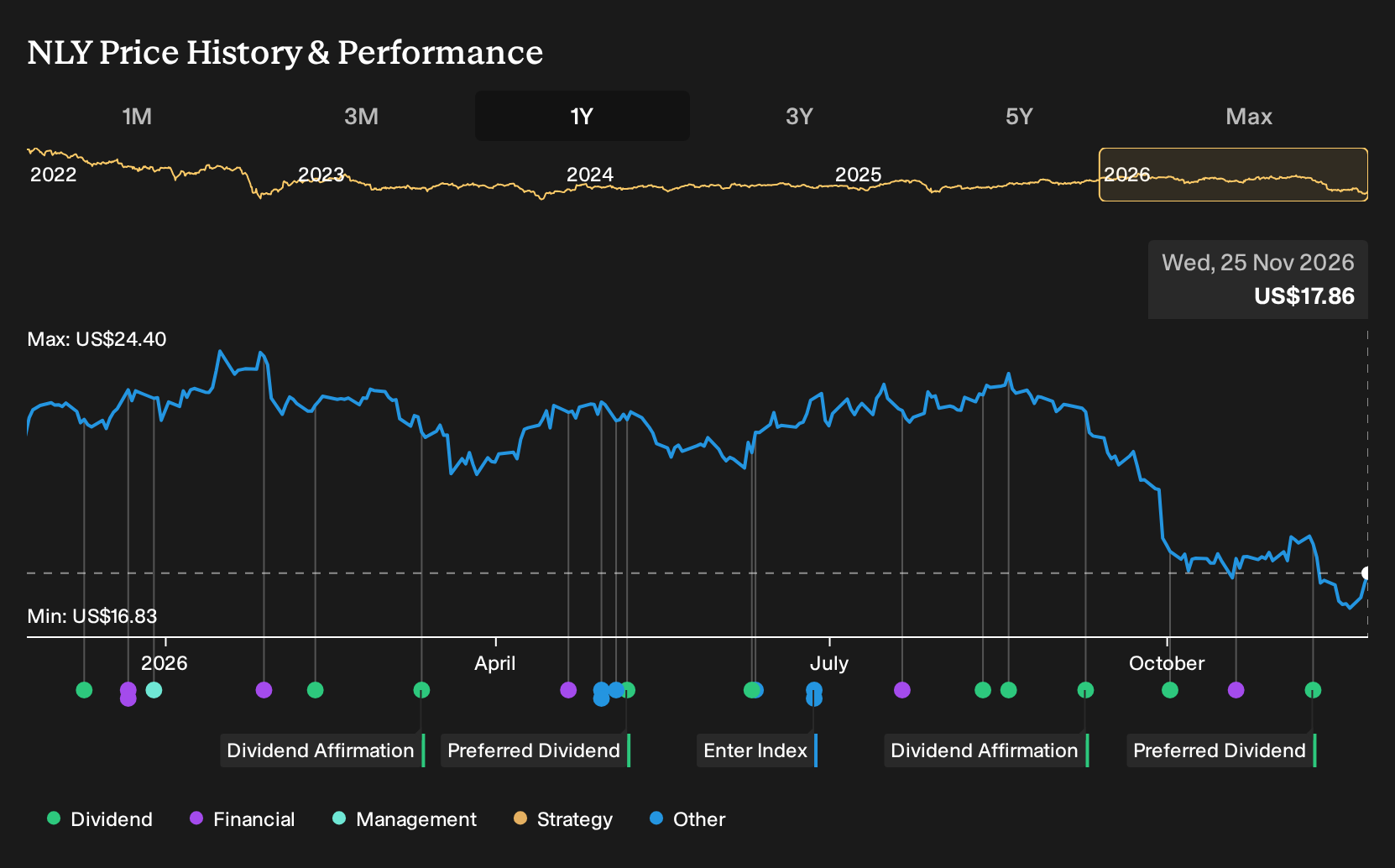
Exploring Other Perspectives
Three fair value estimates from the Simply Wall St Community cluster between US$21.14 and US$30.85, which leaves plenty of room for disagreement on Annaly Capital Management’s upside. When you set those crowd views against risks like higher hedging costs or housing weakness, it becomes clear why you should explore multiple viewpoints before acting.
Explore 2 other Annaly Capital Management fair value estimates, including one that suggests it could be worth just $21.14.
Reach Your Own Conclusion
Disagree with existing narratives? Extraordinary investment returns rarely come from following the herd, so trust your own research and judgment.
- A great starting point for your Annaly Capital Management research is our analysis highlighting 2 key rewards and 3 important warning signs that could impact your investment decision.
- See our latest analysis for Annaly Capital Management. The report includes a comprehensive fundamental analysis summarized in a single visual, the Snowflake, making it easy to evaluate Annaly Capital Management's overall financial health at a glance.
Looking for more investment ideas beyond Annaly Capital Management?
If you want to pressure test your view on Annaly Capital Management by comparing it with other opportunities, the Simply Wall St Screener can help you quickly surface stocks that match different risk and return preferences.
- For investors who want income from companies with more resilient financial footing, start with a list of solid balance sheet and fundamentals (23 results), which can handle tougher conditions without stretching their finances.
- If you prefer to focus on potential mispricing, use the 20 high quality undiscovered gems to spot under followed businesses where strong fundamentals are not yet fully reflected in the share price.
- Those who care most about capital stability can filter for a 31 resilient stocks with low risk scores, which scores well on key risk checks so you can focus your research where downside may be more contained.
Have feedback on this article? Concerned about the content? Get in touch with us directly. Alternatively, email editorial-team@simplywallst.com