
Kroger (KR) Could Be 35% Below Fair Value After Its Cost Cutting Push
Kroger (KR) has just laid out a large cost cutting program built around corporate job reductions and heavier use of technology, a move that sharpened market attention on the stock this week.
Recent trading shows that momentum in Kroger’s share price has been building rather than fading, with a 90 day share price return of 22.66% and a year to date move of 10.91%, while long term total shareholder return over five years sits at 93.67%.
Scan how Kroger’s restructuring story compares with other retailers under pressure to cut costs by running a focused screen of list of solid balance sheet and fundamentals (23 results).
Kroger now trades almost in line with average analyst targets, yet appears materially below some intrinsic value estimates. After a restructuring-driven rally, is the market still too cautious or already paying up for the plan?
Most Popular Narrative: 6% Overvalued
Kroger closed at $69.83 against a narrative fair value of $65.65, and according to LunaRodas, an investor in the Simply Wall St Community who wrote the narrative, the key issue is how far cost discipline can offset softer sales.
The central narrative tension of the latest call is the gap between two clean stories, cost discipline working exactly as committed, and the sales line missing the guidance range. Foran’s response was to present these as compatible, a demonstration that the financial model works even when top-line conditions don’t cooperate.
See why 3 investors see Kroger as 6% overvalued.
Result: Fair Value of $65.65 (OVERVALUED)
Still, the Kroger story could be knocked off course if cost savings fade faster than expected or if weaker ticket trends continue to pressure identical sales.
Find out about the key risks to this Kroger narrative.
Another View: Kroger Through A Cash Flow Lens
The community narrative pegs Kroger at 6% overvalued using a fair value of $65.65, yet the SWS DCF model presents a very different picture. On that cash flow view, KR at $69.83 is described as being around 35% below an estimated value of $106.87, which suggests a very different risk profile for anyone focused on long term cash generation.
If two valuation tools disagree this sharply, it raises a simple question for investors: which set of assumptions appears closer to how Kroger will convert its sales and cost cuts into future cash.
Look into how the SWS DCF model arrives at its fair value.
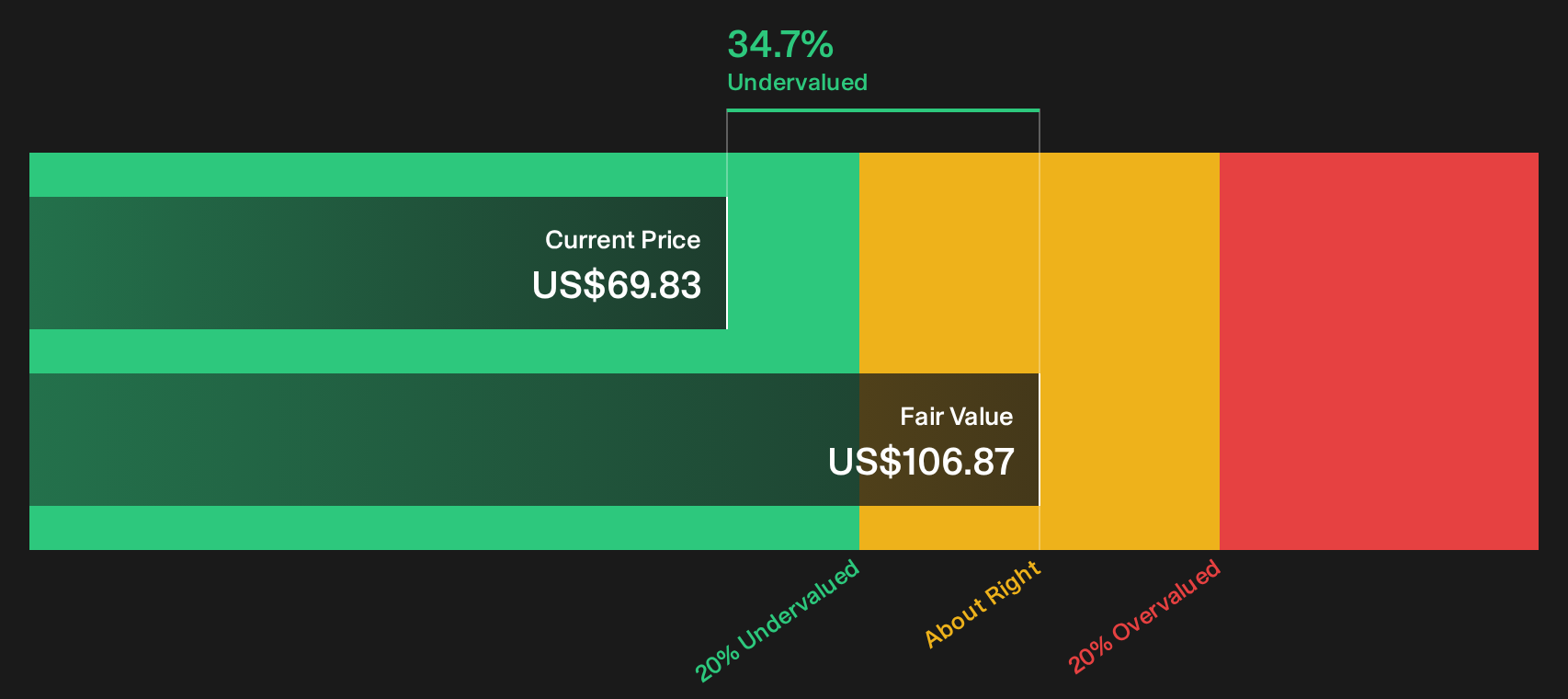
Simply Wall St performs a discounted cash flow (DCF) on every stock in the world every day (check out Kroger for example). We show the entire calculation in full. You can track the result in your watchlist or portfolio and be alerted when this changes, or use our stock screener to discover 36 high quality undervalued stocks. If you save a screener we even alert you when new companies match - so you never miss a potential opportunity.
Next Steps
Sentiment around Kroger is clearly split, with risks and potential rewards both on the table. Move quickly, look through the detail, and test your own thesis against the 3 key rewards and 4 important warning signs.
Looking for more investment ideas beyond Kroger?
If Kroger sharpened your focus on cost control and valuation, broaden your watchlist now with other opportunities that match your preferred balance of risk, yield, and upside.
- Target resilience first and scan a 31 resilient stocks with low risk scores that aims to keep portfolio volatility in check while still giving you meaningful equity exposure.
- Spot potential value gaps early and work through a 36 high quality undervalued stocks that highlights companies with stronger fundamentals than their current price may suggest.
- Boost your income stream and review a 11 dividend fortresses that concentrates on higher yielding payers with the financial strength to keep distributions on the table.
Have feedback on this article? Concerned about the content? Get in touch with us directly. Alternatively, email editorial-team@simplywallst.com