
“Outrageous”! Head of Altimeter talks about NVDA.US (NVDA.US): Growth is real, but the market is no longer paying for growth
The Zhitong Finance App noticed that on Monday, November 23, Nvidia (NVDA.US)'s stock price surged 31.5% after its board of directors made Huang Renxun, who had resigned for less than two weeks, return as CEO.
But Brad Gerstner, CEO of Altimeter Capital, thinks the bigger point is how cheap the stock became before the big rise.
Gerstner said on Monday that as of the morning of the same day, “the market gave Nvidia a valuation multiplier, which actually implied negative growth in 2028 and 2029. I think this is outrageous.”
Wall Street expected the opposite
Also, Nvidia isn't the only one betting big on 2028. TSM.US (TSM.US) and AMD (AMD.US) also need the results of these years to support them.
Wall Street is still optimistic about growth in the past two years
Deepwater Asset Management's Gene Munster said Wall Street expects Nvidia's revenue to grow 72% in the 2027 calendar year and 29% in the 2028 calendar year.
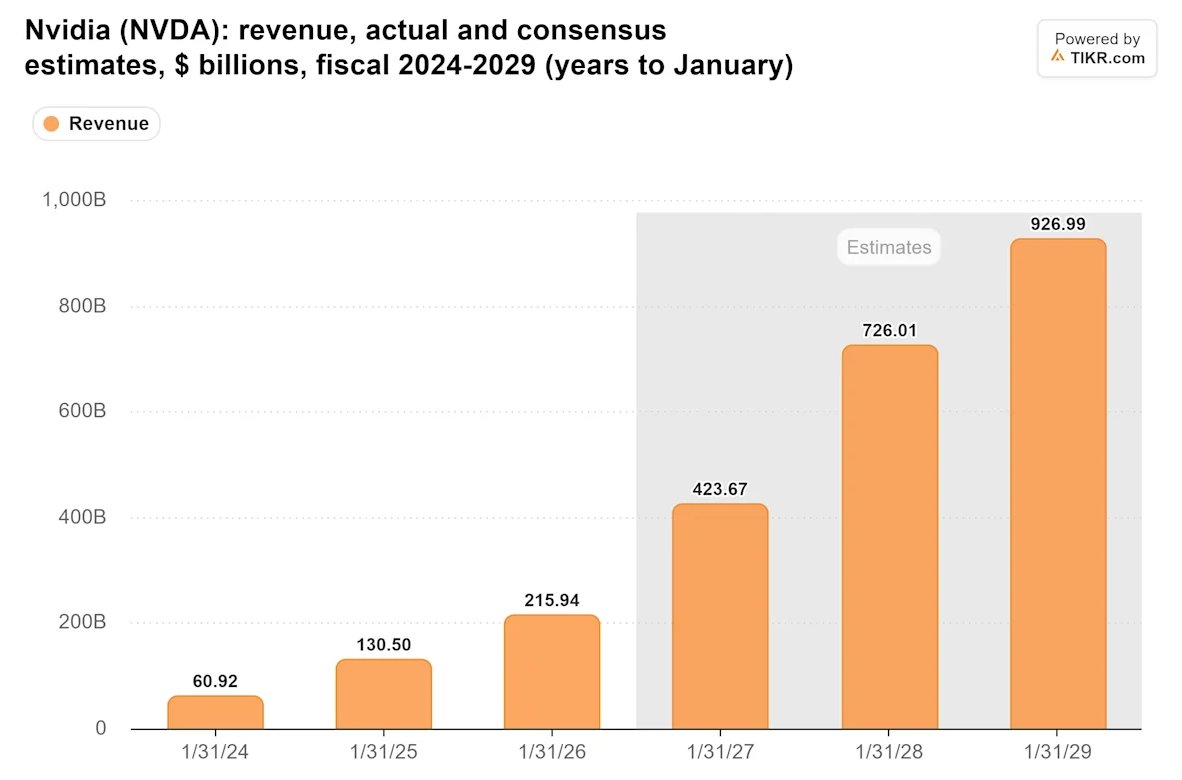
According to TIKR's consistent market expectations, Nvidia's revenue will more than double, from $424 billion for the fiscal year ending January 2027 to $927 billion for the fiscal year ending January 2029:
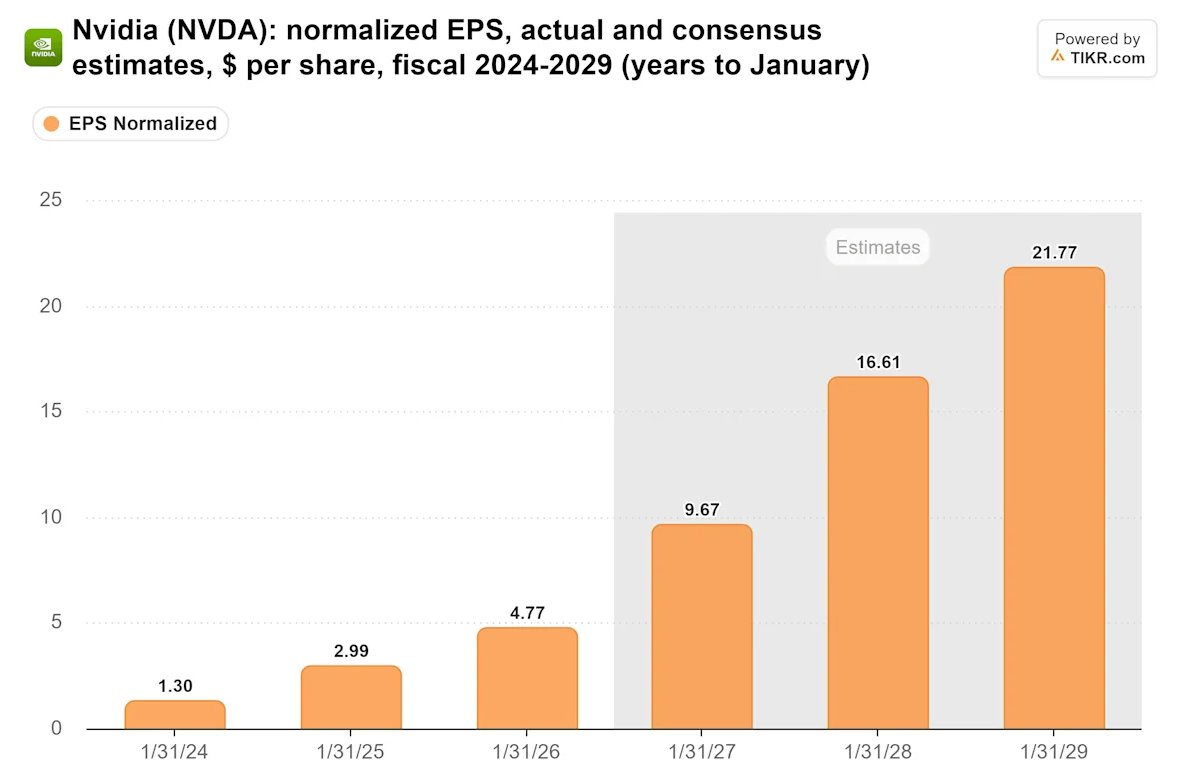
The profit trend is the same. Analysts expect standardized earnings per share (EPS) to rise 31% from $16.61 for the fiscal year ending January 2028 to $21.77 for the next fiscal year:
The market is already setting the price for peaking
Let's take a look at how much investors are paying for this growth. Even after Monday's sharp rise, Nvidia's forward price-earnings ratio at the close was still around 11 times. This is a recovery from the five-year low of 8.7 times hit on Friday, but it is still far below the five-year average of 35 times and the peak of nearly 70 times in May 2023:
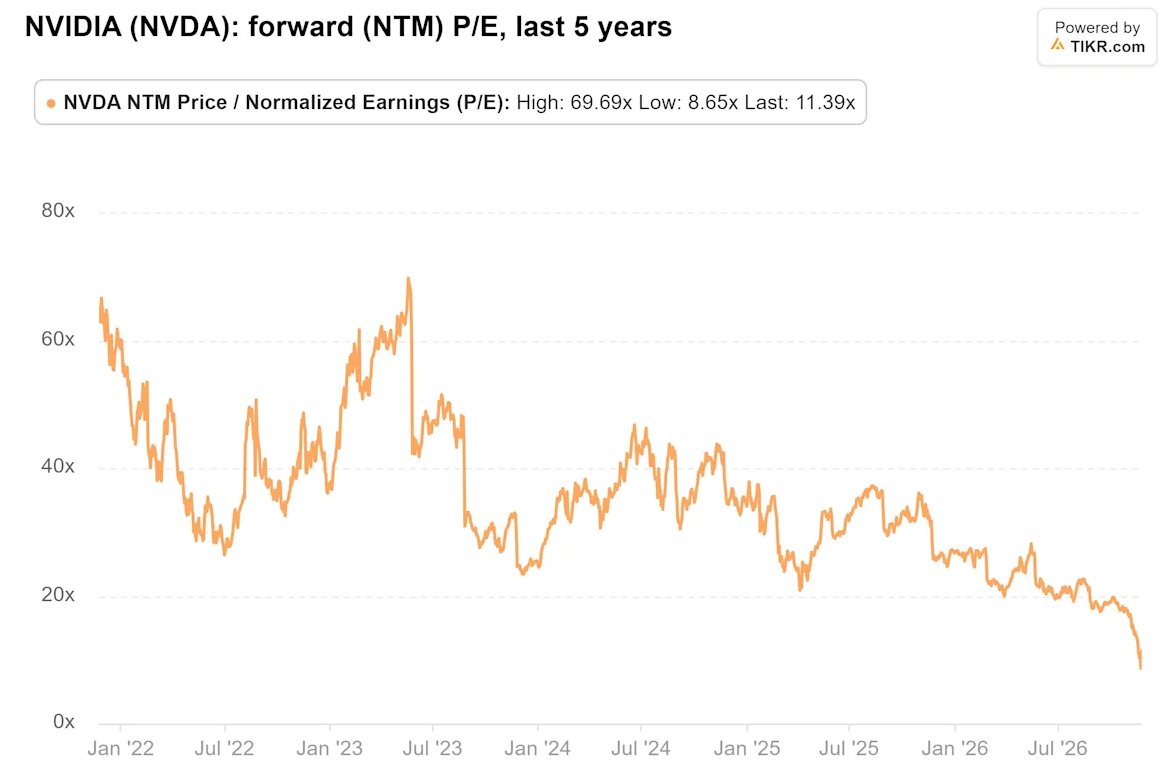
Such a low valuation multiple is only meaningful when investors expect these profit forecasts for 2028 to be drastically lowered, as if the current cycle would peak in 2027.
Capital expenditure forecasts have stopped rising
The focus of concern is Nvidia's customers. As Matt Bryson of Wedbush said on the show, “It feels like the whole AI deal is being assumed and will deteriorate in 2027 or 2028.”
Analysts covering Amazon (AMZN.US), Alphabet (GOOGL.US), Microsoft (MSFT.US), Meta (META.US), and Oracle (ORCL.US) did not raise capital expenditure forecasts for this earnings season. Peter Bouquevall of OnePoint BFG said that the market expects the capital expenditure of hyperscale cloud vendors to increase by about 50% in 2027, far below analysts' expectations of Nvidia's 71% revenue growth for the fiscal year ending January 2028.
However, some of these expenses are probably just a matter of delay. Industry research analyst Mandeep Singh said that hyperscale cloud vendors cannot currently find the capacity to install chips, so some spending will be delayed until 2028 and 2029.
TSMC and AMD will also need 2028
What Bryson called the “whole AI deal” covered far more than Nvidia. On November 10, TSMC's board of directors approved capital expenditure of approximately US$40.9 billion, mainly for advanced process and packaging production capacity, new fabs, and research and development in 2027. This production capacity will only be put into operation in the next few years, so TSMC is betting that demand will continue beyond 2027. The stock's forward price-earnings ratio is approximately 14 times, and analysts expect its standardized earnings per share to grow 34% in 2027.
AMD, on the other hand, bears the greater risk in 2027. Its data center revenue grew 97% to $8.5 billion in the third quarter, and analysts expect its standardized earnings per share to more than double, from $8.08 in 2026 to $17.62 in 2027. However, investors paid AMD a forward price-earnings ratio of about 30 times, while Nvidia was only 11 times. If AI trading actually assumes a slowdown in growth in 2027 or 2028, AMD's stock price does not reflect this.
Verification will have to wait until next year
The market seemed to be overreacting to Nvidia. Even with an 11-fold valuation, analysts lowered their earnings forecasts for the fiscal year ending January 2029, the stock is still cheap compared to its own history.
As Gerstner said, investors “can only wait until the bottom of the market unfolds.” The first-hand cards will be revealed with the financial reports of hyperscale cloud vendors from the end of January to the beginning of February. If the 2027 capital expenditure guidance remains close to the current forecast of about 50% growth, and Nvidia's earnings per share forecast for the fiscal year ending January 2029 remains around $21.77, then Gerstner's judgment will be confirmed. If any of these are downgraded, it means that the market already had a foretaste.