
The AI chip boom boosted inflation, and the Bank of Korea ignored weak consumption and resumed interest rate hikes to 3.25%
The Zhitong Finance App learned that the Bank of Korea resumed interest rate hikes because a historic semiconductor boom boosted economic growth stronger than expected and kept inflation high. Its importance exceeded market concerns about weak household demand and the recent sharp decline in the stock market. The central bank raised the seven-day repurchase rate by 25 basis points to 3.25% on Thursday. 21 of the 23 economists surveyed predicted this move.
This rate hike was carried out on the basis of two consecutive interest rate hikes in July and August and then suspended once in October, bringing the total amount of austerity this year to 75 basis points.
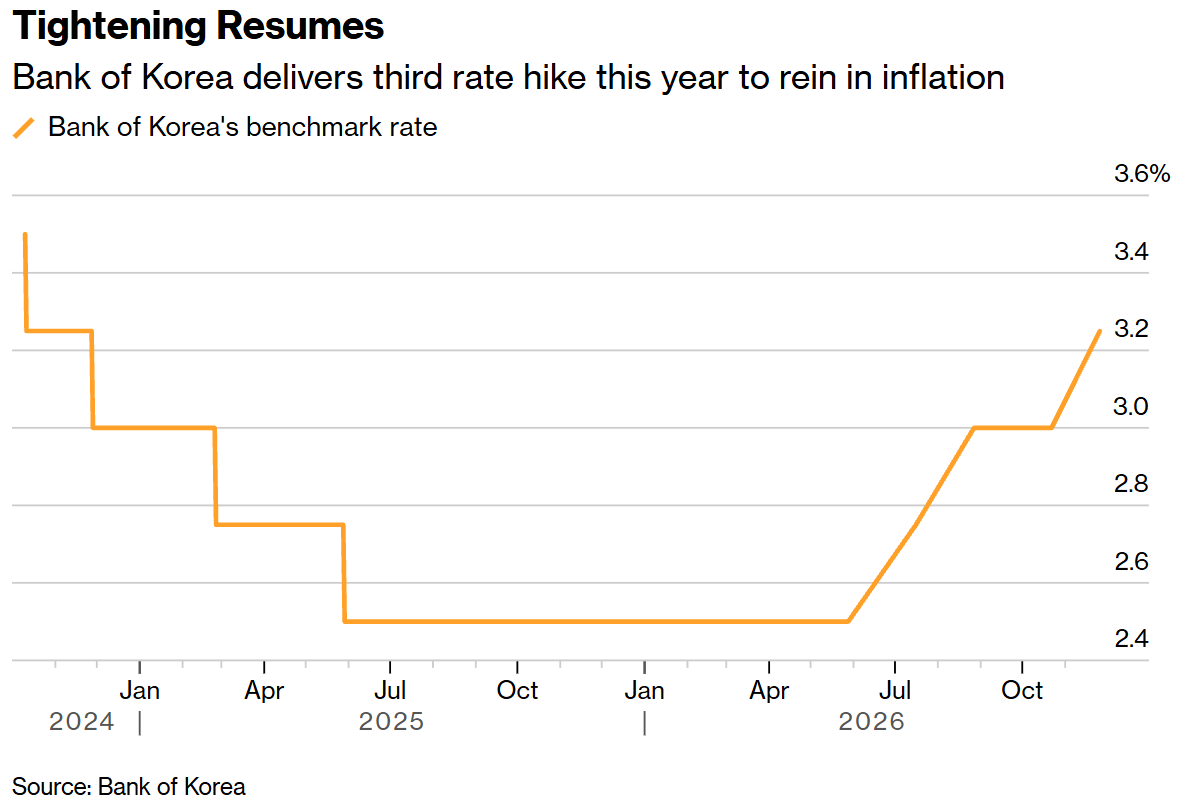
The Bank of Korea raised interest rates for the third time this year to curb inflation
South Korea, an export-oriented economy, has been driven by an unusually strong memory chip cycle associated with global artificial intelligence construction. At the same time as announcing the interest rate decision, the Bank of Korea raised its economic growth forecast for this year and next year to 3.9% and 4.1%, respectively, from 3.3% and 2.9% in August.
Kong Dongrak, a fixed income strategist at Daxin Securities, said in a phone call: “The growth forecast for next year has exceeded 4%. I think this is largely due to the rapid expansion of the semiconductor industry's share of the economy.” “Looking at it this way, the outlook for 2027 means that the current austerity cycle is likely to last longer and peak higher than previously anticipated.”
After the central bank raised its growth forecast, the yield on South Korea's policy-sensitive three-year treasury bonds rose slightly by 2 basis points to 3.62%. The won was basically flat at 1342.80 won against the US dollar.
Thursday's move highlights that central banks are focusing on curbing inflation as the semiconductor boom drives growth beyond expectations. By resuming austerity after suspending a meeting, policymakers are sending a signal that, at least for now, strong momentum in inflation and export-driven expansion has overtaken concerns about weak consumer spending.
Central Bank Governor Shin Hyeon-sung has stated many times that the central bank will maintain a restrictive policy until it is convinced that inflation will subside towards the 2% target. He once compared the Bank of Korea's approach to using a “homi” (a small Korean hoe) rather than a larger “garae” (shovel), and said that the previous two consecutive interest rate hikes were a pre-emptive move to prevent deep-seated inflation.
The Bank of Korea raised its inflation forecast for next year from 2.3% to 2.4%, reflecting that price pressure is expected to remain high as economic growth strengthens and is transmitted to domestic demand. The bank kept its consumer price index (CPI) forecast unchanged at 2.7% for this year.
Governor Shin Hyun-song is scheduled to hold a press conference at around 11:10 a.m. Seoul time. Investors will look for clues as to how much interest rates may increase.
South Korea's economy grew 1% month-on-month in the third quarter, exceeding economists' expectations of 0.8% due to surging exports and investment. However, the unexpected contraction in private consumption highlights how much of this chip-driven boom has yet to be transmitted to the household level.
Economist Hyosung Kwon said, “As we expected, the stock market crash did not stop the Bank of Korea from raising the policy interest rate by 25 basis points to 3.25%. As inflation remains stubbornly above target, strong growth has given room for action by the Monetary Policy Committee. We expect to raise interest rates to 3.50% in February 2027, but the slowdown in global AI-related investment will put this judgment at risk.”
This fragmentation poses a challenge to policymakers trying to contain inflation without further weakening domestic demand. Although strong exports and corporate profits have boosted overall growth, households are facing a tight financial environment and the impact of recent stock market pullbacks.
Despite this, the export boom showed little sign of losing momentum. After the workday adjustment, South Korea's exports increased by about 76% year-on-year in October, and semiconductors continued to be the main driving force. South Korea's cumulative merchandise exports also surpassed 1 trillion US dollars for the first time last week, making it the fourth country in history to reach this milestone in a single calendar year.