
Whirlpool (WHR) Stock Looks Cheap Even As Sales Concerns Linger
Whirlpool Corporation has seen its share price fall sharply in recent years, and that kind of drop prompts a simple question for investors who still follow the stock. Does the current market value make sense when set against the level of sales the business is generating today?
- Whirlpool’s share price has declined 85.0% over the past 5 years. This puts the current valuation debate squarely on what investors are now willing to pay for each dollar of revenue.
- The recent decision to halt common dividend payments and raise fresh capital through equity, preferred stock and new debt signals a focus on balance sheet support. This can affect how investors frame the trade off between sales, profitability and financial flexibility.
- There is a second opinion on Whirlpool worth weighing. See what analysts think Whirlpool's shares could be worth.
The issue now is whether Whirlpool’s current share price is appropriately aligned with the sales it produces when judged against the Fair Ratio benchmark.
This kind of sales based valuation question does not stop with Whirlpool; you can compare how the same issue plays out across solid balance sheet and fundamentals stocks screener (23 results).
Is Whirlpool a Bargain on Sales?
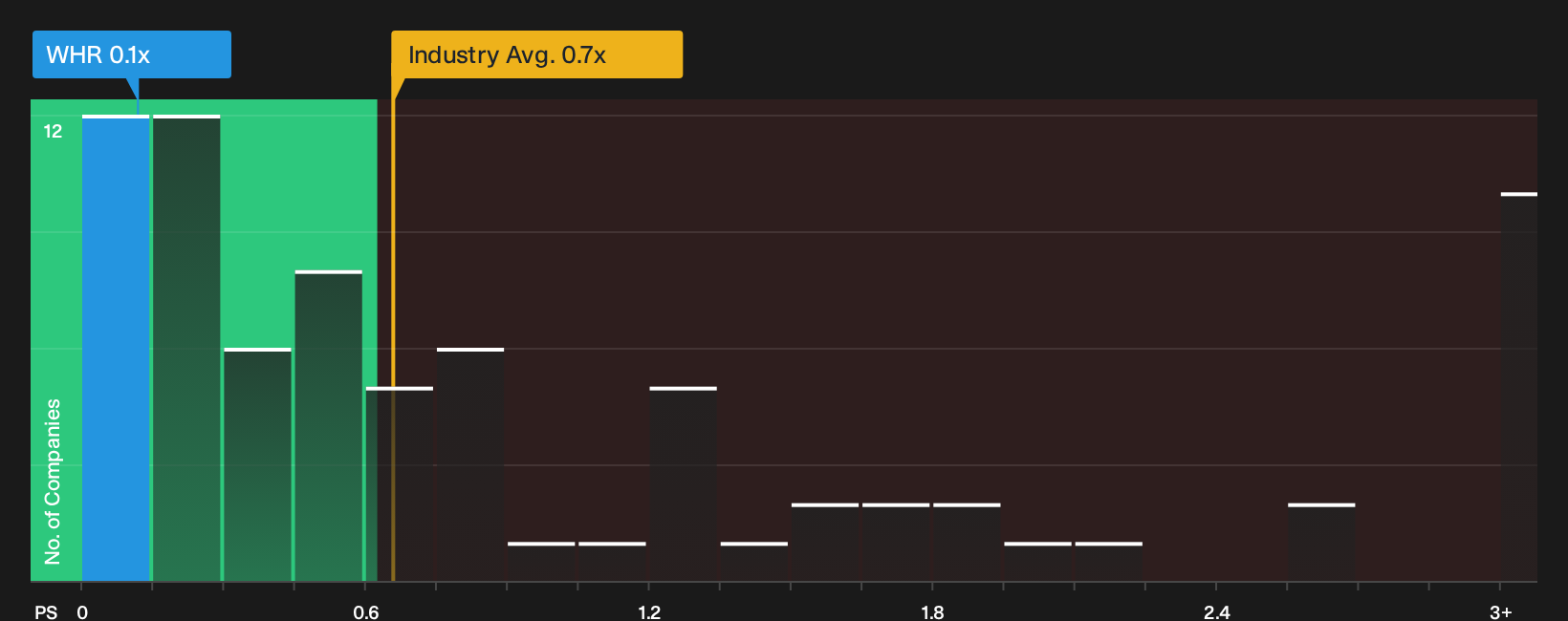
P/S is a useful lens for Whirlpool because the stock is currently loss making and reported negative free cash flow, so earnings based gauges like P/E do not tell you much. On this measure, Whirlpool trades on a P/S of 0.1x, which is far below the Consumer Durables sector average of 0.7x and also well under the broader peer group on 1.2x. That is a steep gap in what the market is paying for each dollar of Whirlpool’s revenue versus comparable businesses.
Because the Fair Ratio framework folds in Whirlpool’s margins, growth profile, size and risk, it points to a higher P/S multiple than the one the market is assigning today. This suggests the stock prices those fundamentals on the low side of that model. The recent halt to dividends and capital raise in Q3 2026 may be weighing on sentiment, yet the current P/S still values Whirlpool’s sales at a discount to both the Fair Ratio signal and sector norms. Explore the numbers behind Whirlpool's P/S valuation.
The Whirlpool Narrative: What Would Justify Today's Price?
Simply Wall St Narratives pick up where Whirlpool's pricing gap on sales leaves off. They spell out what future growth, margins and earnings would need to look like for the stock to line up with a higher or lower valuation than today. Each one is framed as a thesis about Whirlpool's business that can be tracked over time, rather than a static fair value label. They sit on Simply Wall St's Community page for readers to assess and revisit.
Bulls and bears looking at Whirlpool today are working off the same cost and product plans, but reach very different conclusions on how much risk is priced in.
Bull case: 30% undervalued
This view comes from the analyst consensus Narrative on Simply Wall St, which leans on cost cuts, pricing and liquidity support.
"Ongoing factory consolidation, automation investments and logistics footprint changes in North and Latin America... are expected to deliver at least $150 million of 2026 cost savings and roughly $180 million of annualized EBIT benefits from 2027 onward…"
Discover why this Narrative puts Whirlpool at 30% undervalued.
Bear case: 71% overvalued
This angle comes from the bearish analyst Narrative on Simply Wall St, which focuses on weak demand, promotions and higher funding costs.
"Despite a detailed program targeting about US$150 million of cost takeout in 2026... the company is still reporting very low ongoing EBIT margins and has already consumed more than US$2.0b of free cash flow in the first half of 2026…"
Explore why this Narrative puts Whirlpool at 71% overvalued.
Whirlpool’s valuation still leaves one critical angle unresolved
Before forming a view on Whirlpool, it is worth asking what the underlying risk checks are flagging about the business and how those could color any reading of the current price. Take a closer look at 2 warning signs (1 major) before settling on a valuation.
Have feedback on this article? Concerned about the content? Get in touch with us directly. Alternatively, email editorial-team@simplywallst.com