
It's too early to cut the bottom of US stocks! Goldman Sachs warns: Huge AI investments need to be redeemed, profit markets are still weak
The Zhitong Finance App learned that Christian Mueller-Glissmann, head of asset allocation research at Goldman Sachs, said that investors need to see huge capital expenditure in the field of artificial intelligence (AI) turn into real profits, and warned that it is still too early to buy stocks. At a time when the cost of capital remains high and investors' concerns about the return on AI investment continue to heat up, the financial market is still quite weak.
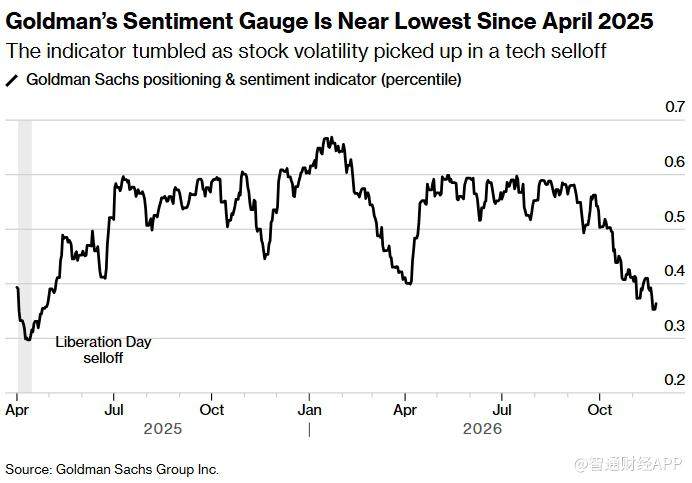
In an interview, Mueller-Glissmann said that the current market is uneasy about whether the invested capital can generate sufficient returns, yet the cost of capital remains at a high level. Meanwhile, despite recent significant adjustments in the stock market, investors' positions have yet to fall to a level that is usually sufficient to judge that the market is bottoming out. He pointed out that the comprehensive risk appetite index compiled by Goldman Sachs has not yet reached a level where it is easy to confirm the bottom of the market, unless fundamental factors such as the economy and corporate profits can provide more support.
The central bank's shift to dovish may be the key to stabilizing the market
Mueller-Glissmann believes that the clearest catalyst for market stabilization will be a shift by central banks to a more relaxed monetary policy stance. He pointed out that as far as the US is concerned, the implied inflation rate in the market is currently generally in line with the Federal Reserve's inflation target, so there is reason for the Federal Reserve to adopt a more dovish policy stance.
However, if the current stock market adjustment continues for too long, the impact may no longer be limited to the financial market, but spread further to the real economy. Mueller-Glissmann warned that the current share of US household asset allocation in US stocks is even higher than during the internet bubble. This means that the continued decline in the stock market may have an impact on consumer consumption and overall economic growth through negative wealth effects.
Be wary of repeated market turmoil at the end of 2018
In addition to stock market performance, Mueller-Glissmann is also concerned about risk signals released by the credit market. He pointed out that credit spreads are continuing to widen, and what he is most concerned about is the resurgence of market turbulence at the end of 2018. At the time, the Federal Reserve continued to tighten monetary policy, causing market expectations for economic growth to be severely impacted, and triggered severe turmoil in the financial market, which eventually forced the Federal Reserve to switch to an easing policy.
According to Mueller-Glissmann, if the current financial market is slow to stabilize, a negative feedback cycle may form between the decline in the stock market and the deterioration of economic growth expectations, thereby increasing the downward pressure on the economy. He said, “If we continue to maintain the current state, the market cannot stabilize, and the stock market cannot resume rising, then economic growth will be significantly impacted.”
Goldman Sachs's view highlights that the current challenge facing the market is not only the adjustment of the valuation of AI-related assets, but also whether huge capital expenditure can be realized into sustainable profit growth. In a context where the return on corporate investment has not been fully verified and capital costs are still high, improvements in fundamentals and a shift in monetary policy may become important factors driving the real stabilization of the market.