
“Icarus” in the AI era? Nvidia (NVDA.US)'s market value evaporated to 3 trillion dollars in two months, and the “Cisco” nightmare reappeared
The Zhitong Finance App learned that the market value of Nvidia (NVDA.US) evaporated by nearly 3 trillion US dollars within two months, and the return of CEO Wong In-hoon did not stop losing blood. Investors should be wary of this fragile shock at the heart of America's AI boom.
Countless questions surrounding the dramatic collapse of Nvidia's stock price will resonate again and again for years to come. Foremost among them are concerns at the corporate governance level: how can one exert so much influence over such huge market capitalization; whether this leaves shareholders in the dark about market-sensitive events; and the impact of domestic and foreign political disputes.
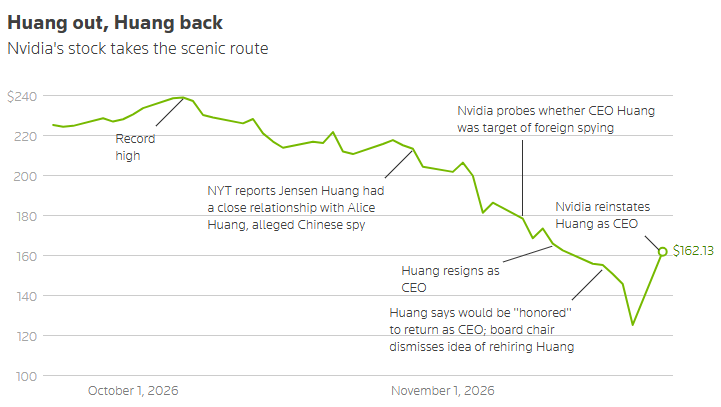
By the time it hit rock bottom last Friday, the stock was down nearly 50% from its October 6 high — an astonishing loss of wealth regardless of the era.
On Monday, after the intervention of the White House, Wong In-hoon almost unbelievably returned to the position of CEO after only 11 days in office — while many investigations surrounding extramarital affairs, espionage allegations, transparency, and overall governance were still ongoing — the news spurred a 31% rebound in stock prices. But the relief was fleeting.
For example, the prediction market doesn't think Hwang In-hoon's roller coaster is over. According to Polymarket, bettors think the probability that he will be evicted again before the end of next year is close to 30%. Nvidia shares fell another 6% on Tuesday — still around 35% below the high of just six weeks ago.
This is no surprise; the options market has always priced fluctuations. Despite constant cheers and political interference surrounding co-founder Hwang In-hoon rather than the company's fundamentals, the stock's implied volatility is now exploding. According to LSEG data, the implied monthly volatility of Nvidia shares surpassed 80% last Friday and is still close to 70%. This is more than double the level of other leading stocks, and more than double Nvidia's own reading from the beginning of the year to October, which was already a turbulent year.
Admittedly, the entire stock market's nerves have been strained by many factors: concerns that the AI infrastructure boom is at its peak, congressional scrutiny heats up after the midterm elections, tightening global chip restrictions, rising interest rates, and, of course, Nvidia's own reputation.
The VIX “Panic Index” with implied volatility of the S&P 500 hit 40 in the intraday session last Friday, the first time since Trump's tariff storm in April 2025, then fell, but is still far above the historical average. Meanwhile, its constituent stock volatility index closed at its highest level since the outbreak of the epidemic in spring 2020, close to 58.
Nvidia's volatility explosion is at the center of it all — a rare company story that has infected the wider market. Even after Hwang In-hoon returned, the market's fears about this company were still somewhat almost existential. Fluctuation, risk taking, and trial and error are often seen as the norm in the tech industry, but this is usually reserved for startups, up-and-coming innovators, or emerging disruptors.
The situation was completely different when the company had the highest market capitalization and sat at the top of what many people thought was just plain conservative savings instrument — the S&P 500 index. The violent shocks at the largest companies should trigger deep self-reflection, while extensive investigations are already underway.
Earlier this month, Michael Cembalest (Michael Cembalest), Chairman of J.P. Morgan's Asset and Wealth Management Markets and Investment Strategy, made a compelling observation: since 1960, only 10 US companies have been crowned No. 1 by market capitalization in the S&P 500.
As the economic and technological landscape has changed over the decades, some of this small group of companies have fallen to the ground. GM, General Electric, AT&T, Altria, and even ExxonMobil and IBM, which once seemed unshakable, have all dropped sharply in the rankings due to various reasons. Others, such as Apple and Microsoft, dominated for over a decade and were only recently surpassed by Nvidia.
Comparing Nvidia to Icarus in Greek mythology who flew too close to the sun and the wax wings melted and fell, Sumberrest said that Nvidia's rise was extraordinary. From just 1% of the S&P 500 in December 2022 to a high of 8.5% earlier this year, this has made it the fastest company to reach the top, he said. It remained at its peak for almost 15 months before falling.
The company's earnings report last week showed that profitability and profit margins will remain strong for years to come. However, the fears and fluctuations induced by the sharp decline over the past two months, combined with lingering doubts about governance, may have now caused the market to be bitten by snakes.
After all, one reason only 10 companies have climbed to the top in decades is that many of them have stayed on the throne for a long time — winning this position over a long period of time with sound business models and governance.
However, in Sumber's 66 year statistics, the company that stayed at the top the shortest was Cisco Systems (CSCO.US). The networking equipment manufacturer topped the US market capitalization for just a few days at the peak of the Internet bubble in 2000, then a spectacular tech stock crash and bear market dragged it into a 15-year trough.
For those who constantly compare today to the turn of the millennium, the Cisco story is a sobering read. It wasn't until this year that it regained the high price points of the online stock bubble era — some 26 years later — although for many of those years it was still largely a healthy and profitable business.
The Cisco saga is very different from Nvidia in many ways. Nvidia's huge profit stream meant that its stock was relatively cheap, with a forward price-earnings ratio of only 11 times, compared to more than 100 times that of Cisco.
But markets can be ruthless. Both the rate of increase and excessive volatility are not healthy signs of sustainable market leadership. Both should keep the saver's back cool.