
Deere’s Q3 CY2026 earnings results: Revenue in line with expectations

Agricultural and construction machinery company Deere (NYSE:DE) met Wall Street’s revenue expectations in calendar Q3 2026 [fiscal Q4 2026], but revenue fell by 2.3% year on year to $12.12 billion. Its GAAP profit of $3.89 per share was 4.1% below analysts’ consensus estimates.
For more on Deere, read our free full research report.
Deere Q3 CY2026 highlights:
- Revenue $12.12 billion vs S&P analysts’ consensus estimates of $12.06 billion (2.3% year-on-year decline, in line)
- EPS (GAAP) $3.89 vs analysts’ consensus estimates of $4.06 (4.1% miss)
- Operating margin 10.6%, in line with the same quarter last year
- Free cash flow margin 34.9%, up from 30.6% in the same quarter last year
- Market capitalization $165.5 billion
"Fiscal 2026 proved the strength of our Smart Industrial operating model," said John May, chairman and chief executive officer of Deere & Company. "Even at cyclical lows, we executed with discipline. Our results are structurally stronger compared with the same point in the last cycle, and we delivered them while sustaining investments and continuing to return capital to shareholders. Those investments are paying off for our customers, as digital engagement and technology utilization continue to expand."
Revenue growth
A company’s long-term performance is an indicator of its overall quality. Any business can have short-term success, but a top-tier one grows for years. Deere’s revenue grew at a sluggish 1.6% compounded annual growth rate over the last five years, falling short of our standards.
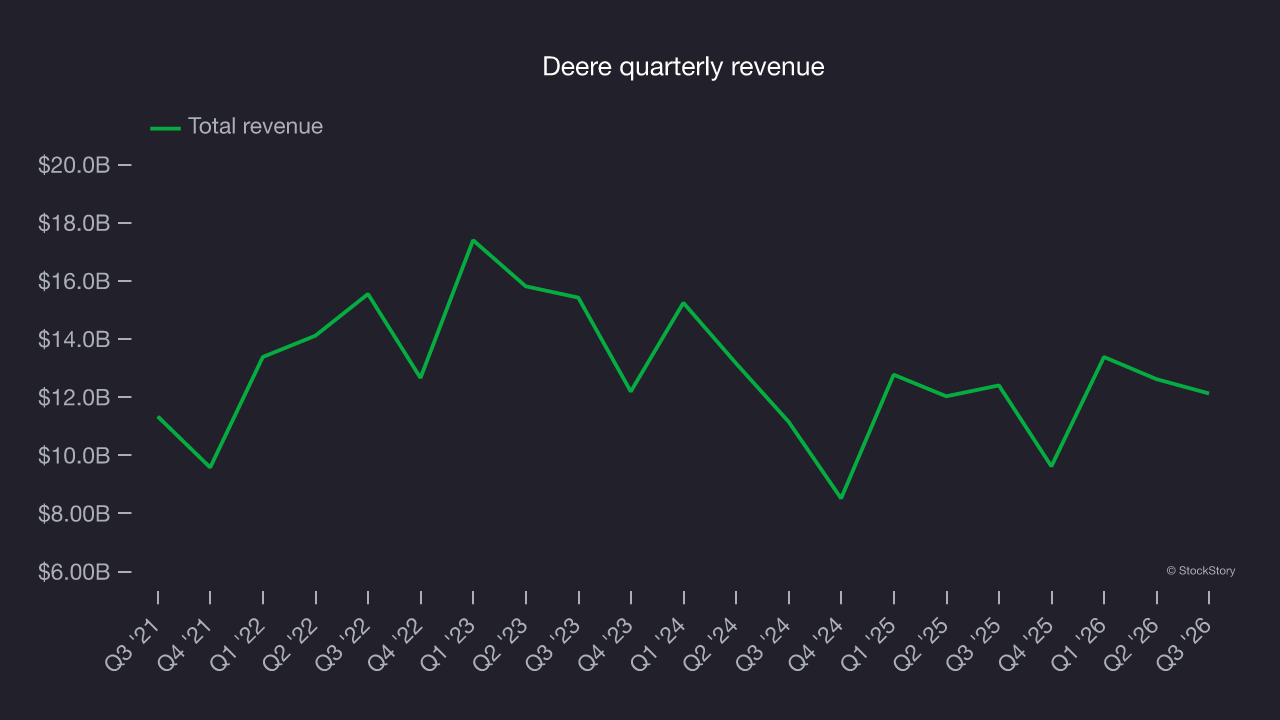
Long-term growth matters most, but within industrials, a half-decade historical view may miss cycles, industry trends or a company capitalizing on catalysts such as a new contract win or a successful product line. Deere’s performance shows it grew in the past but relinquished its gains over the last two years, as its revenue fell by 4% annually. 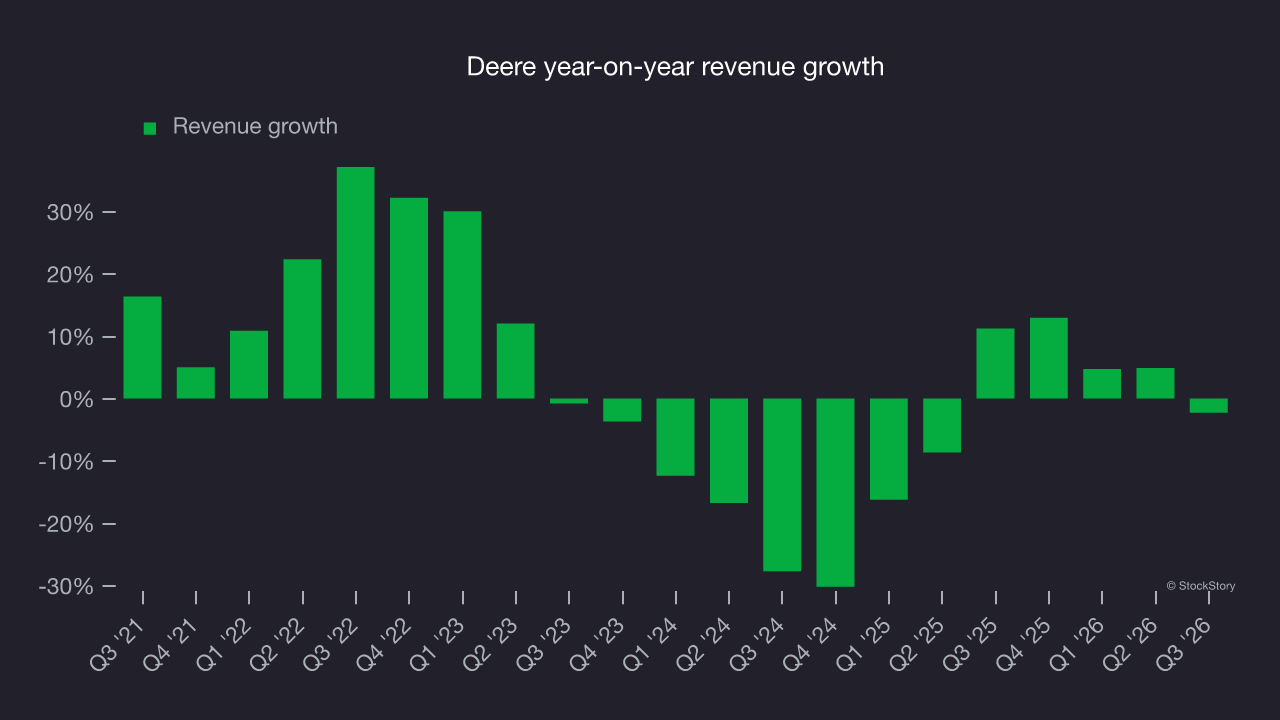
Its three most important segments offer a closer look at the company’s revenue dynamics: Production & Precision Agriculture, Construction & Forestry and Small Agriculture & Turf, which are 33.2%, 22.3% and 31.3% of revenue. Over the last two years, Deere’s Production & Precision Agriculture (tractors, harvesters, tillage) and Construction & Forestry (loaders, excavators, dump trucks) revenues averaged year-on-year declines of 10.8% and 3.9% while its Small Agriculture & Turf revenue (mowers and other small vehicles) averaged 12.1% growth. 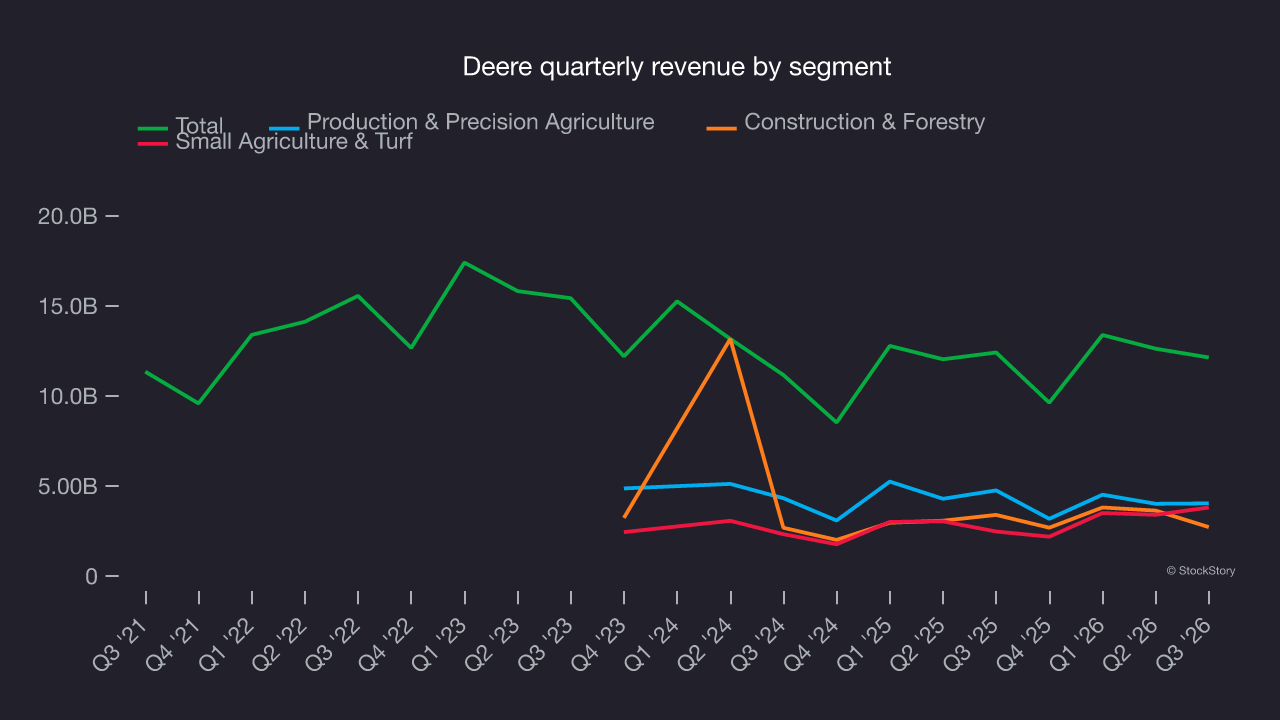
This quarter, Deere reported an uninspiring 2.3% year-on-year revenue decline to $12.12 billion, in line with Wall Street’s consensus estimates.
Looking ahead, sell-side analysts expect revenue to grow 8.7% over the next 12 months, according to S&P, an improvement versus the last two years. This projection is notable for a company of its scale and implies its newer products and services will improve revenue performance.
Operating margin
Over the last five years, Deere’s operating margin fell by 5.3 percentage points. This deterioration shows its costs grew relative to revenue, putting pressure on profitability. Its trailing 12-month operating margin was 12.8%.
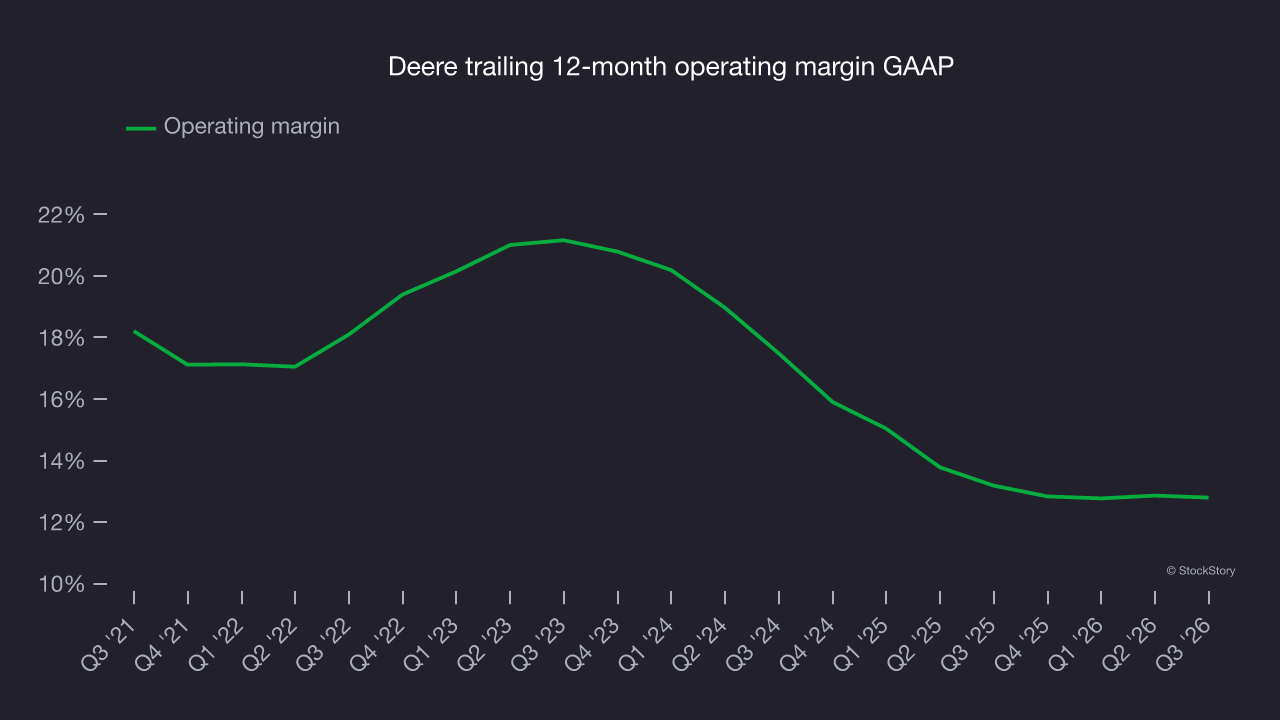
In Q3, Deere generated an operating profit margin of 10.6%, in line with the same quarter last year. This indicates the company’s cost structure has recently been stable.
Earnings per share
We track the long-term change in earnings per share, or EPS, for the same reason as long-term revenue growth. Compared to revenue, however, EPS highlights whether a company’s growth is profitable.
Deere’s EPS declined by 1.1% annually over the last five years while its revenue grew by 1.6%. This indicates the company became less profitable on a per-share basis as it expanded due to non-fundamental factors such as interest expenses and taxes.
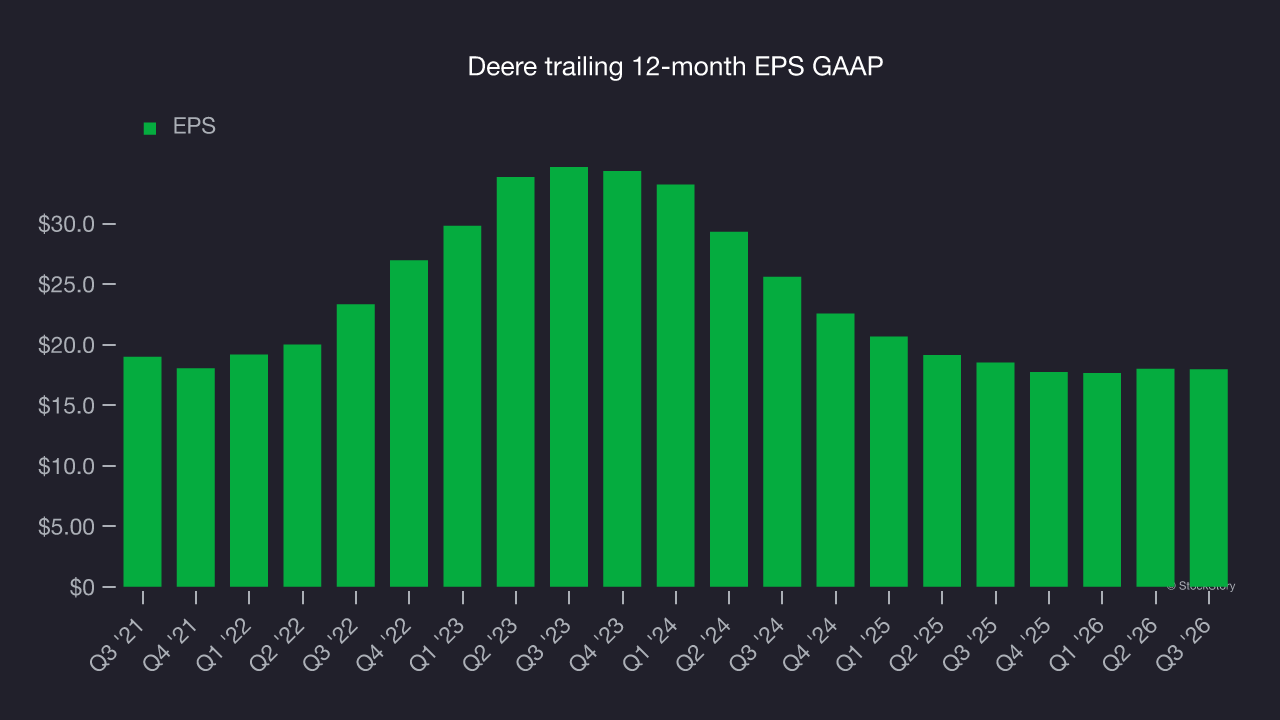
Diving into the nuances of Deere’s earnings can give us a better understanding of its performance. As we mentioned earlier, Deere’s operating margin was flat this quarter but declined by 5.3 percentage points over the last five years. This was the most relevant factor (aside from the revenue impact) behind its lower earnings; interest expenses and taxes can also affect EPS but don’t tell us as much about a company’s fundamentals.
Like with revenue, we analyze EPS over a shorter period to see if we are missing a change in the business.
Deere’s two-year annual EPS declines of 16.3% show it has continued to underperform. The results were poor across both timeframes.
In Q3, Deere reported EPS of $3.89, down from $3.93 in the same quarter last year. This result missed analysts’ consensus estimates. Over the next 12 months, Wall Street expects Deere’s full-year EPS to grow 23.3% from $17.95 to $22.13, according to S&P.
Key takeaways from Deere’s Q3 results
Deere’s Q3 results could have been better: Revenue met analysts’ consensus estimates, but EPS fell short. Shares fell 3% to $595.49 immediately after the report.
Deere’s earnings report left more to be desired. Let’s examine whether this quarter has created an opportunity to buy the stock. The latest quarter matters, but longer-term fundamentals and valuation are far more important when deciding whether the stock is a buy. Read the full research report here (it’s free).