
Why Does Wednesday Bring to Mind the Song "King of Pain"?
The US army is schedule to detonate 5 tons of lead azide in eastern Iowa Wednesday morning. A fun way to get the US Thanksgiving Holiday rolling.
Interestingly enough, a winter weather system is forecast for an area almost spot-on with the Iowa Ammunition Plant, tracking to the east and south.
The soybean market was solidly lower overnight, while the rest of the Grains sector was wearing red as well.
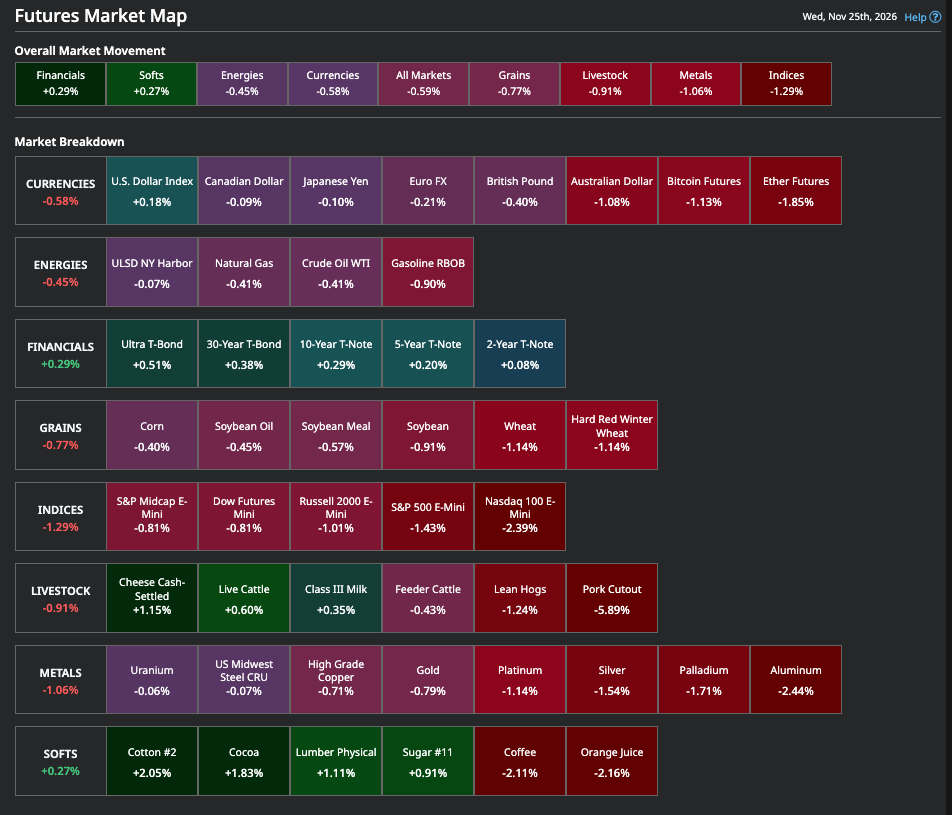
Morning Summary: Back in 1983, the rock band The Police released its final album “Synchronicity”. The album included a number of songs that would become oldies radio classics, at least for folks my age, including “King of Pain”. This Sting penned tune came to mind this morning as the countdown began for the US army to detonate roughly 5 tons of degraded lead azide at the Iowa Ammunition Plant in Middletown, Iowa at approximately 9:00 (CT) today, Wednesday, November 25. What’s the connection? The first line of the song is, “There’s a little black spot on the sun today…”, and in my mind I can picture a little black spot on the satellite image of the US later today where eastern Iowa and western Illinois meet. I guess this is the payback for Iowa turning blue this past mid-term election. It’s interesting to note Wednesday’s weather forecast shows winter weather starting – well – almost exactly at Middletown, Iowa and tracking to the south and east (slide 2). Coincidence? Sure, why not. Given today is the day before the US Thanksgiving Holiday, a good friend in ag media sent me a message that read, “Cue up the Les Nessman turkey drop[i]…with a side of lead if you are in Iowa”.
Corn: The corn market was in the red pre-dawn. Trade volume was light overnight, but the trend has been for corn to put up big numbers by the end of the day. Given it is the session leading into another US holiday, with Friday’s session abbreviated, grain markets closing at noon (CT), it will be interesting to see if the corn market racks up sizeable trade activity Wednesday. A look at the CME website shows Tuesday’s volume came in at roughly 599,500 contracts, with nearly half of those (258,000) traded in the March issue (ZCH27). Meanwhile, total open interest in corn decreased again, this time losing 22,050 contracts. What continues to stand out to me is the decrease is due to the soon-to-be-in-delivery December issue, down 62,200 contracts Tuesday, while March added about 28,000 contracts. This pushed open interest in March to 827,500 contracts, inching closer to the all-time high mark for March futures at 906,600 contracts from November 30, 2020. Recall Mar26 closed 0.5 cent higher Tuesday but lost 0.75 cent to May. This put the spread at 9.5 cents carry, equaling its record large from June 29. Last night, the National Corn Index came in near $4.0575, up about 0.75 cent for the day.
Soybeans: The soybean market was solidly in the red overnight through early Wednesday morning. The nearby January issue (ZSF27) dropped as much as 13.5 cents on trade volume of 16,000 contracts, not a big number by any stretch of the imagination and was sitting 11.0 cents lower at this writing. Maybe the world’s largest buyer prefers its soybean imports lead-free. After all, we are talking about the same buyer who will turn down an entire shipment due to a hint of nightshade. Anyway. I’m sure all will be fine on the upper Mississippi River today. After all, the US government is in charge. In other news, there is an old-time trade around the US Thanksgiving Holiday that this old-time brain can’t quite remember. It’s either buy soybeans the day before and sell the day after or sell the day before and buy the day after. I know, it’s an important detail I can’t seem to recall. But who knows, maybe it is coded somewhere deep in Watson’s algorithms, and the double-digit overnight selloff proves attractive. January closed Tuesday 5.25 cents in the green, after rallying as much as 15.5 cents, followed by the National Soybean Index coming in 6.0 cents higher for the day.
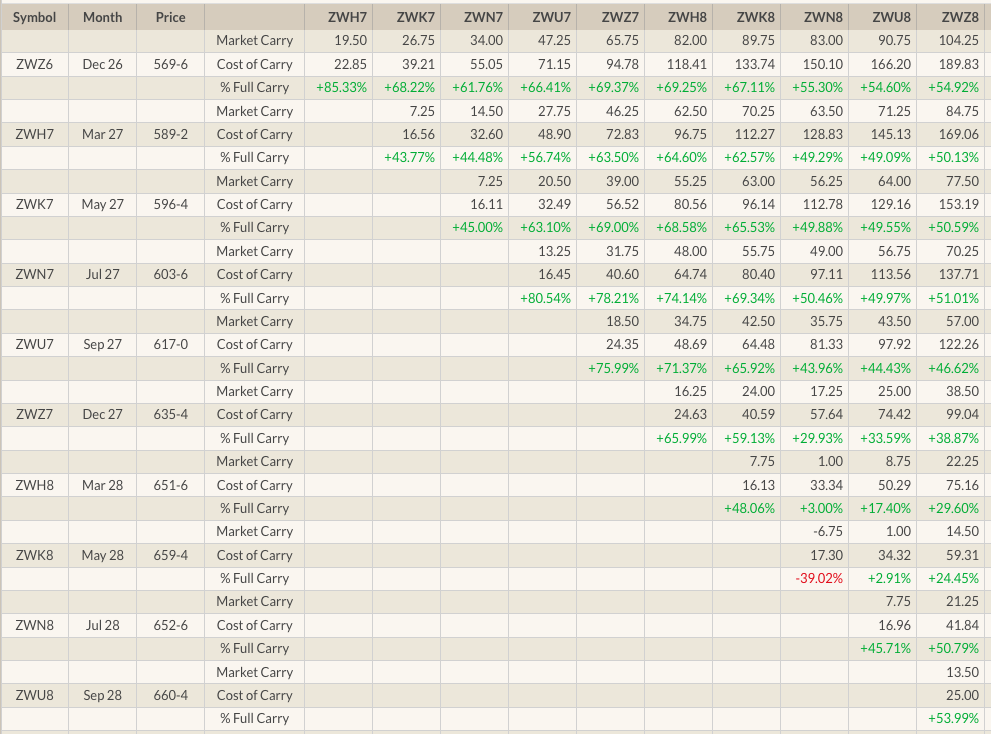
Wheat: The wheat sub-sector was also in the red pre-dawn Wednesday, a move that should surprise nobody. Though most of the attention and trade activity has turned to March winter market issues, the collapse of the December-March futures spreads in both SRW and HRW may be worth noting. If for no other reason than it sets the stage for a potential Down Escalator Simulator over the winter quarter. Recall the Dec-March SRW spread finished Tuesday’s session at a carry of 19.5 cents, a new lifetime low, and covered a bearish 85% calculated full commercial carry. Meanwhile, the March-May settled at a carry of 7.25 cents covering 44%. It was a similar story in HRW with the nearby spread closing at a carry of 19.75 cents and 84% with the first deferred spread 5.25 cents and 31%. To add a bit more fuel to the fire, the SRW new-crop July-September spread finished at 13.25 cents carry and 80.5%. In other words, winter wheat markets are not fundamentally bullish. But that won’t stop most of the talking heads in the industry from saying they are. As for Wednesday morning, the March SRW issue (ZWH27) s down 5.0 cents while the lead[ii] HRW issue (KEH27) is down 4.5 cents.
[i] If you are too young to know, this is in reference to what I consider the funniest scene ever put on television: The famed turkey drop from WKRP in Cincinnati.
[ii] Some fun with the US version of the English language.
On the date of publication, Darin Newsom did not directly have a position in any of the securities mentioned in this article. All information and data in this article is solely for informational purposes. For more information please view the Barchart Disclosure Policy here.