
Dutch International Group: Risk trading “completely ebbs down” with multiple downsides impacting emerging market currencies
The Zhitong Finance App learned that Dutch International Group (ING) strategists warned that emerging market currencies are facing increasing pressure. Sources of pressure include the sell-off of technology stocks, the risk of narrowing interest rate premiums, and the threat of a new round of global tariffs. Dutch International Group strategist Chris Turner wrote in a report: “The investment environment is still unfriendly.” He said that the combination of these factors has triggered a “full unwind” (full unwind) of risk appetite trading, and the foreign exchange sector in emerging markets has been particularly affected.
The MSCI Emerging Markets Currency Return Index has continued to decline since it hit an all-time high in September. On Wednesday, another weakening in technology stocks further dampened global risk sentiment, while the prospect that the US might impose additional tariffs on products from major economies also increased market pressure.
Expectations of a Fed rate hike dampen demand for emerging assets
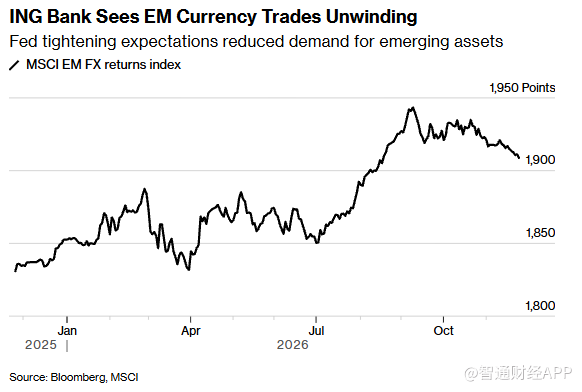
Traders are also closely watching key US inflation data. These data will provide information on the Fed's next interest rate action, and will also affect the additional yield that emerging market assets can provide compared to the core market.
According to reports, tonight at 21:30 Beijing time, the US Department of Commerce will announce the October PCE Price Index. This is the last complete inflation data before the FOMC meeting on December 8-9. The market expects overall PCE to rise to 3.8% year over year from 3.6% year on year in September, and core PCE to rise to 3.2% year over year. Currently, the market expects that the probability that the Fed will raise interest rates by 25 basis points in December is about 95.8%, and the probability of a cumulative 50 basis point rate hike by January next year is about 55.5%.
“Global economic growth is facing greater resistance, which is putting pressure on most commodities and emerging market currencies,” Turner wrote. He also added that given the high correlation between Latin American currencies and metals, they are particularly vulnerable.
Prices of metals such as copper, aluminum, and tin fell, putting further pressure on the already impacted Chilean and Peruvian currencies.
The Dutch International Group anticipates that Eastern European currencies will face continuing negative factors. On Wednesday, the Hungarian forint fell 1% against the euro, after the Hungarian central bank reiterated its cautious policy stance gradually subsided. The Polish zloty declined simultaneously with the Czech koruna, and all three currencies have declined since this month.
“If the Czech central bank maintains a hawkish tone in the coming months while inflation continues to rise, we may see a short-term rebound,” Dutch International Group strategist František Taborski wrote in the report. “But if these central banks don't stay hawkish, I'm afraid the zloty and the HUF will have to wait for the global environment to improve.”