
Funding Secured Could Change The Case For Oracle Stock (ORCL)
- Oracle confirmed that it has fully secured funding for its large AI infrastructure build-out and OpenAI contract, alongside new AI product launches in life sciences and construction software, while shareholders recently voted down a proposal to broaden the inclusion of stockholder proposals in future proxy statements.
- The combination of heavy borrowing, record-wide credit default swap levels, and a concentrated AI contract backlog leaves Oracle balancing ambitious infrastructure expansion against tighter financing conditions and questions about how quickly contracted demand converts into cash.
- Next, the focus shifts to how Oracle's fully funded AI build, particularly around the OpenAI agreement, may reshape its broader investment narrative.
Compare Oracle's AI build-out and balance sheet pressure with a curated group of 31 resilient stocks with low risk scores that may offer a different risk profile to this kind of leveraged expansion.
Oracle Investment Narrative Recap
For an Oracle shareholder, the core belief is that heavy AI data center spend and debt ultimately support a durable cloud and software franchise. According to andre_santos, an investor in the Simply Wall St Community, the appeal rests on strong projected margin and revenue profiles, even with a high estimated cost of capital. Today, the main near term catalyst is whether the large contracted AI backlog converts to cash quickly enough to ease balance sheet strain.
The biggest risk sits on the other side of that same equation. Borrowing funded AI infrastructure, record wide credit default swaps and reliance on OpenAI related demand keep refinancing and free cash flow timing in focus. The failed governance proposal around stockholder submissions does not materially change that operating picture, though it keeps questions around board flexibility and shareholder influence in the background.
Among recent announcements, Oracle Life Sciences AI Agents matter most for the business story. They tie Oracle’s cloud capacity and AI infrastructure directly into highly regulated, sticky workflows in clinical trials. That gives the AI build a clearer revenue use case anchored in portfolio monitoring, trial planning and protocol linked operations rather than only headline compute deals.
If Oracle executes well here, Life Sciences AI Agents could help broaden AI driven workload mix beyond OpenAI and ease some concentration worries. The tools rely on human in the loop oversight, which keeps operational responsibility with clinical teams but still leans on Oracle’s software and data platforms. For investors watching catalysts, adoption and contract wins in life sciences sit right next to AI infrastructure utilization and upcoming earnings as key proof points.
andre_santos frames Oracle’s fair value at US$192.59 as the blended outcome of several methods, including a DCF point estimate of US$208.27, EPS growth modelling with a 5 year P/E of 28, and multiple mean reversion across P/S, EV/EBITDA and P/E, all discounted using a 12.00% cost of capital.
Uncover how Oracle's fair value indicates a 76% potential upside to its current price that could narrow.
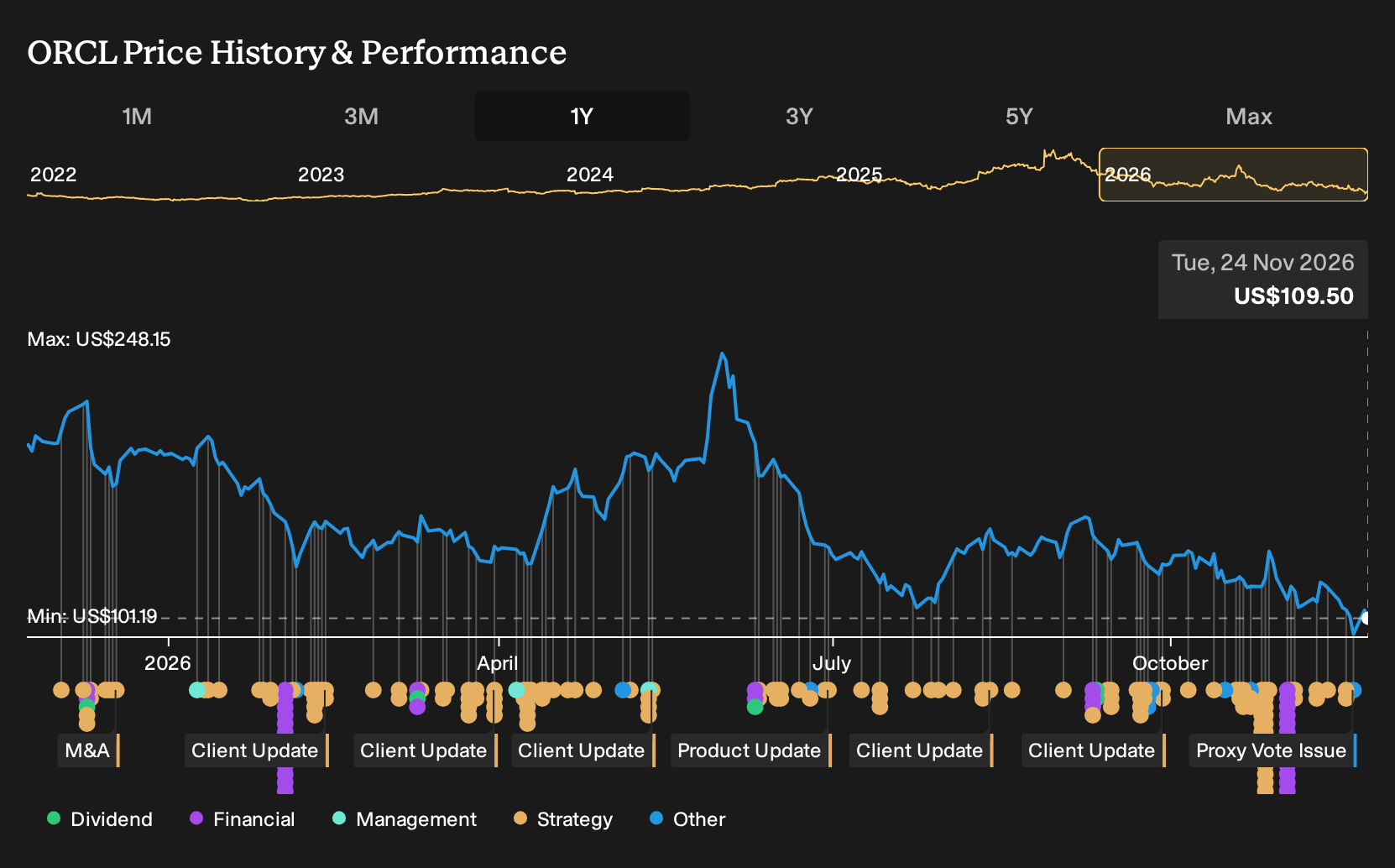
Exploring Other Perspectives
The stark contrast comes from how much faith you place in Oracle’s AI CapEx cycle. The lowest analysts were already cautious, assuming revenue of US$178.6b and earnings of US$37.7b by 2029, yet only a 14.9x P/E. Those estimates, set before this funding news and the proxy vote, could shift meaningfully from here.
Explore 16 other Oracle fair value estimates, including one that suggests it could be worth just $120.33.
Form Your Own Verdict
Disagree with existing narratives? Extraordinary investment returns rarely come from following the herd, so consider trusting your own analysis.
- A great starting point for your Oracle research is our analysis highlighting 4 key rewards and 3 important warning signs that could impact your investment decision.
- See our latest analysis for Oracle. The report includes a comprehensive fundamental analysis summarized in a single visual, the Snowflake, making it easy to evaluate Oracle's overall financial health at a glance.
Looking For More Investment Ideas Beyond Oracle?
If Oracle's AI build and funding profile has you thinking harder about risk, it can help to widen the lens and compare it with other businesses that line up better with your preferred balance of quality, leverage and income.
- If capital preservation and steadier balance sheets matter most to you, scan a list of solid balance sheet and fundamentals (23 results) that may better match a cautious approach.
- For readers hunting for mispriced quality, review a 19 high quality undiscovered gems that surfaces companies with fundamentals many investors may be overlooking.
- If regular cash payouts are a priority, assess a 11 dividend fortresses that screens for higher yielding businesses with a focus on durability.
Have feedback on this article? Concerned about the content? Get in touch with us directly. Alternatively, email editorial-team@simplywallst.com