
The war in the Middle East “violently hits” the British family! Energy bills will soar 26% in January next year, and persistent inflation may increase the pressure on the central bank to raise interest rates
The Zhitong Finance App learned that with the Middle East war driving up wholesale prices of natural gas and electricity, and further increasing pressure on winter demand, British households are expected to face the problem of a sharp rise in energy costs in January next year. British energy regulator Ofgem said in a statement on Wednesday that from January 1, it will raise the energy price cap by 26% to £2,166 (about 2,833 US dollars). This price cap sets the upper limit of the unit energy price charged by energy suppliers to consumers. This will be the biggest increase since October 2022.
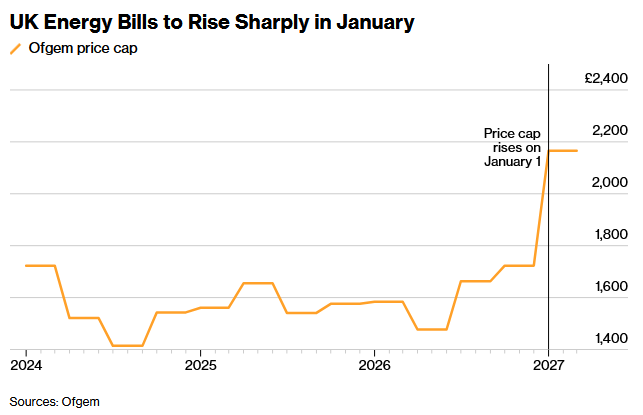
UK energy bills will rise sharply in January next year
This sharp rise in energy growth is expected to further increase the cost of living pressure on British households. The war in the Middle East has already boosted inflation and borrowing costs across the economy, and may also weaken the British government's efforts to ease pressure on households. Meanwhile, the public finance situation continues to be under pressure, leaving government ministers with very limited policy space to cushion shocks.
Compared with the previous round of price caps, the price that households in the UK need to pay per unit of gas has risen 38%, to a record high, and even surpassed the level of the last time the energy crisis was severe. UK Energy Secretary Miata Farnbull said in a statement: “For a long time, British households have been paying the price of overseas conflicts and sharp fluctuations in the fossil fuel market.”
British Prime Minister Andy Burnham has been trying to protect households from rising energy prices by lowering the value-added tax (VAT) on energy costs. Meanwhile, government ministers added further support measures to the October budget, including £100 in subsidies to millions of families. However, this latest price increase may offset most of the burden reduction brought about by the relief measures mentioned above.
According to forecasts from energy consulting agency Cornwall Insight, the UK energy bill is expected to remain above £2,000 throughout 2027. The next time the price cap is expected to be adjusted in April next year, energy prices will drop by only 1%.
Since the outbreak of the US-Iran war earlier this year, wholesale energy prices have soared sharply, and British gas futures and electricity contract prices have more than doubled. Craig Lowry, chief retail analyst at Cornwall Insight, said: “We would love to be able to indicate a point in time when the outlook will improve, but frankly, this depends on how the situation in the Middle East develops next.”
Energy prices will remain high for a longer period of time, further increasing the financial burden on vulnerable households, and this pressure has continued since the 2022 energy shock. Many households are already struggling to pay their energy bills. In the second quarter, household energy arrears in the UK reached a record £5 billion, almost double the level of three years ago.
The impact of rising energy prices will gradually spread to the wider economy starting next year. The upper limit of energy prices is adjusted every three months, and this increase will allow higher energy costs throughout the winter and further support the market's expectations that inflation will continue to rise at an accelerated pace.
Soaring energy prices have pushed the UK's inflation rate to 3.6%, the highest level in a year. To prevent price pressure from spreading to the entire economy, the Bank of England raised the benchmark interest rate by 25 basis points to 4% with an 8-1 vote at the Monetary Policy Committee (MPC) meeting that ended on November 4. This is the first time in more than three years that the Bank of England has raised interest rates. As inflation remains high and the UK economy unexpectedly shows resilience, the market currently anticipates that the Bank of England will raise interest rates again at the December monetary policy meeting.
Bank of England's chief economist Hugh Peel said on Monday that it is necessary for the Bank of England to further raise interest rates to prove its determination to continue pulling the inflation rate back to the 2% target. Peel said at the Bank of Austria meeting in Vienna on Monday that in order to maintain price stability and ensure that the inflation rate continues to return to target levels over a longer period of time, the Bank of England needs to act immediately. “In order to keep prices stable and continue to meet the inflation target in the longer term, I think we really need to act now,” he said.
Peel stressed that the policy credibility established by the Bank of England over the past few years is an important foundation for keeping inflation expectations stable, but this credibility cannot be relied upon indefinitely. He pointed out that since 2021, the UK inflation rate has been above the 2% target set by the central bank almost every month. “We initially had strong credibility, which was built over a long period of time. But I don't think this kind of credibility can ever be taken for granted.” Peale said, “At some point, you have to deliver real results or show a firm commitment to achieve your goals.”
Furthermore, Peel pointed out that although the latest round of rising inflation has yet to trigger an obvious secondary transmission effect, Bank of England officials are closely watching upcoming wage negotiations. The secondary transmission effect of inflation means that after commodity prices such as energy rise, workers demand wage increases to make up for the increase in living costs, and enterprises then pass on costs by raising the prices of goods and services, so that inflationary pressure continues to exist.
If wage growth accelerates markedly, it may be more difficult for the Bank of England to stabilize the inflation rate at the target level of 2%. Therefore, even if significant increases in wages and prices have not been observed so far, policymakers still hope to prevent short-term price shocks from turning into long-term inflationary pressure by taking timely policy actions.