
Japan's potential inflation index accelerated upward to a three-year high! The door for the central bank's interest rate hike in December was further opened
The Zhitong Finance App learned that the Bank of Japan's index for measuring potential inflation trends has risen to the highest level in three years, further strengthening the reason for the central bank to raise interest rates again. According to a report released by the Bank of Japan on Wednesday, the consumer price index (CPI), which excludes fresh food and special factors, rose 3.5% year on year in October, the fastest increase since September 2023. The index accelerated to 3.2% last month.
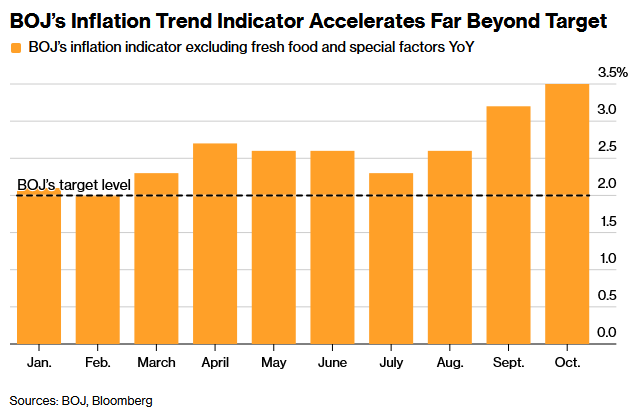
The Bank of Japan's inflation trend indicators accelerated upward, far exceeding policy targets
The Bank of Japan's index for measuring potential inflation is significantly higher than the inflation data released by the Japanese government. The reason is that the latter did not exclude the impact of temporary measures taken by the government to ease the pressure on the cost of living. The Bank of Japan's data set excluded special factors, including gasoline and utility subsidies.
This result may further reinforce the market's already quite strong expectations that the Bank of Japan will raise interest rates again next month. The reason is that there is growing evidence that the rising cost of living has become a continuous phenomenon.
Data released earlier on Wednesday showed that the price increase for corporate services hit the highest level in 36 years. According to data released by Japan's Ministry of Internal Affairs and Communications on Friday, the consumer price index (CPI), which excludes fresh food, rose 2.2% year on year — the biggest increase since December last year, although still slightly below the median forecast of 2.3%; excluding fresh food and energy — the core CPI — the basic inflation indicator closely monitored by the Bank of Japan — also rose 2.2%; the overall CPI rose 2.3%.
The Bank of Japan has made it clear that the policy goal is no longer to push underlying inflation to the 2% target, but to stabilize it around this level. The Bank of Japan kept the policy interest rate unchanged at 1.25% at the end of last month, but at the same time indicated that underlying inflation reached the target level for the first time since the target was set in 2013. This marks a declaration of “victory” in an anti-deflation battle that has continued for nearly 14 years. The policy has entered a new phase of being more hawkish. Since then, raising interest rates every few months has become an option.
Bank of Japan Governor Ueda Kazuo pointed out last month that the central bank will continue to observe various indicators, but what is more important is to determine the mechanism behind price changes, especially whether medium- to long-term inflation expectations have stabilized near target levels. He also stressed that after potential inflation reaches 2%, it is not advisable for prices to exceed the target by a large margin, so the central bank must respond appropriately to upward risks.
The hawkish meaning of this statement is that the Bank of Japan no longer needs to wait for inflation to rise more clearly before considering tightening its policy. As long as potential inflation is close to target, financial conditions remain relaxed, and upward risks persist, there are more compelling reasons to adjust interest rates further.
Last week, Kazuo Ueda reiterated his hawkish stance in Congress — the central bank is prepared to continue to raise interest rates to ensure stable underlying inflation is anchored around 2%. He warned that the core CPI increase could clearly exceed 2% — companies are shifting labor costs, oil prices remain high, yen continues to weaken, and global demand brought about by the AI construction boom are injecting additional inflationary impetus.
Since economic data and policymakers' statements confirm the reasons for the Bank of Japan to raise interest rates next month, the overnight index swap (OIS) market pricing shows that investors think the probability that the Bank of Japan will raise interest rates at the monetary policy meeting that ends on December 18 is about 70%.