
Underpinning fundamentals, it's difficult to guarantee “passport” minimally invasive brain science (02172) Hong Kong Stock Connect eligibility is locked in one direction
Minimally Invasive Brain Science (02172)'s withdrawal from Hong Kong Stock Connect seems to have been settled.
The latest estimates of the Zhitong Finance App “Hong Kong Stock Connect Withdrawal” have included minimally invasive brain science in the next potential withdrawal list. It is estimated that the applicable withdrawal threshold will be lowered to HK$5.830 billion. The author calculated that as of August 31, Minimally Invasive Brain Science (total share capital of 585 million shares) had an average daily market value of HK$6.084 billion during the year, and was still barely above the red line with a weak margin of about HK$254 million, forming a safety cushion. However, the intervention of the suspension mechanism evolved this “safe and secure” game from dynamic adjustment to one-way lockdown.
According to public information, since September 1, 2026, Minimally Invasive Brain Science has suspended trading at the same time as the remaining three Hong Kong stock listed companies in the “Minimally Invasive Department” due to mid-term results. It has been over two months now. Judging from the assessment criteria, the Hong Kong Stock Connect's withdrawal decision is anchored in the average month-end market value for the past 12 months. Every day that the suspension of trading continues has passively locked more low market capitalization months into the calculation window and raised the probability of triggering the withdrawal.
Trading was suspended, and the market capitalization of 6.084 billion dollars was frozen, but the month that met the liquidity standards was locked
According to the Zhitong Finance App, the reason for the current suspension of Minimally Invasive Brain Science is a compliance and governance crisis caused by historic property leases. The source of this storm was a property lease contract signed in May 2021 for a five-year lease period with a total rent of about 1,258 million yuan. As the lease expires at the end of July 2026, the breakdown of lease renewal negotiations forced the company to re-examine the background of the lessor, Shanghai Huiqingcheng Investment Management Co., Ltd. The core question between the market and the auditor is whether there is an undisclosed relationship between the lessor and the founder and shareholders of the company, and whether the security deposit of up to 296 million yuan far exceeds industry norms.
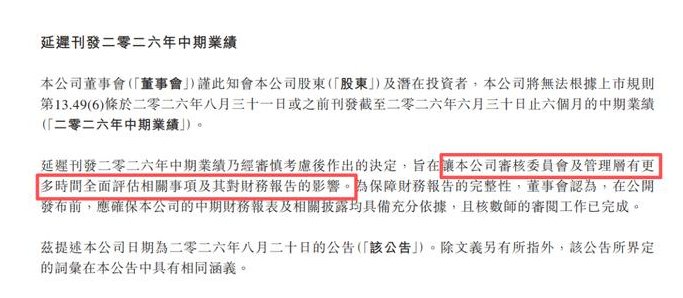
Due to the inability to publish interim results on or before August 31, 2026 in accordance with the Hong Kong Stock Exchange listing rules, Minimally Invasive Brain Science and the remaining three “Minimally Invasive Department” listed companies collectively suspended trading on September 1. This delayed disclosure directly hit the Hong Kong Stock Exchange's compliance red line, causing the shares to fall into a “dormant” state where they are priceless. Although the company responded to market concerns in late October through governance adjustments such as the founder's resignation as chairman of the board of directors and the appointment of a new CEO in an attempt to clear barriers to forensic inspections, as of late November, the four suspended companies had not announced a clear schedule for resuming trading. According to the rules, the company must publish the first quarterly update after the suspension of trading around the beginning of December, explaining the status of business operations and the progress of the resumption of trading. This forms the only observation window in the short term.
As far as the Hong Kong Stock Connect mechanism is concerned, the market value calculation under suspension shows a cruel one-way lockdown effect. Hong Kong Stock Connect's withdrawal decision is anchored in the average month-end market value of the past 12 months. Every day that the suspension of trading continues, more months of low market capitalization are passively locked into the calculation window. More fatally, the suspension of trading deprived the company of any channel to actively restore market value through normal transactions. Risk exposure was passively amplified, while hedging tools were simultaneously confiscated. As the December assessment window approaches, if the resumption of trading is not achieved as scheduled, it may be transferred out of Hong Kong Stock Connect or completely transformed into an established fact.
Specifically, Hong Kong Stock Connect needs to consider both market value and liquidity. At the level of liquidity rules, the regular liquidity requirement for the benchmark index is a monthly turnover rate of not less than 0.05%, meeting the standards for at least 10 months during the review period, and at least 5 months in the past 6 months. However, after triggering “trading has been suspended for more than a month,” the requirements were tightened to meet the standards for at least 11 months within 12 months, and to meet all standards in the last 6 months. The liquidity of Minimally Invasive Brain Science before the suspension of trading was not a shortcoming; the turnover rate was several times higher than the 0.05% threshold for a long time.
The problem is that the suspension of trading continued until the testing point on September 1. Every valid month generated after the resumption of trading directly entered the zero-fault tolerance range of “meeting all standards in the last 6 months”, while only January-August can support the “11-month compliance” count before the suspension. While the continued suspension of trading has frozen the market value at around HK$6.084 billion in book safety pads, it has also made it impossible to accumulate liquidity months.
Building a foundation of fundamental resilience is not a “pass”
Removing the short-term disruptions of the suspension of trading, the fundamentals of minimally invasive brain science still reveal a deep moat leading in neurological intervention. According to the 2025 financial data, the company achieved revenue of 790 million yuan, an increase of 3.8% year on year; although net profit fell 26.2% year on year to 184 million yuan due to non-cash factors such as impairment of associated companies, adjusted net profit still recorded 299 million yuan, an increase of 6.0% year on year, showing strong operational resilience.
In terms of business growth, the company is hedging the pressure of collection through “domestic replacement+overseas expansion” two-wheel drive. In the domestic market, although products such as dense net stents are facing the challenge of collection and price reduction, the company was successfully selected in multiple collections such as the Hebei Interprovincial Alliance with its rich product pipeline. The number of core product terminals implanted achieved rapid growth. In 2025, about 310 new hospitals were developed, covering nearly 3,800 hospitals across the country. The overseas market has become a new growth pole. In 2025, overseas revenue broke through the 100 million yuan mark for the first time, up 39.4% year on year, accounting for 13% of total revenue. 10 core products have been commercialized in 36 countries and regions.
By product, hemorrhagic collection “price-for-volume” has entered the latter half of cashing, and is a ballast stone for short-term performance. In 2025, revenue from hemorrhagic stroke products was 475 million yuan, an increase of 8.1% over the previous year, accounting for about 60% of revenue. The ischemic category has an extremely low base and the highest growth rate. It is the most flexible business line in the medium term. Revenue from acute ischemic stroke products in 2025 was only 47 million yuan, a year-on-year decrease of 2.9%, but this decline was a phased phenomenon during the product changeover period. Two one-stop bolt removal solutions, AISAdvance and AISFast, were approved in 2025, and will enter the official release window starting in 2026. Embolization stents and suction catheters are subdivided tracks with the greatest room for improving permeability in neurological interventions. SPDB International predicts that from 2022 to 2032, the embolization stent market will increase from 3.31 billion yuan to 11.22 billion yuan, suction catheters will increase from 970 million yuan to 5.73 billion yuan, and the number of surgeries will increase by about 20% and 27%, respectively. The base of ischemic patients is far greater than that of hemorrhagic patients. The current extremely low income base means that once the one-stop plan is completed, the incremental slope will be significantly higher than in other sectors.
Overseas markets have been upgraded to the “second growth pole”, which is a core variable in long-term market revaluation. Overseas revenue in 2025 was 105 million yuan, up 39.4% year on year, accounting for 13%; gross margin of international business increased dramatically, and profits grew rapidly at the same time. By the end of 2025, 17 products had gone overseas, covering 36 overseas countries/regions, and 21 new registration certificates were added throughout the year. What is more signalling is that APOLLO Dream intracranial sirolimus targeted elution stents have been recognized by the FDA as a breakthrough medical device, pointing to an empty market for treating intracranial atherosclerosis. Once clinically progresses smoothly, the ceiling of overseas revenue will rise to “hundreds of millions”. In the global competitive landscape of neurointervention, the layout density of multinational enterprises is lower than coronary and electrophysiology, and there is room for domestic products to continue to increase their share based on cost performance and differentiated adaptations.
More importantly, minimally invasive brain science is actively expanding into cutting-edge fields such as brain-computer interfaces in an attempt to open up room for long-term growth. The company covers nearly 3,800 hospitals in China, including over 2,00 tertiary hospitals and the top 100 hospitals in all national stroke centers, supporting nearly 290,000 surgeries. This channel and clinical resource network is not only an infrastructure for current product distribution, but also an interface extending to neurosurgery (brain hematoma, hydrocephalus, brain tumors) and brain-computer interfaces. Brain-computer interfaces have been incorporated into the “future industry” policy framework, and seven departments have set a timeline for key technological breakthroughs in 2027 and industrial strength entering the world's leading position in 2030. The company established the Chaos Brain and Computer Research Institute to construct a complete technical closed loop of “brain signal acquisition → intention decoding → robot execution” using a “brain-vascular-intervention” entrance advantage card position scenario for neurological intervention, targeting markets in immediate need such as stroke rehabilitation.