
Former member of the Bank of Japan: The Bank of Japan may raise interest rates three times to 2% by the middle of next year, the first time since 1993
The Zhitong Finance App learned that, according to a former board member of the Bank of Japan, the Bank of Japan may raise the benchmark interest rate three more times to 2% by the middle of next year — a level that has not been seen since 1993.
“The Bank of Japan is probably considering increasing interest rates to 2%,” Makoto Sakurai (Makoto Sakurai), who served as a member of the Board of Japan's board of directors from 2016 to 2021, said in an interview on Tuesday. “Then they will spend some time watching how the situation develops before deciding what to do next.”
Sakurai's forecast is slightly higher than the Bank of Japan observers' median estimate of the so-called terminal interest rate of about 1.75%. He also said that depending on the inflation outlook, the possibility that borrowing costs will eventually rise above 2% is not ruled out.
The former central bank official expects the Bank of Japan to raise interest rates again in its next policy decision on December 18 — in line with mainstream market expectations. Overnight index swaps (OIS) indicate that the probability of this move is around 80%. The recent sharp decline in global stock markets is unlikely to change the central bank's calculations unless the decline worsens significantly.
Meeting the inflation target was only in the first half; oil prices were the biggest variable
The Bank of Japan reached a milestone last month: it acknowledged for the first time that potential inflation had reached its 2% target since it was set in 2013. Now its challenge is turning to ensuring that inflation stays close to that level, rather than rushing upward.
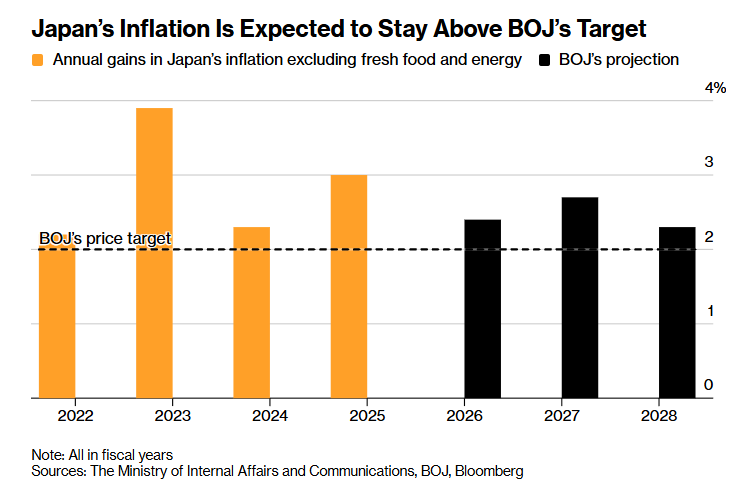
“Inflation has reached the 2% target, but the problem is that it may be higher,” Sakurai said, citing rising oil prices as the biggest factor driving up the cost of living. Japan's crude oil imports surged 60.5% year on year in October — energy costs are bringing a new round of inflationary pressure, according to government data released last week.
Although Bank of Japan observers are wary that the government may resist further interest rate hikes, Sakurai believes this kind of pressure is unlikely to occur. He also pointed out that the government may be happy to see results in another area — the Bank of Japan's decision to speed up the sale of ETF holdings will enrich public finances.
A committee led by Governor Kazuo Ueda decided last month to more than double the rate of reduction in ETF holdings. The move is expected to generate additional revenue for the Takashi government — which is seeking funding to cut taxes on food sales, increase defense spending, and other economic plans.
“Almost certainly, the Bank of Japan thought of this,” Sakurai said. “They didn't have to do this in October.” When asked in the Diet last week if this move was intended to relieve government finances, Ueda said that the central bank made an independent decision on the sale of ETFs.
Nikkei 51,000 points: the “invisible threshold” for interest rate hikes
The recent decline in global stock markets has sparked some speculation — the Bank of Japan may skip the December rate hike. Sakurai said that as long as the Nikkei 225 index remains above 51,000 points, Ueda's committee is likely to act as usual — a level roughly equivalent to when Takashi took office in October last year. The index closed at 58644.63 on Monday.
“The real test will be in the first half of next year,” Sakurai said. “I'm referring to whether the Bank of Japan can properly handle inflation. If it can be done, after fighting deflation for more than ten years, it will become a normal central bank in the true sense of the word.”