
Fast money can't keep up with the market! Quantitative funds are collectively “left behind”, and after throwing away 68 billion US dollars in five days, they still can't keep up with the pace of the market
The Zhitong Finance App noticed that the stock market narrative is changing so fast that even so-called “fast money” is difficult to keep up with the pace.
Estimates compiled by Goldman Sachs Group's trading department show that the model tracked by these systematized funds has yet to signal a slowdown in sell-off, although stock market sentiment has picked up since Huang Renxun unexpectedly returned to the helm of NVDA.US (NVDA.US) last week.
Commodity trading advisors (CTAs) act on price trends rather than fundamentals, and once they start selling off, the feedback loop that follows often lowers stock exposure until certain thresholds are reached. According to estimates, CTA is expected to sell $68 billion worth of global stocks within the next five days, which is comparable to the five-day sell-off up to last Friday, when the stock market recorded its worst weekly performance since the COVID-19 pandemic.
The thrilling price fluctuations in global stock markets are becoming more and more unbearable for groups known for their bold operations, extremely liquid, and flexible tactics. However, signs that this group's sell-off is becoming more protracted may weaken the stock market's attempts to rebound and increase volatility.
Matt Marley, chief market strategist at Miller Tabak+ Co., said, “Over the past four days, the NASDAQ 100 index has fluctuated between 3% and 6% daily, and the direction has generally varied, making it almost impossible for fast money fund managers to keep up with the pace.”
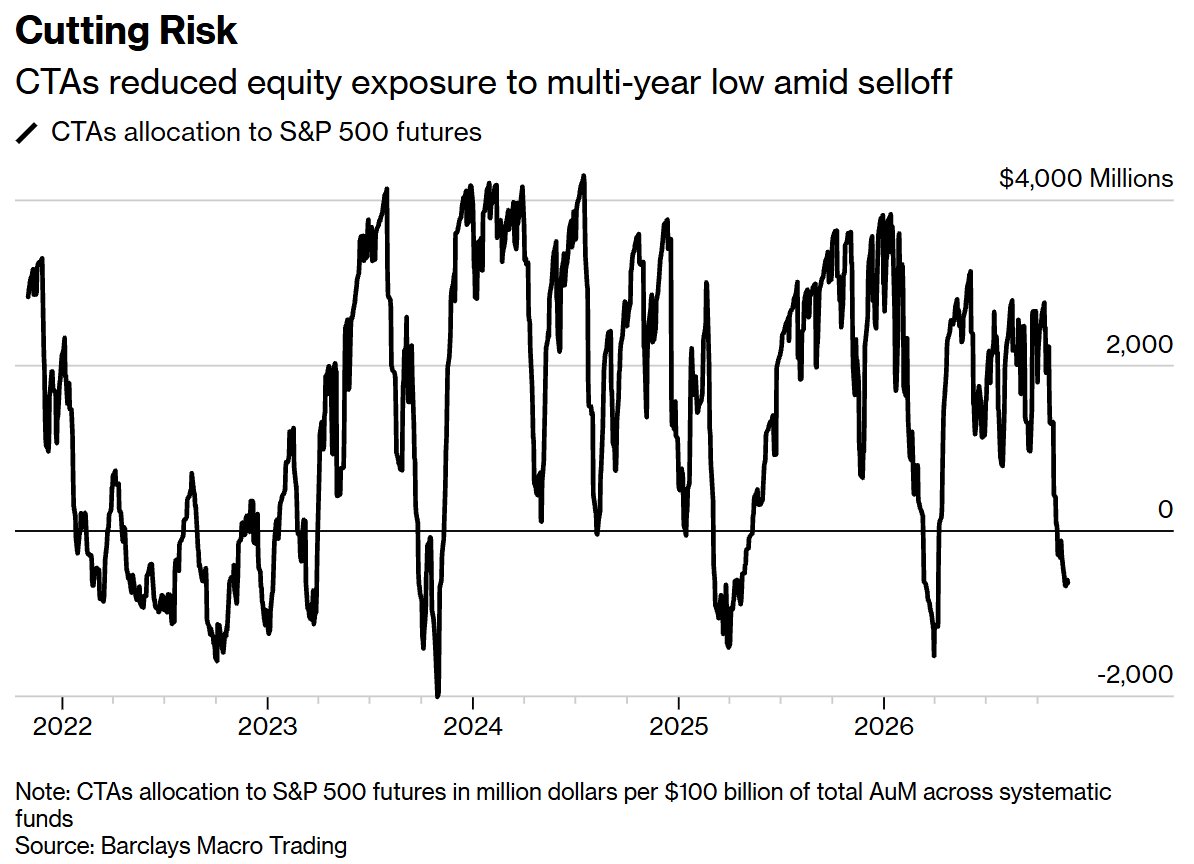
CTA stock exposure falls to a multi-year low amid a wave of sell-offs
Extreme fluctuation
The moderate rebound in global stock markets on Monday gave way to a new round of concerns about the sustainability of artificial intelligence transactions the next day, driving the S&P 500 and Nasdaq 100 indices to face their worst November performance since the global financial crisis. According to data compiled by Barclays, CTA has short positions in both indices, and its position is in the bottom quarter of the readings since a year ago.
Alex Altman, head of global equity tactical strategy at Barclays, said: “For most strategies, increased volatility simply means a decrease in risk allocation, and in the end, we did see this.” “The reason CTA is shorting stocks is because this is the general trend in the past month, but the nominal scale is small, because this trend can be said to be still in its infancy and extremely volatile.”
For some people, if this kind of doubt can stop the market from rebounding too fast, it may be seen as good news. Defensive positions in so-called rule-driven funds help create conditions for a rebound, as happened in March.
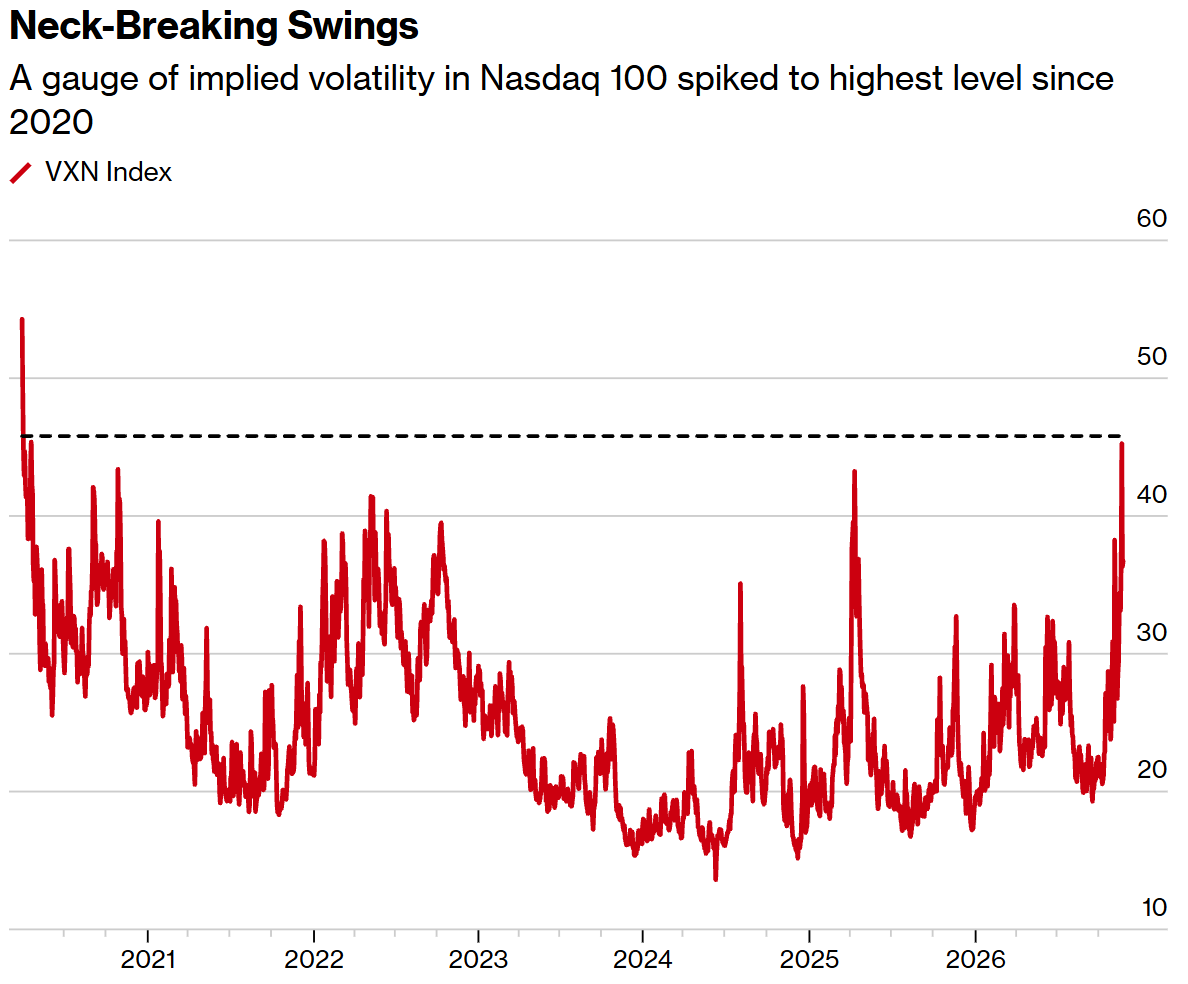
The Nasdaq 100 implied volatility indicator soared to its highest level since 2020
Seizing the timing of recovery is easy, but at least for CTAs, there are certain signposts. Goldman Sachs traders say that 7560 points, 7527 points, and 7117 points are key points for the S&P 500 index's short-, medium-, and long-term trend signals, respectively. On Tuesday, the index, which includes 500 constituent stocks, fell 0.5% to 7201.09 points, an increase of 7.9% from the record high set last month.
The rise in volatility is also dragging down another type of systematic investors: volatility-control funds. As price fluctuations expand, these strategies often reduce stock exposure, which may become another source of selling pressure. Since mid-October, the Volatility Control Fund has reduced its stock holdings by about 400 billion US dollars, the largest and fastest reduction since US President Trump imposed global tariffs in 2025.
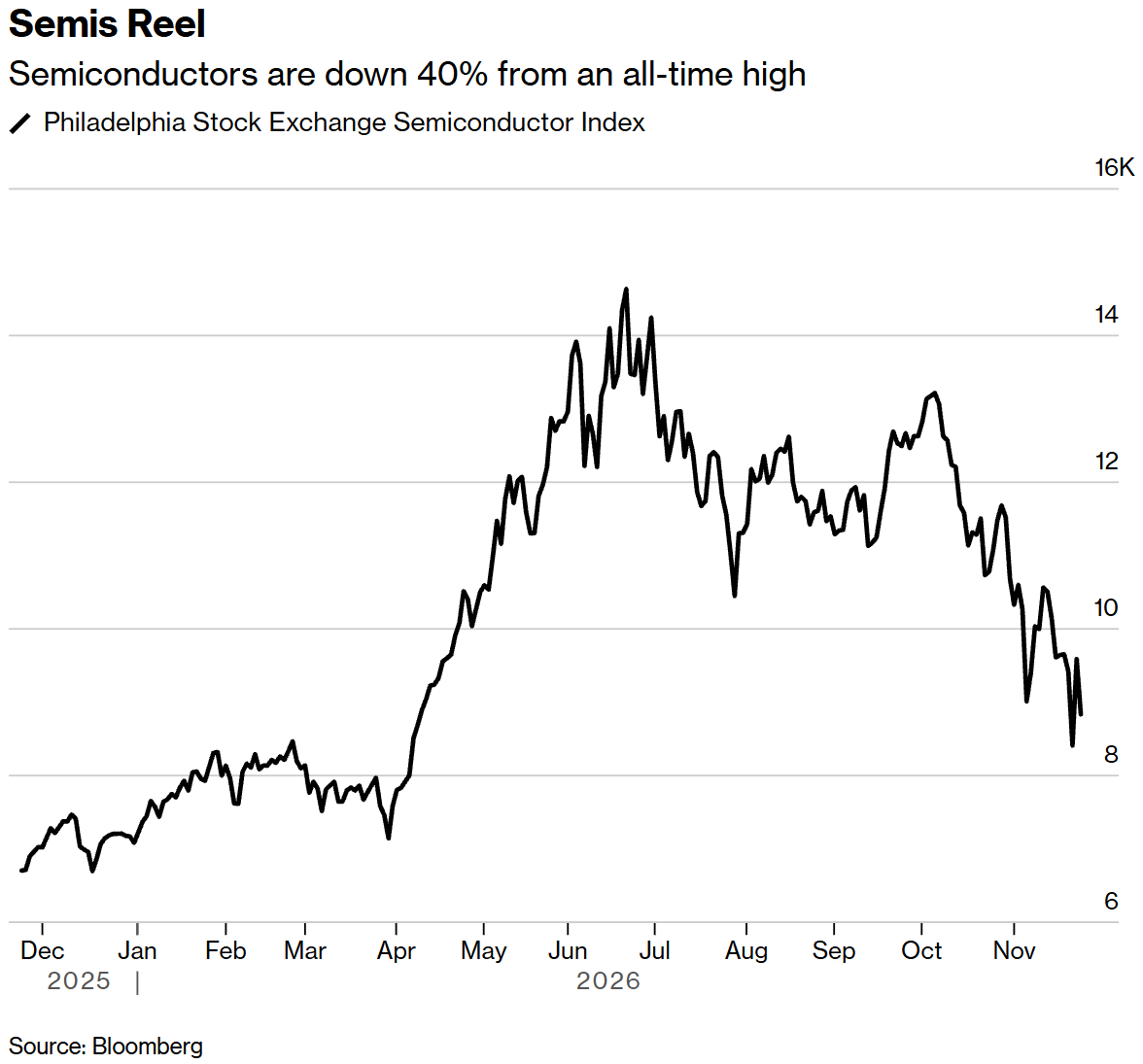
Semiconductor prices are down 40% from their all-time high
The indicator that measures the 30-day volatility of the S&P 500 index has been rising for seven consecutive weeks, to the highest level since May 2025. The Chicago Board Options Exchange Volatility Index (VIX), which measures implied volatility, closed around 26.6 after surging above 35 last week.
Altman said, “Arguably, it is because of the drastic reduction in stock exposure levels, this provides a much cleaner 'white board' for internal reconstruction risks in these strategies.”