
Does Racial Discrimination Verdict Change The Bull Case For adidas (XTRA:ADS)?
- In Oregon, an earlier court ruling found Adidas liable on a racial discrimination claim brought by former manager April Burton, awarding her $1.23 million while clearing the firm on four additional allegations.
- The verdict introduces potential incremental legal and reputational costs for Adidas, which may influence how management allocates cash between growth investment, marketing and shareholder returns.
- This article examines how Adidas’s valuation story intersects with the discrimination verdict and what that may mean for long term investors.
Scan how adidas compares with other consumer stocks dealing with brand, legal and reputational pressure by reviewing our hand picked list of 200 resilient stocks with low risk scores.
adidas Investment Narrative Recap
To own adidas, you need to believe the brand can turn recent sales momentum into durable earnings and free cash flow. Ivoed, a Simply Wall St Community investor who wrote the Narrative, argues that the key near term catalyst is evidence that heavy marketing and inventory investment translate into a sustained operating margin above 10%. The Oregon discrimination verdict looks incremental for near term profit, but it adds reputational friction just as adidas is trying to prove the quality of this earnings recovery.
The biggest operational risk right now is that enthusiasm around franchises such as Samba and Gazelle cools before working capital and marketing spend settle at more efficient levels. That would pressure both pricing and margins. Any perception that adidas has cultural or workplace issues could also affect talent retention and consumer sentiment, which would complicate that margin story even if the direct financial cost of the lawsuit remains limited.
The most interesting recent development around catalysts is adidas being highlighted as a key player in the global field hockey equipment market, with that segment expected to reach about €8b by 2035. This links directly to Ivoed’s focus on broadening growth beyond a few sneaker franchises into performance categories where adidas has long product heritage and technical credibility.
Field hockey gear is a niche next to footwear, yet it speaks to two important levers. First, it shows adidas pushing into sport specific hardware where pricing power can be healthier and sponsorships matter. Second, it connects with themes investors already watch, such as material science and more sustainable products, which could support margin and brand strength if management executes and avoids overextending on costs.
Ivoed’s narrative arrives at a fair value of €190.00 for adidas by assuming revenue growth of 10.6% a year and a future profit margin of 5.3%, which together support higher long run earnings power than the current financial profile alone might imply.
Uncover why adidas' fair value indicates a 13% potential upside to its current price that could narrow quickly.
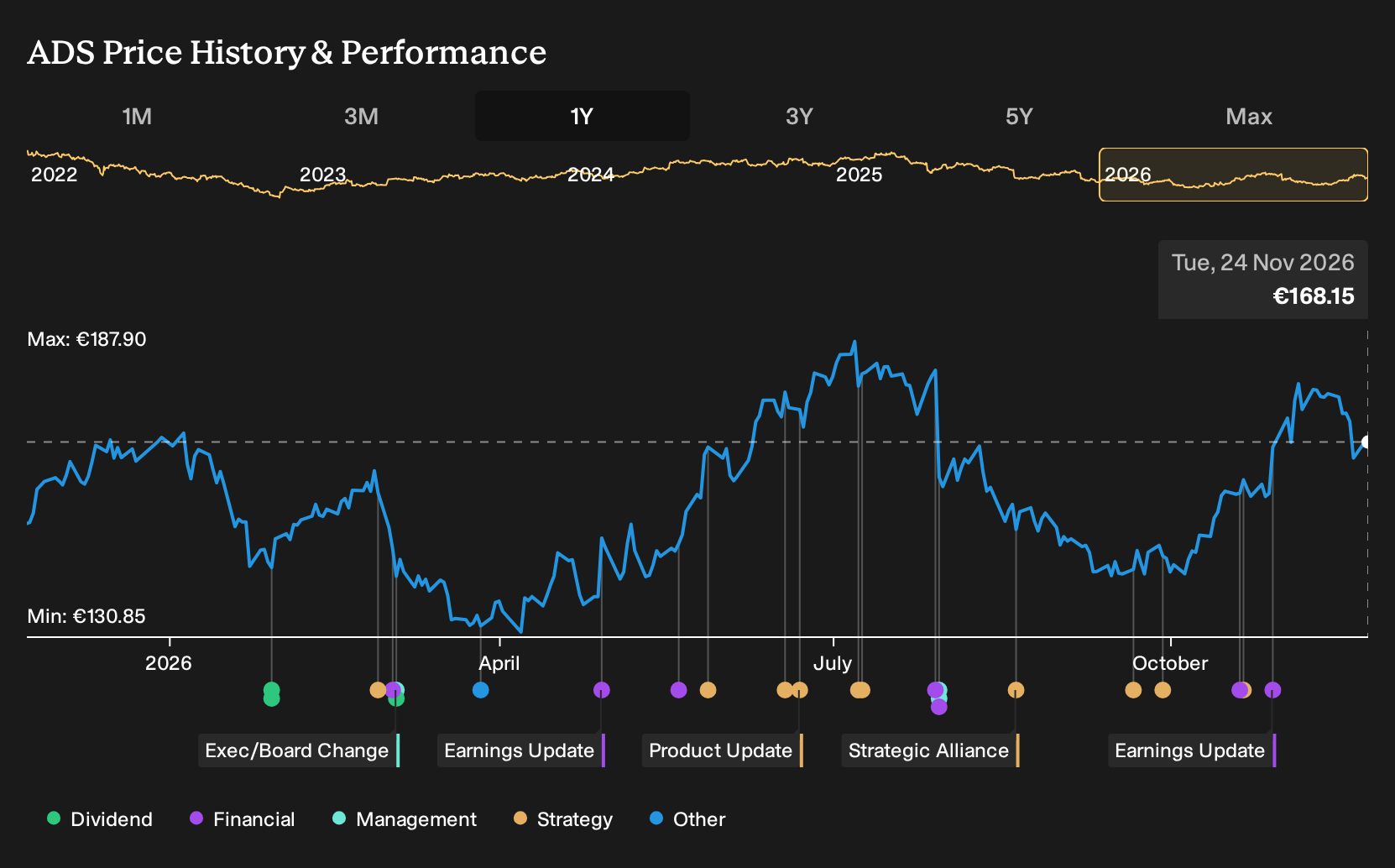
Exploring Other Perspectives
One alternate view puts far more weight on adidas’s exposure to promotion heavy lifestyle footwear. Those analysts already expected revenue to reach about €32.1b and earnings of roughly €2.1b by 2029, yet still saw limited upside at a 14.6x P/E. The Oregon verdict could push that cautious camp to reassess.
Explore 6 other adidas fair value estimates, including one that suggests it could be worth just €190.00.
Reach Your Own Conclusion
Disagree with existing narratives? Extraordinary investment returns rarely come from following the herd, so consider developing your own view.
- A great starting point for your adidas research is our analysis highlighting 3 key rewards and 1 important warning sign that could impact your investment decision.
- See our latest analysis for adidas. The report includes a comprehensive fundamental analysis summarized in a single visual, the Snowflake, making it easy to evaluate adidas' overall financial health at a glance.
Looking for more investment ideas beyond adidas?
If the adidas story has sharpened your view on brand, risk and valuation, it can help to put those insights to work across a broader watchlist using the Simply Wall St Screener.
- If resilience and capital strength matter most to you, start with companies on our list of solid balance sheet and fundamentals (185 results) that may handle shocks more effectively.
- If you are hunting for income, focus on businesses in our 247 dividend fortresses that currently offer higher yields with the potential for steadier payouts.
- If you want to back under followed opportunities, review our 553 high quality undiscovered gems that pair quality fundamentals with lower market attention.
Have feedback on this article? Concerned about the content? Get in touch with us directly. Alternatively, email editorial-team@simplywallst.com