
Dear Li Auto Stock Fans, Mark Your Calendars for November 25
The electric vehicle (EV) market has become a tough race in China, with fierce price wars, cooling consumer demand, and rising competition keeping automakers on their toes. Li Auto (LI), headquartered in Beijing, is right in the thick of it. The company has built its name on premium, family-focused EVs, but slowing deliveries, shrinking margins, and geopolitical headwinds have made the road ahead considerably bumpier. On the flip side, its expanding BEV lineup, new model launches, and growing charging network offer some fresh growth opportunities.
Now, Li Auto investors have an important date to circle on their calendars. The company is set to release its Q3 2026 financial results tomorrow, Wednesday, Nov. 25, before the market opens. With the stock under pressure and Wall Street taking a cautious stance, the upcoming report could offer some clues about where the business is headed.
Let’s take a closer look at what to expect.
About Li Auto Stock
Founded in 2015, Li Auto has carved out a name in China’s EV market by building premium, tech-loaded vehicles for families. The company pioneered extended-range electric vehicles before branching into pure battery EVs, with its lineup spanning the Li L and Li i SUV series and the flagship Li MEGA MPV. But Li Auto is not just selling cars; it's building an ecosystem around them.
As of October 2026, it operated 481 retail stores across 159 cities, 527 service centers, and authorized service shops across 217 cities. Li Auto operated 4,206 supercharging stations with 23,163 charging stalls in China, up by 18 stations and 86 stalls from the end of September. With a market cap of $10.8 billion, its next challenge is turning that expanding footprint into sustainable growth and stronger profits.
Li Auto’s shares have taken a serious beating, and investors have not had much reason to celebrate lately. The Chinese EV maker is now down roughly 77.4% from its record high, with shares sliding 42% over the past 52 weeks. The stock hit a fresh all-time low of $10.35 on Nov. 20, extending its losses to 16% over three months and another 10% over just the past five trading sessions. That’s quite a rough stretch for a company that once enjoyed plenty of investor enthusiasm.
So, what’s going wrong? A combination of slowing deliveries, shrinking margins, mounting losses, and a pretty ugly backdrop for China’s EV industry. Chinese automakers are building increasingly sophisticated, affordable EVs, but domestic demand is not keeping pace with supply. That has sparked aggressive discounting and price wars, squeezing profitability across the industry. Beijing has also begun scaling back its support for the sector, leaving manufacturers with fewer incentives to lean on.
And the trouble does not stop at China’s borders. Rising raw material and shipping costs, compounded by geopolitical tensions surrounding the U.S.-Iran war, are adding to the pressure. Meanwhile, Washington’s 100% tariffs on Chinese EVs and potential similar restrictions in Europe are making global expansion harder. For Li Auto, it’s a tough combination of weaker demand at home, tighter margins, and fewer easy routes to growth overseas.
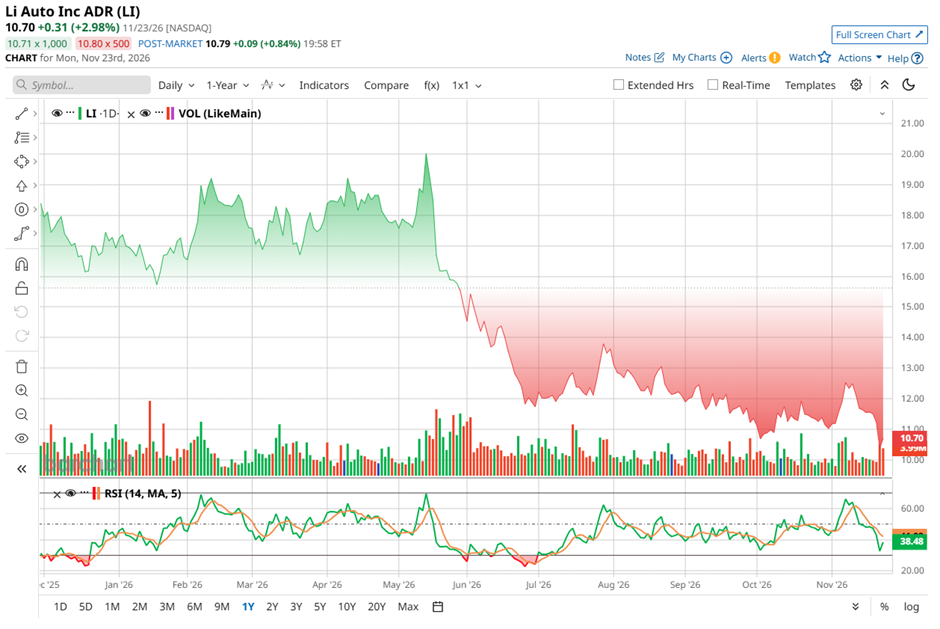
From a valuation standpoint, Li Auto looks relatively inexpensive, trading at just 0.6 times forward sales. That’s well below both the sector average and its own historical median, suggesting the stock is trading at a considerable discount. However, with profitability under pressure and margins still recovering, investors may want to see a stronger earnings comeback before getting too excited about the bargain tag.
A Snapshot of Q2's Earnings Report
Li Auto’s second-quarter 2026 results, released in August, showed just how tough China’s EV market has become. The Chinese automaker brought in revenue of RMB25.7 billion ($3.8 billion), down 15.1% year-over-year (YoY) but up 11.7% sequentially.
The bigger headache, however, was profitability. Gross profit plunged 53.3% YoY to RMB2.8 billion ($418 million), while gross margin nearly halved to 11% from 20.1% last year. Vehicle margin also took a beating, falling to 9.4% from 19.4%.
Higher battery, raw material, component, and memory chip costs put considerable pressure on the business. Li Auto acknowledged these industry-wide challenges but has chosen not to pass the additional costs on to customers. Instead, it is banking on its own battery and chip development capabilities to improve cost efficiency over time.
The pressure also showed up on the bottom line, with the company swinging to a non-GAAP net loss of roughly -RMB1.5 billion (-$220.9 million), compared with a net profit of RMB1.5 billion a year earlier.
Cash flow was not particularly pretty either, but there was some improvement. Free cash flow remained negative at RMB1.3 billion (-$191.7 million), considerably better than the negative RMB7.4 billion recorded in the previous quarter. Meanwhile, Li Auto ended June with a healthy cash balance of RMB87.5 billion ($12.9 billion).
Looking ahead, management expects long-term gross margins of 15% to 20% and relatively stable quarterly operating cash flow from Q3 as new-model deliveries pick up. The company has also earmarked approximately RMB 6 billion in 2026 capex, including investments in its supercharging network.
Wall Street expects Li Auto to bring in around $4.13 billion in Q3 revenue, although the company is still likely to remain in the red, with an estimated loss of $0.08 per share. For fiscal 2026, analysts project a loss of $0.72 per share, before the company potentially returns to profitability in fiscal 2027 with an estimated EPS of $0.10.
Li Auto’s October Deliveries
Li Auto is facing another slowdown in deliveries. The Chinese automaker handed over 29,025 vehicles in October, down 8.6% YoY and 8.8% from September’s 31,817 units. That’s the second consecutive month of annual delivery declines and the company’s weakest monthly showing since February, when it delivered 26,421 vehicles. Still, cumulative deliveries since the company's inception reached 1,862,676 as of Oct. 31.
Behind the slowdown, Li Auto is busy refreshing its BEV lineup and pushing more homegrown technology. The company delivered more than 3,000 units of its updated Li MEGA flagship electric MPV in October. It also launched the 2026 Li i6 on Oct. 28, with deliveries beginning the following day.
Li Auto’s product line head, Li Xinyang, said cumulative i6 production had reached 200,000 units. The company plans to increase monthly production capacity to 20,000 units in November, with another ramp-up in December. New orders currently carry a seven-to-eight-week wait. Meanwhile, Li Auto introduced its Lianshan battery, electric drive system, and battery warranty program in October, further expanding its in-house technology push.
What Do Analysts Expect for LI Stock?
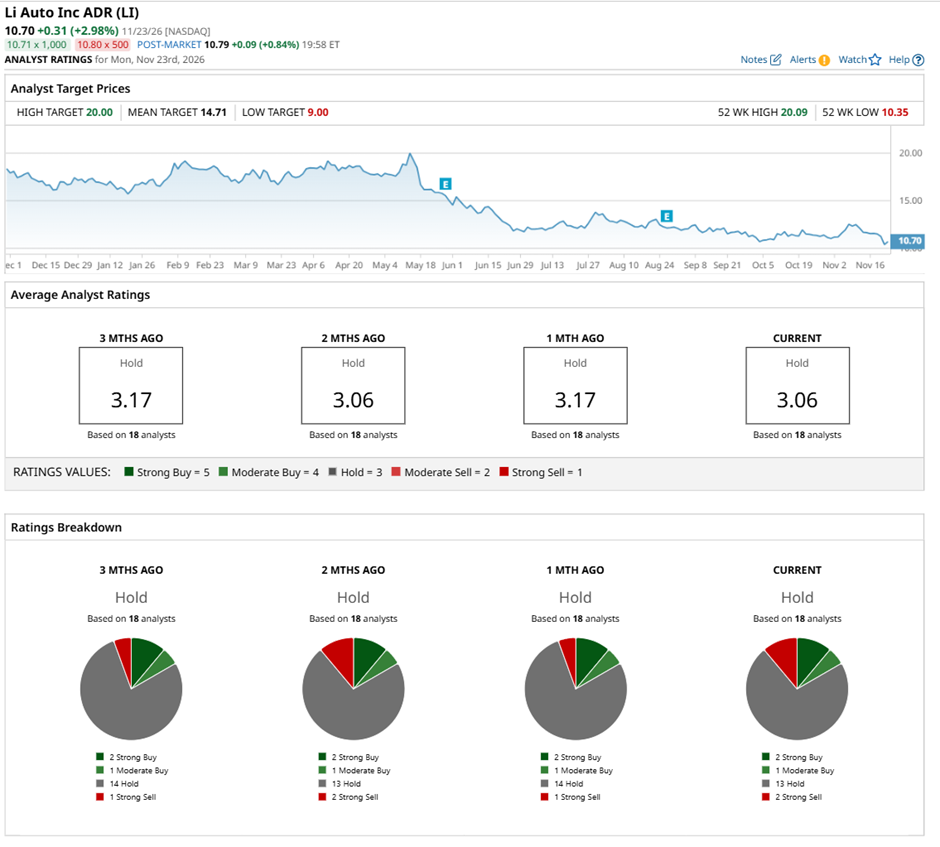
Overall, Wall Street analysts are cautious on LI stock. Among the 18 analysts covering Li Auto, the consensus rating is a “Hold.” Two analysts are bullish with a “Strong Buy,” and one recommends a “Moderate Buy,” while 13 analysts prefer to stay on the sidelines with a “Hold.” The remaining two are not convinced at all, handing the stock a “Strong Sell” rating.
Meanwhile, the mean price target of $14.71 suggests the EV stock could surge by 38% from yesterday’s close. The Street-high of $20 implies an upside potential of 87%.
On the date of publication, Sristi Suman Jayaswal did not directly have a position in any of the securities mentioned in this article. All information and data in this article is solely for informational purposes. For more information please view the Barchart Disclosure Policy here.