
US stocks are under pressure again after surging! Nomura warns that mechanical buying cannot eliminate the structural risks of AI trading
The Zhitong Finance App learned that as Huang Renxun returned to Nvidia (NVDA.US) to restore market sentiment and investors turned from panic to excitement, US stocks rebounded strongly on Monday — the Dow rose 3.01%, the S&P 500 index rose 4.73% to end seven consecutive declines, the Nasdaq Composite Index rose 6.51%, and the Nasdaq 100 Index closed up 6.86%. Among them, the S&P 500 index and the Nasdaq index recorded their biggest one-day percentage gains since April 8, 2025. However, before the Tuesday market, most technology stocks retreated, and NASDAQ futures fell more than 2%.
However, analysis of this market trend shows that mechanical buying also added impetus to this round of upward movement. Charlie McEligott, a cross-asset strategist at Nomura Securities International, said that with the sharp decline in market volatility on Monday, the exercise price of put options bought as a hedge during the previous market decline was far higher than the current market level, so sensitivity to index trends declined. In a report sent to clients on Monday, he wrote that traders who previously sold stock index futures in response to these put options had to buy back futures contracts, while short sellers were in a hurry to make up for short positions, and investors are also chasing up.
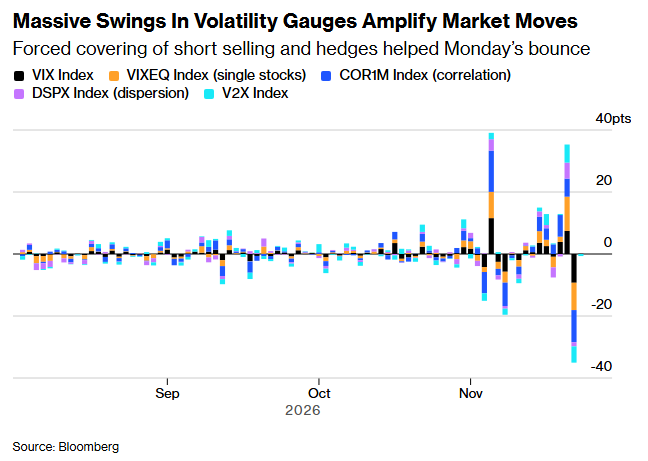
Forced recovery of short positions and hedging positions boosted the market's rebound on Monday
Leveraged exchange-traded funds (ETFs) must rebalance at the end of each trading day in the direction of the day's market trend to maintain their level of leverage unchanged. Charlie McEligott estimates that these funds are expected to buy about $41 billion in assets by the close of trading on Monday, which will be the second-largest single-day purchase amount on record for Nomura Securities. In contrast, volatility-controlled funds will sell $11 billion to $16 billion in assets — such funds reduce risk exposure when the market is too volatile, far below the estimated purchase size of these leveraged ETFs.
Notably, there may be more buying to follow in the future. The model developed by Nomura Securities for trend-tracking funds — that is, commodity trading advisors (CTAs) — shows that in the past few weeks, such funds have been shorting the S&P 500 index over all time periods. Charlie McEligott wrote in the report that if the S&P 500 index closes above 7043 points, it will be enough to turn the 12-month signal in this model back long. This means that related funds may need to buy about $16 billion in S&P 500 futures and about $2.5 billion in Nasdaq 100 futures. Meanwhile, on Monday, the S&P 500 closed at 7237.17 points.
Meanwhile, Charlie McEligott pointed out that these factors have not allayed the larger concerns facing the market. He said that it would be naive to think that a single day surge could eliminate all the factors that previously triggered the sell-off in the market. The risks he cited include a tightening financial environment, readjustment of market expectations for artificial intelligence (AI) capital expenditure, inflation remaining too high, rising real interest rates, and widening credit spreads.
He wrote in the report: “This 'mechanical rebound' does not guarantee any changes in those longer-term, more structural forces.” However, he added that Hwang In-hoon's return may help maintain Nvidia's role in financing AI infrastructure construction, thereby extending the duration of the current cycle and reducing the risk of more serious market outcomes.
In this round of AI computing power infrastructure expansion cycle, Hwang In-hoon is not only the manager of a chip company, but also a key hub connecting chip supply, cloud vendor capital expenses, industrial chain support, and even market expectations. Global computing power investment has continued to increase over the past few years, largely due to Nvidia's stable pace of product iteration, mature ecological collaboration, and the long-term expansion narrative that Hwang In-hoon himself continues to convey to the market.
When Hwang In-hoon suddenly left office, investors' concerns erupted: the market began to doubt whether the delivery pace of next-generation chips such as Blackwell could be fulfilled, worried that Nvidia would shrink its external computing power support promises and tighten investment in upstream and downstream companies. Originally, the AI sector, which was in a high position and highly sensitive to forward capital expenses, naturally ushered in a double downturn in valuation and sentiment.
Some analysts pointed out that Hwang In-hoon's re-appointment as CEO of Nvidia mainly eliminated market uncertainty about the chip giant's strategic direction, product roadmap, technology development progress, and supply chain management. These previously unresolved issues have put significant pressure on a wider range of technology stocks, including Nvidia, over the past week or two.
Despite a sharp rebound in US stocks on Monday, the core index is still significantly below the previous all-time high. Whether technology stocks, led by Nvidia, can continue to rebound, and whether AI transactions can regain their popularity, also address market concerns such as AI's huge return on investment and circular financing.
The actual return on investment in AI computing power projects is being scrutinized. There is currently no clear evidence on how trillion-dollar AI infrastructure investments can obtain reasonable returns. Under the revolving financing model, rising compliance costs and stricter scrutiny will constrain existing and subsequent related transactions. Furthermore, Hwang In-hoon and Nvidia are still under investigation. Future public statements, internal decisions, and external interactions may all be included in the scope of the investigation and become a new basis for questioning. This will also further exacerbate uncertainty on the sales side and circular financing. These are deep problems in the fundamentals of the industry, and Hwang In-hoon's return will not allow these restrictions to be circumvented.
What also requires close attention is the Federal Reserve's monetary policy path. Since underlying inflation is still above 3%, the pressure on the Federal Reserve to continue to raise interest rates still exists, and a number of Federal Reserve officials have recently sent hawkish signals of further tightening monetary policy. If high financing costs are compounded by stronger regulations after the Democratic Party takes control of Congress, and the US macroeconomy moves towards a pessimistic trajectory of a “hard landing” under the interest rate hike cycle, I'm afraid the market will once again drastically lower the overall profit expectations of the AI computing power industry chain and the valuation multiplier premium that capital is willing to pay for these profits.