
Abercrombie and Fitch beats Q3 2026 sales expectations, stock jumps 12.6%

Young adult apparel retailer Abercrombie & Fitch (NYSE:ANF) reported Q3 2026 results topping the market’s revenue expectations, with revenue up 11.2% year on year to $1.44 billion. The company expects next quarter’s revenue to be around $1.79 billion, close to analysts’ consensus estimates. Its GAAP profit of $3.82 per share was 21.3% above analysts’ consensus estimates.
For more on Abercrombie and Fitch, read our free full research report.
Abercrombie and Fitch Q3 2026 highlights:
- Revenue $1.44 billion vs S&P analysts’ consensus estimates of $1.37 billion (11.2% year-on-year growth, 4.9% beat)
- EPS (GAAP) $3.82 vs analysts’ consensus estimates of $3.15 (21.3% beat)
- Adjusted EBITDA $266.8 million vs analysts’ consensus estimates of $229.5 million (18.6% margin, 16.2% beat)
- Revenue guidance $1.79 billion at the midpoint for Q4 2026, roughly in line with what analysts were expecting
- GAAP EPS guidance $13.80 at the midpoint for the full year, beating analysts’ consensus estimates by 1.7%
- Operating margin 15.5%, up from 12% in the same quarter last year
- Free cash flow margin 13.7%, up from 10.2% in the same quarter last year
- Same-store sales rose 6% year on year (3% in the same quarter last year)
- Market capitalization $5.96 billion
Revenue growth
A company’s long-term revenue performance can indicate its overall quality. Any business can experience short-term success, but top-performing ones sustain growth for years.
With $5.49 billion in revenue over the past 12 months, Abercrombie and Fitch is a mid-sized retailer, which sometimes brings disadvantages compared to larger competitors benefiting from better economies of scale. On the positive side, it can still generate high growth rates because it’s working from a smaller revenue base.
Abercrombie and Fitch’s revenue grew at a solid 10.8% compounded annual growth rate over the last three years as it opened new stores and increased revenue at existing, established locations.
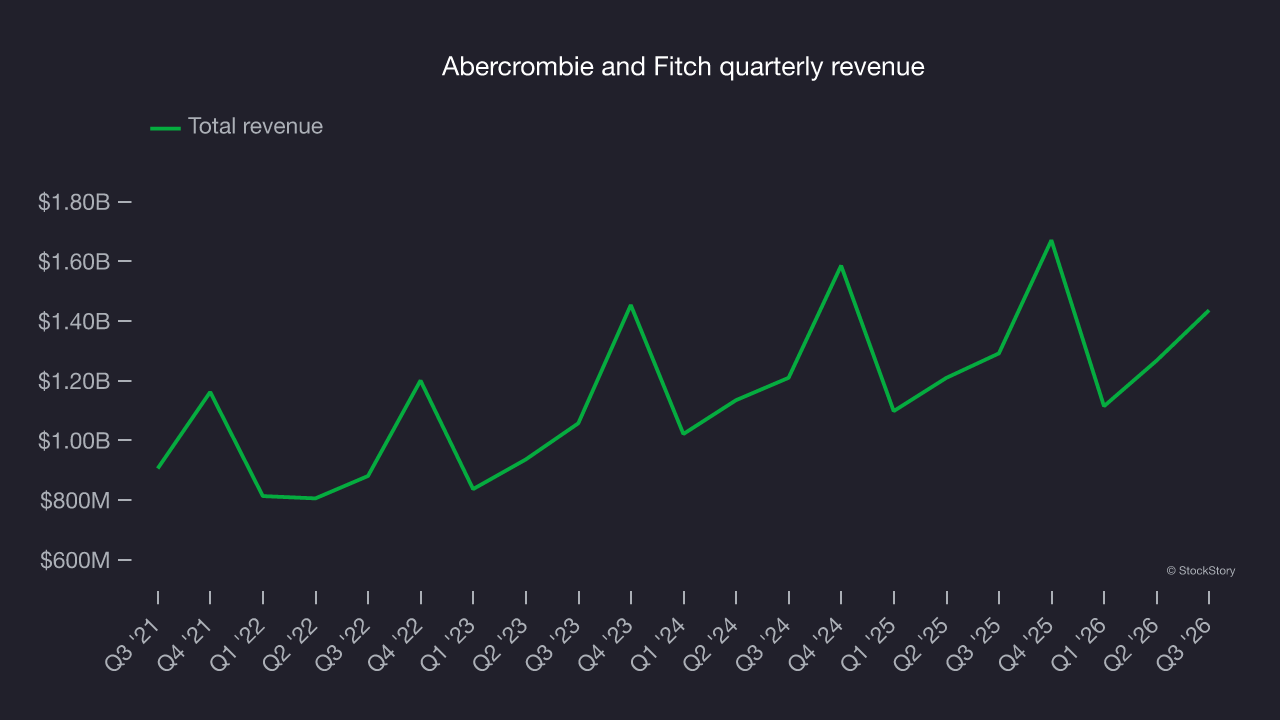
This quarter, Abercrombie and Fitch reported year-on-year revenue growth of 11.2%, and its $1.44 billion in revenue exceeded Wall Street’s consensus estimates by 4.9%. Management is guiding for a 7% year-on-year increase in revenue next quarter.
Looking further ahead, sell-side analysts expect revenue to grow 4% over the next 12 months, according to S&P, a deceleration versus the last three years. Still, this projection is above the sector average and suggests the market is forecasting some success for its newer products.
Store performance
Number of stores
The number of stores a retailer operates is a critical driver of how quickly company-level revenue can grow.
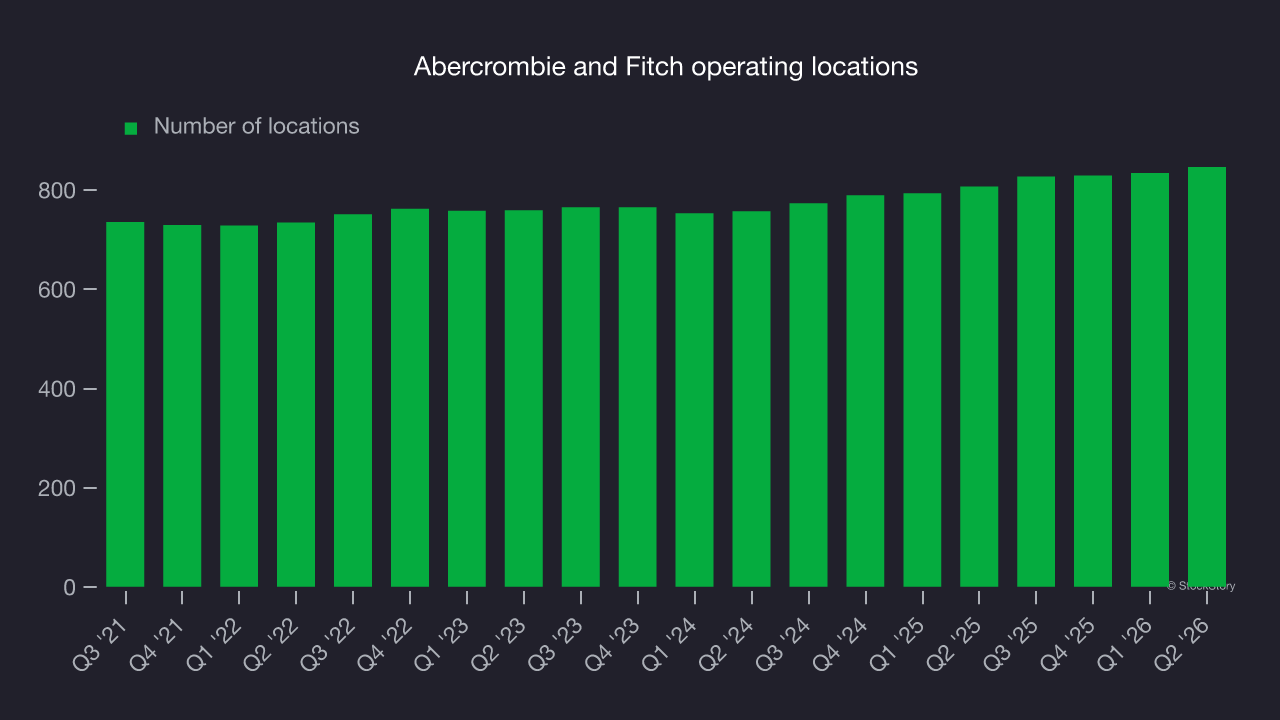
Over the last two years, Abercrombie and Fitch expanded its store count rapidly, averaging 5.3% annual growth, among the fastest in the consumer retail sector. This gives it a chance to become a large-scale business over time.
When a retailer opens new stores, it usually means it’s investing for growth because demand is greater than supply, especially in areas where consumers may not have a store within reasonable driving distance.
Note that Abercrombie and Fitch reports its store count intermittently, so some data points are missing in the chart below.
Same-store sales
A company’s store base only paints one part of the picture. When demand is high, it makes sense to open more. But when demand is low, it’s prudent to close some locations and use the money in other ways. Same-store sales is an industry measure of whether revenue is growing at those existing stores and is driven by customer visits (often called traffic) and the average spending per customer (ticket).
Abercrombie and Fitch’s demand has been strong for a retailer over the last two years. On average, the company has increased its same-store sales by 3.8% per year. This performance suggests its rollout of new stores is beneficial for shareholders. This backdrop gives Abercrombie and Fitch multiple paths to revenue growth: new stores, e-commerce or increased foot traffic and higher spending per customer at existing locations.
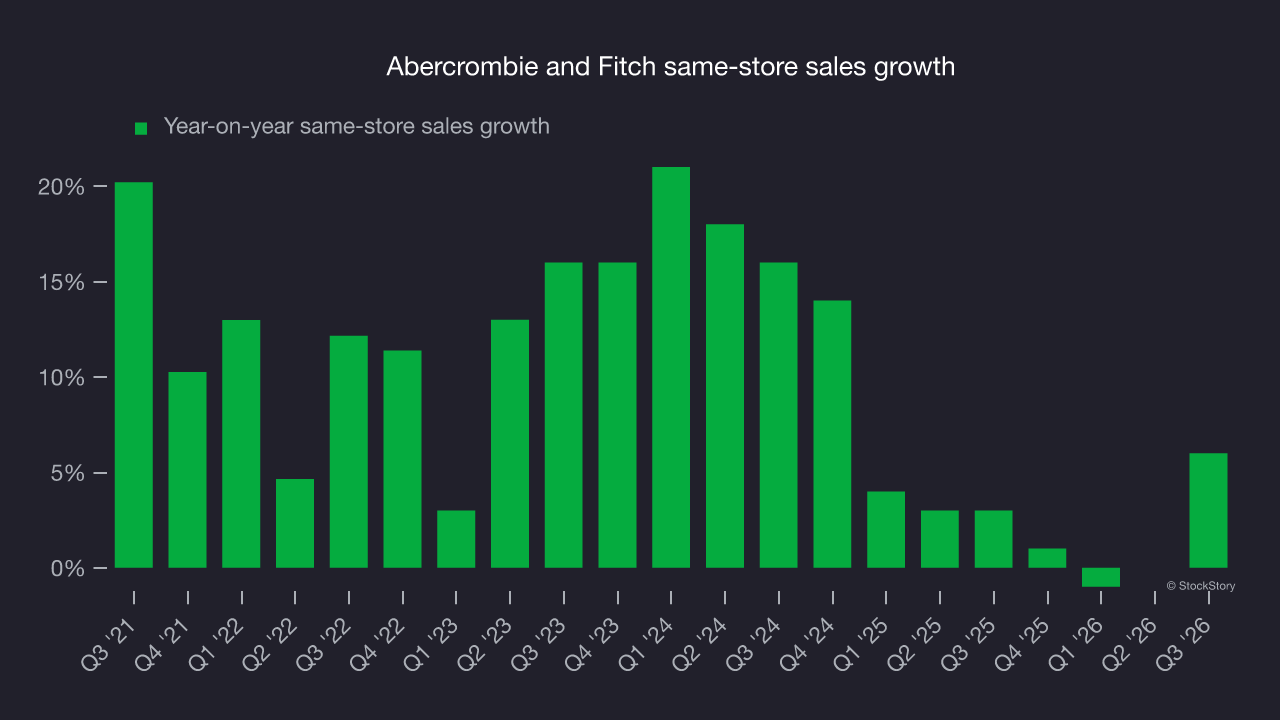
In the latest quarter, Abercrombie and Fitch’s same-store sales rose 6% year on year. This growth marked an acceleration from its historical levels, a positive sign.
Key takeaways from Abercrombie and Fitch’s Q3 results
Abercrombie and Fitch delivered a solid Q3, with EBITDA and revenue both beating analysts’ consensus estimates by wide margins. The quarter had clear positives, but EPS guidance for next quarter fell short of expectations. Shares soared 12.6% to $155.55 immediately after the results.
Abercrombie and Fitch reported solid earnings, but one quarter doesn’t necessarily make the stock a buy. To assess the investment case, consider valuation and business quality as well as the latest earnings. Read more in our full research report here (it’s free).