
The 2027 profit forecast game for US stocks! Hedge funds “vote with their feet” to measure profit growth in single digits, Wall Street is still optimistic about a 16% increase
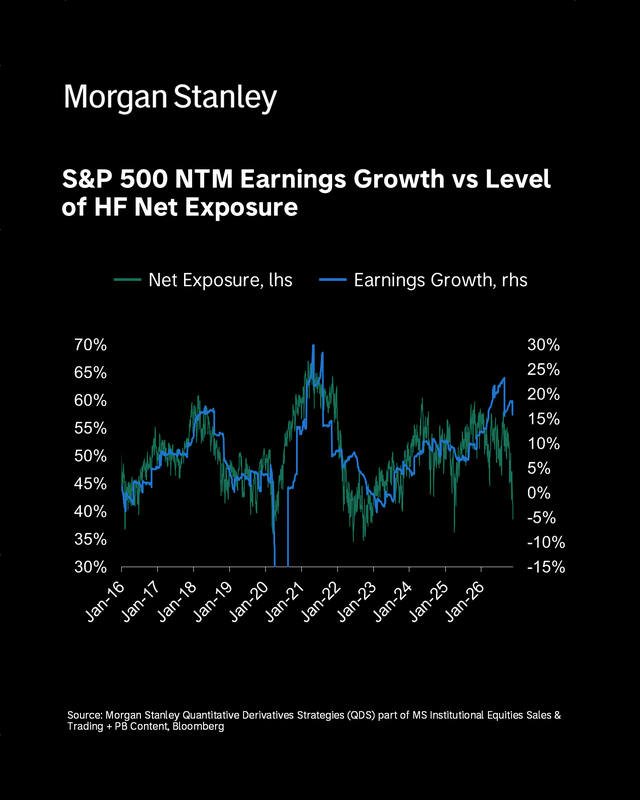
The Zhitong Finance App learned that Morgan Stanley said that the current position layout of hedge funds already reflects expectations of a slowdown in corporate profit growth, but Wall Street's profit forecast does not reflect this trend. Morgan Stanley said that judging from the historical situation, the risk exposure of hedge funds is closely related to the fundamental trend of corporate profits. Since 2016, the correlation between the two has reached 58%: the stronger the profit growth, the higher the net leverage level of hedge funds; a slowdown in profit growth is often accompanied by a decrease in the level of leverage.
The chart presented by Morgan Stanley shows the historical relationship between net exposure of hedge funds and the growth of forward earnings in the S&P 500 index. Although these two indicators generally move in the same direction, the two have not always stayed in sync, and there have been significant differences throughout various stages of the time series.
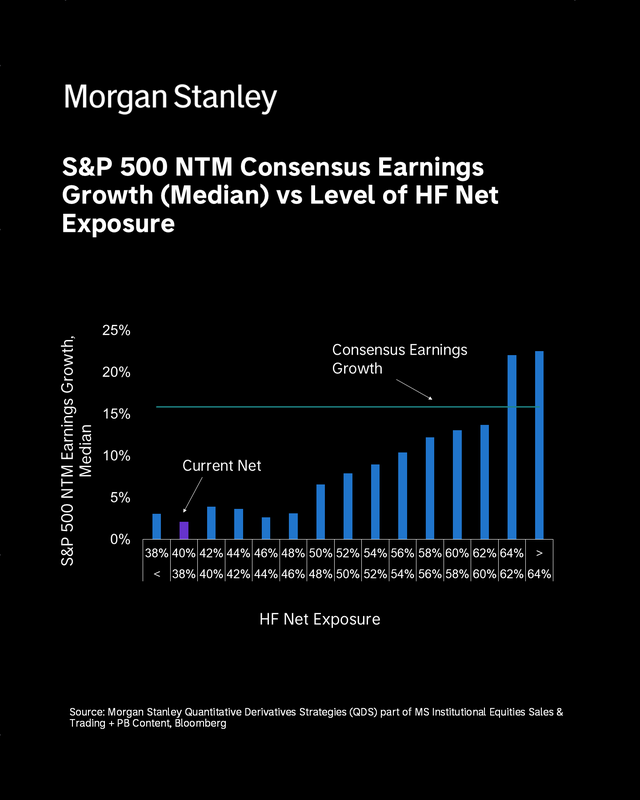
According to data from Morgan Stanley's main broker business department, the net exposure of US long and short hedge funds is currently 41%, the lowest level in a year, and is in the sixth percentile of all readings since 2010. This means that during this period, approximately 94% of the observed values were above current levels.
The bank explained that according to the current level of net exposure, when referring to historical data since 2016, the hedge fund's median consensus expectation of earnings growth for S&P 500 index constituent stocks over the next 12 months is usually only 5%. In contrast, Wall Street's current consensus forecast is 16%.
Wall Street is more optimistic than hedge funds, but the slowdown in profit growth in 2027 has become the mainstream judgment
Judging from specific forecasts, Wall Street's current overall judgment on the profits of US stock companies is still biased towards optimism, but different institutions clearly disagree on the growth rate in 2027.
According to the latest data released by FactSet as of November 20, the profit of S&P 500 companies is expected to increase by 33.7% for the full year of 2026 and 16.4% in 2027; among them, profit for the fourth quarter of 2026 is expected to increase by 28.9% year-on-year, and the first quarter of 2027 is expected to increase by 20%. This means that although corporate profits are still expected to maintain double-digit growth, the growth rate may drop significantly from the high level in 2026.
The predictions of major investment banks also showed a similar trend, but the exact figures were different. Morgan Stanley predicts that the earnings per share (EPS) of the S&P 500 index components will reach 420 US dollars in 2027, higher than its forecast of 369 US dollars in 2026, corresponding to a profit increase of about 14%; the bank believes that corporate profits will still be the main driving force for the rise in US stocks. J.P. Morgan Asset Management predicts that S&P 500 earnings will increase by about 16% in 2027. Goldman Sachs's judgment is relatively cautious. It is expected that earnings growth in the S&P 500 index will slow to 11% in 2027 from about 30% in 2026.
AI capital expenditure is one of the most important factors supporting profit expectations. Over the past year, hyperscale cloud service providers have continued to expand investment in data centers, AI chips, servers, and power infrastructure, which not only directly boosted the revenue and profits of semiconductor companies such as Nvidia, but also brought large orders to cloud computing, network equipment, electrical equipment, and industrial infrastructure suppliers. At the same time, companies are applying AI to software development, customer service, operation management, and data analysis, and are also expected to improve profit margins by improving production efficiency and reducing operating costs.
Goldman Sachs previously estimated that AI-related capital expenditure contributed about half of the increase in earnings per share of the S&P 500 index in 2026. However, the bank believes that as the growth rate of AI capital expenditure slows and depreciation costs of data centers and computing equipment gradually increase, this growth momentum may weaken in 2027.
Another important change is that corporate profit growth is spreading from a few large tech stocks to the wider industry. According to FactSet data, as of November 20, 93% of the S&P 500 companies had announced their results for the third quarter of 2026. Of these, 84% of companies had earnings per share exceeding market expectations, exceeding the average of 78% over the past five years. The profit growth rate of the S&P 500 index reached 32.9% year-on-year in the third quarter, and is expected to exceed 25% for the third consecutive quarter.
It is worth noting that profit growth is no longer entirely dependent on the “Big Seven.” According to FactSet data, the third-quarter earnings of the remaining 493 companies in the S&P 500 index are expected to increase by 34.7%, which is higher than the actual growth rate of 27% of the “Big Seven”. If the final data is confirmed, this will be the first time since the fourth quarter of 2022 that the profit growth rate of the “Big Seven” is lower than that of the rest of the S&P 500 stock companies. This indicates that the profit performance of industry, finance, healthcare and other traditional industries is also improving, providing broader support for US stock earnings growth.
However, behind earnings growth expectations, there are also some risks worth being wary of.
First, whether AI investment can continue to be converted into actual revenue and profit is still one of the biggest questions in the market. Currently, the backlog of orders from cloud service providers and demand for AI computing power is still strong, but large-scale capital expenses are also draining companies' free cash flow and increasing external financing requirements. If AI-related revenue growth cannot continue to outperform costs such as reasoning, electricity, network equipment, and depreciation, corporate profit margins may be under pressure. J.P. Morgan Asset Management pointed out that in the future, investors will pay more attention to whether AI investments can be converted into sustainable income, improve the economic efficiency of projects, and bring a sufficiently high return on capital.
Second, a high interest rate environment may limit the expansion of corporate profits. If inflation continues to be stubborn, the Fed's room to cut interest rates is limited, and even considering further interest rate increases, corporate financing costs, debt repayment pressure, and consumer credit costs may all remain at a high level. For growing businesses that rely on external financing, and for industries where consumer demand is more sensitive to interest rates, this may stifle investment, consumption, and profit growth. Goldman Sachs also pointed out that higher interest rates and a slowdown in profit growth will limit the further expansion of the US stock valuation ratio.
Furthermore, tariff policies, geopolitical conflicts, and fluctuations in energy prices may increase corporate costs and disrupt supply chains. In particular, for consumer goods and industrial enterprises with low profit margins and weak bargaining power, rising costs of raw materials, transportation, and labor may not be fully passed on to customers and may eventually erode profits.
Market differences are shifting from profit growth to whether profits can be realized
The recent sharp fluctuations in the US stock market reflect investors' concerns about these risks. On November 23, Morgan Stanley pointed out that the recent market sell-off already reflects extremely pessimistic profit expectations: according to the bank's market pricing analysis, investors are actually accounting for a 6% contraction in corporate profits in 2027, while Morgan Stanley itself expects profit to increase by 14%, while Wall Street analysts agree that it will increase 17%.
This means that profit expectations implied by current market prices have even shifted from a “slowing growth rate” to “negative profit growth,” which is in stark contrast to the double-digit growth generally predicted by analysts. Morgan Stanley believes that the recent sell-off is more of an excessive adjustment in valuation and market sentiment; it is not that corporate fundamentals have deteriorated to the same extent. The bank is particularly optimistic about hyperscale cloud service providers, industrial enterprises, and cyclical stocks with high operating quality.
This also explains why the signals released by Morgan Stanley hedge fund position data are worth paying attention to. On the one hand, institutional investors are already preparing for a slowdown or further deterioration in corporate profits by reducing net exposure; on the other hand, analysts still expect the S&P 500's profit to increase by about 16% over the next 12 months. The gap between the two means that the market may have two completely different interpretative paths — if corporate performance can be delivered and even continues to exceed expectations, the current low institutional positions may fuel a rebound in the stock market; however, if AI investment returns fall short of expectations, financing costs remain high, or consumer demand weakens further, Wall Street's currently more optimistic profit forecasts may face a centralized downturn.
Therefore, the key to future US stock market trends is not only whether companies can continue to achieve profit growth, but also whether profit growth can get rid of dependence on a small number of AI giants and capital expenditure cycles, and whether companies can maintain profit margins in a high-cost environment. For investors, the third quarter results, 2027 performance guidance, AI capital expenditure returns, and changes in corporate profit margins will be important indicators to determine whether current profit expectations are too optimistic.