
Nvidia soared 31.48% in a single day, and AI hardware in Hong Kong stocks followed suit: did Wong In-hoon's reinstatement become the strongest catalyst in the computing power chain?
The recent curve drawn by the AI hardware sector of Hong Kong stocks is a typical example of high volatility.
From November 16 to 17, the sector was still collectively retreating. The high computing power standards in the early period were driven down by emotion. All PCBs, storage, and optical communication lines plummeted, and the Hang Seng Technology Index fell five times in a row.
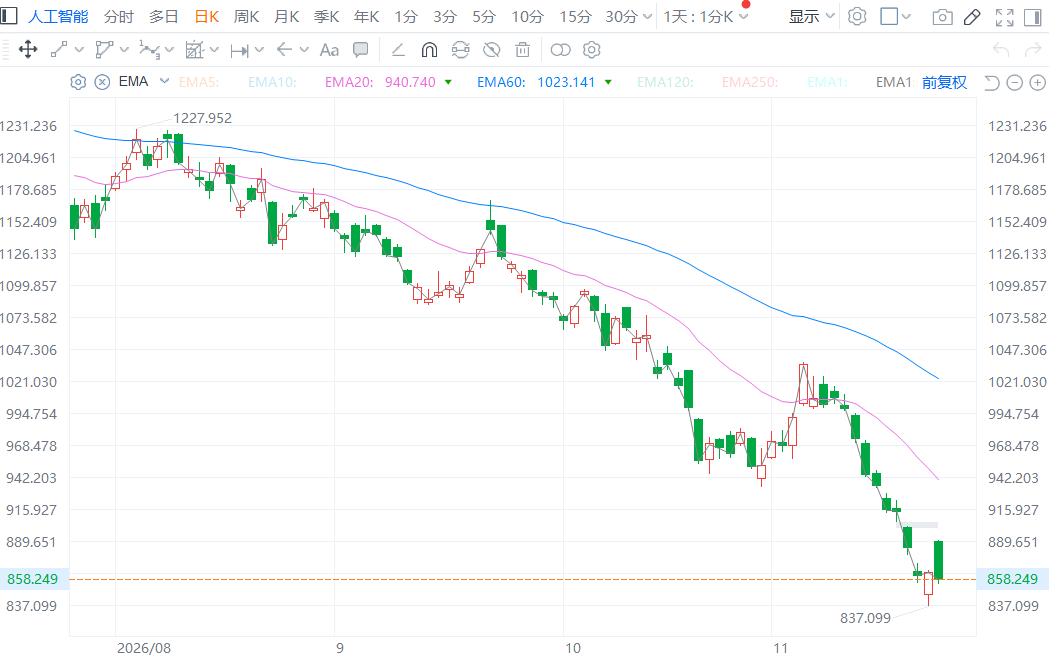
(Image source: Futu)
After just one weekend, the market reversed directly on November 24. Roboco (03757) surged 22% in the intraday session and closed up 9.18% to HK$155.80; Zhongji Xuchuang (03308) surged nearly 15% in the intraday period, then closed up 3.21% to HK$530; Haiguang Xinzheng (01191) surged more than 13% and closed up 3.63% in the intraday; Dingtai Hi-Tech (01377), Shenghong Technology (02476), Jingwang Electronics (03228), etc. also followed the same signal as PCB Higher, closing in the 4%-7% range.
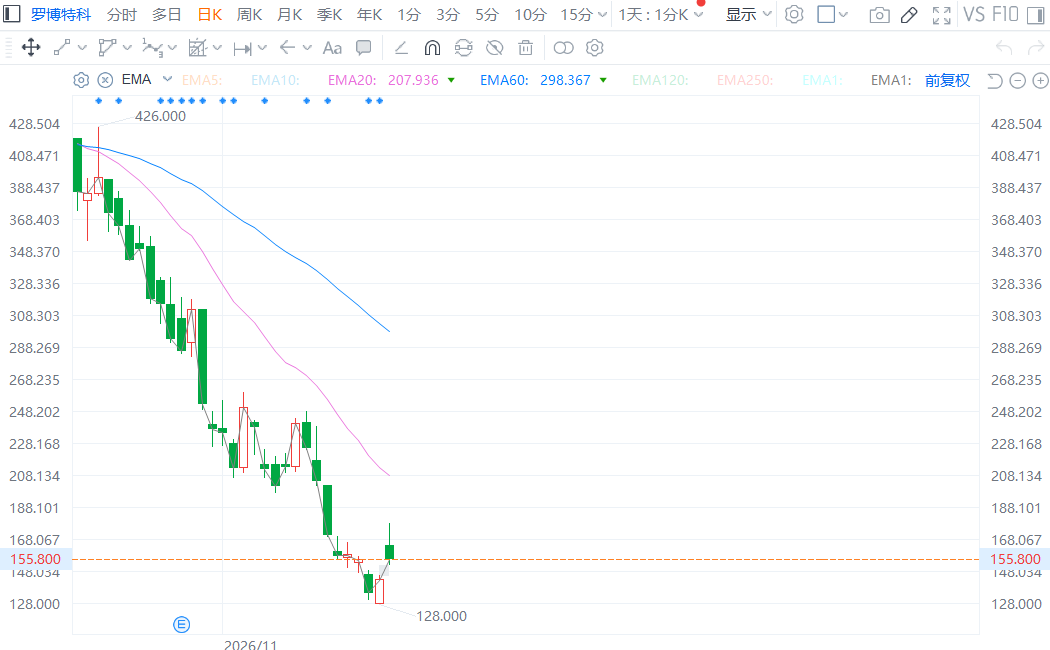
(Roboco Market Trend Chart Source: Futu)
It falls in two days and rises in one day, and the amplitude in a single day tends to be more than ten points. Looking at this round of the market, what is ostensibly igniting is a piece of personnel news — Hwang In-hoon's reinstatement as CEO of Nvidia; what really holds up the sector is the industry's main line of global computing power and capital expenditure, which has not changed.
A piece of personnel news leverages the global computing power chain
The turning point happened on the night of November 23.
On November 23, local time, Nvidia's board of directors passed a resolution reinstating Huang Renxun as president, CEO, and board member, with immediate effect.
After the news came to fruition, Nvidia closed up 31.48% in a single day, recording the biggest one-day increase since 2003. The market value increased by about 952 billion US dollars in a single day, setting a new record for the increase in the market value of global listed companies in a single day.
The Nasdaq Composite Index rose 6.51%, the S&P 500 rose 4.73%, and the Dow Jones rose 3.01%; the Philadelphia Semiconductor Index surged about 14.03%, the biggest one-day increase since 2025. Chip chains such as Micron, Intel, TSMC, and Asmack generally rose.
Why does a piece of personnel news have such a level of lethality and healing power? The key is not “who comes back” itself, but rather that it removes one of the biggest uncertainties in AI transactions.
Nvidia is the core anchor for global AI computing power capital expenditure. The market's judgment on demand for optical modules, PCBs, storage, and computing power equipment essentially follows Nvidia's product pace and capital expenditure expectations. The previous management turmoil cast a shadow over “whether the strategy continues and whether orders are stable” over the entire computing power chain; Hwang In-hoon's return to superposition public statements at the US government level is tantamount to confirming to the market that the direction of AI infrastructure investment has not changed, and the leaders' steering logic has not changed. When uncertainty is removed, valuations previously suppressed by discounts due to concerns will be repaired as quickly as possible.
At the same time, the transmission path is also very clear: Nvidia's stock price soared — overseas computing power chain sentiment was repaired — Philadelphia Semiconductor and individual optical communication stocks linked — Hong Kong stock A shares followed and revalued optical modules, PCBs, silicon, and storage targets. As an offshore market, Hong Kong stocks are particularly sensitive to the emotional transmission of overseas technology leaders. This is also the reason for the high market concentration and rapid financial response on November 24.
What needs to be calm is that the personnel return solved the “confidence problem” and did not directly add an order or financial report. It fixes expectations, and whether expectations can be turned into profits still needs to be verified by returning to the actual operating data of the industrial chain.
Industrial chain opportunities range from “point” to “surface”, and the long-term cycle is measured over decades
Needless to say, the AI hardware industry trend is not fake.
Zhitong Finance has observed that despite sharp stock price fluctuations, the AI hardware industry's industrial prospects are more solid than ever before. 2026 is regarded as the first year of the “AI hardware supercycle”. Its core driving force has been upgraded from simple computing power chips to “network, storage, heat dissipation, and power supply” to fix bottlenecks at the system level.
Optical communication sector: Definitive growth with sharp increases in volume and price.
Optical communication is the first step in this round of computing power expansion to reflect the characteristics of “repairing bottlenecks.” After the rapid release of 800G is completed, the 1.6T has now entered the large-scale shipment stage, and it is not still in the early stages of climbing.
On the one hand, the market size has entered explosive growth. Goldman Sachs raised the industry forecast sharply in its latest global optical module report. It is estimated that the global optical module market size will reach about US$67.7 billion, US$131.4 billion, and US$148.5 billion from 2026 to 2028, respectively, up 33%, 81%, and 115% from the previous forecast. On the other hand, product iteration is also accelerating. CICC predicts that in 2026, the demand for 800G optical modules will reach more than 40 million, and the demand for 1.6T will exceed 20 million.
Among these, Chinese manufacturers dominate the pattern: according to the latest ranking released by Light Counting in May this year, Chinese manufacturers occupy seven seats in the top 10 global optical module suppliers. Zhongji Xuchuang ranked first in the world, Xinyisheng overtook US Coherent to second place, and the total market share of Chinese manufacturers exceeded 60%. This large-scale capacity of midstream manufacturing is difficult to shake in the short term.
Storage sector: The “siphon effect” during the super boom cycle.
Storage is another major line that has changed a lot this year. In the past, the market used to treat GPUs as the absolute core of AI computing power, but the larger the model and the more complicated the reasoning, the more obvious the impact of memory bandwidth and capacity on system efficiency. Computing power increased much faster than DRAM bandwidth, and the “memory wall” began to change from an academic concept to a real engineering constraint.
The imbalance between supply and demand continues, and price increases are still the main theme — according to SEMI forecast data, global storage output will exceed 550 billion US dollars in 2026, surpassing the scale of foundry for the first time, and becoming the number one growth pole for the semiconductor industry. Among them, the HBM market will grow 58% to $54.6 billion, accounting for nearly 40% of the DRAM market. Under the imbalance between supply and demand, HBM's capacity gap will reach 50% to 60% in 2026, and price increases are still the main theme.
At the same time, the price increase was astonishing: according to data released by Jibang Consulting, in the first quarter of 2026, the price of general-purpose DRAM contracts increased 93%-98% month-on-month, and the second quarter increased 58%-63%; NAND contract prices increased 55%-60% month-on-month in the first quarter and 55%-60% month-on-month in the second quarter.
Behind the price increase is a siphon of resources. Samsung, SK Hynix, and Micron continue to sign three-to-five-year long-term agreements with first-tier AI customers to lock in large production capacity until 2028. As computing power giants give priority to seizing advanced production capacity, it is expected that close to half of the world's DRAM production capacity will no longer be open to smaller buyers by 2027. Demand for computing power is draining the highest quality supply from the entire storage industry chain. This is also the most important structural characteristic of this super boom cycle.
PCB: From “using a few more boards” to “upgrading the board itself”
If the optical module solves the data transmission speed, the PCB is more responsible for carrying high-speed signals within the device. Next-generation AI servers and switching equipment place higher demands on the number of PCB layers, materials, and processing accuracy. The products have been upgraded from traditional multi-layer boards to high-grade HDI, higher-grade copper-clad plates, and lower-loss copper foil.
At present, its market space has surpassed 100 billion dollars, and its potential for development is huge. According to Prismark's forecast, the global PCB market will break through the 100 billion US dollar mark in 2026, reach 101.954 billion US dollars, and further increase to 140,516 billion US dollars in 2030, with a compound growth rate of 10.4% during the period.
Specification upgrades also drive value increases — AI server architectures are shifting from CPU platforms to GPU/ASIC clusters, comprehensively raising the technical requirements for PCB usage, number of layers, materials, hole structure, line accuracy and reliability, driving rapid growth in demand for high-multi-layer boards and high-end HDI. The M7-M9 low-loss substrate iteration, accelerated introduction of precision processes such as mSAP, etc., and the trend of high-end industry development is clear. At this point, the PCB industry has bid farewell to homogenized competition at low prices and has officially entered a new stage of high prosperity with technological upgrading, rising value, and sharp rise in volume and price, and has become an indispensable core high growth link in the AI hardware industry chain.
As can be seen from the performance of the various industrial chains mentioned above, the technological revolution has never rewarded only one link. The initial amount of value was concentrated on computing power chips, then network interconnection, PCBs, storage, liquid cooling, power supplies, and data centers began to emerge one after another. Opportunities in the AI industry chain are changing from “point” to “surface.”
Meanwhile, Nvidia CEO Hwang In-hoon also expressed his opinion on this round of AI industry development cycle — he emphasized at the shareholders' meeting that this round of artificial intelligence infrastructure construction cycle will be measured in units of decades, similar to the construction of power grids, transportation systems, and the Internet, and will become the largest infrastructure project in human history.
The above types clearly provide macro-narrative support for the long-term growth of the AI hardware industry chain.
Summarize
At the end of the article, I need to remind you that although the future of the AI hardware industry is promising, it is necessary to separate the two things.
First, at the industrial level, the AI hardware boom is real. Optical module orders were scheduled for the next year, 800G/1.6T accelerated iteration, HBM storage was in short supply, and the number of PCB layers and value for AI servers increased. This isn't a bubble story; it's a real wave of capital spending.
Second, at the price level, sector pricing is weak. When a piece of CEO reinstatement news can leverage a 20% increase, it means that too much sentiment, leverage, and linear extrapolation have been incorporated into the stock price.
This means that the future of the AI hardware industry is real, but it cannot hide the fragility of prices. At the same time, it also shows the industry's current “narrative addiction” in disguise: the more real the industry, the more excited the market; the more excited the market, the weaker the pricing. When the entire market keeps an eye on Nvidia's every whim, it just shows that pricing in this sector is no longer in the hands of the industry.
There will be countless pieces of news in the future: once good, once bad. Those who can get through this cycle are never people who chase 20cm, but those who don't panic when plummeting, are sober when they soar, and always keep an eye on orders and profits.