
From utilities to AI data center energy storage, Fluence (FLNC.US)'s $8.9 billion on-hand order set a record! Citigroup's target price suggests 190% upside
The Zhitong Finance App learned that as of November 23 EST, Fluence Energy (FLNC.US), a large battery energy storage system (BESS) integrator covering utilities, project developers, and AI data centers, rose 9.83% to $3.80. After the financial report was announced, it was once reported at $4.17 after the market, up 9.74% from the regular closing. At 21:09 EST, Blue Ocean's overnight price jumped to $4.40, 15.79% higher than the regular closing price, and about 27.2% higher than last Friday's closing price of $3.46. Citi maintained a “buy/high risk” and a target price of $11 in the quick review released that night, implying room for growth of up to 189.5% over the next 12 months at $3.80.
The company's revenue and gross margin for the fourth fiscal quarter of fiscal year 2026 fell short of expectations, but new orders of US$3.5 billion and ongoing orders of US$8.9 billion both set records, and the daily output of the Houston plant has also risen from 3 to about 10 units. The stock price continued to rise after the financial report, reflecting the market beginning to reassess the possibility that these orders will be delivered on schedule, reduced compensation, and converted into cash.
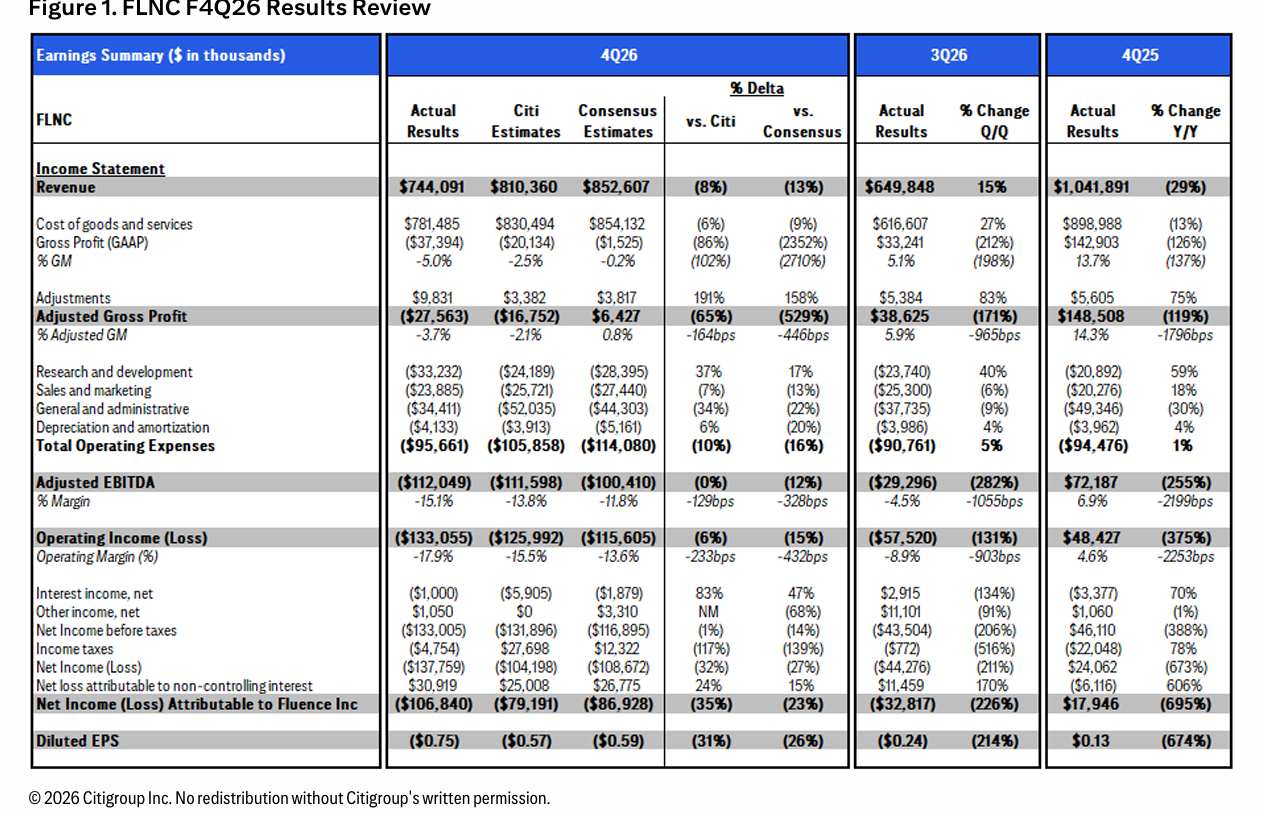
The company's performance in the fourth fiscal quarter was slightly more stable than what Citi feared, and mainly relied on cost controls to offset gross profit pressure. Revenue was US$744.1 million, up 15% month-on-month and 29% year-on-year, lower than Citi's and Visible Alpha's agreed expectations of about 8% and 13%, respectively, and about US$66 million lower than previous management guidance. Sales and service costs were US$781.5 million, higher than current quarter revenue. GAAP gross margin fell to negative 5.0% from 13.7% in the same period last year and 5.1% in the previous quarter. The adjusted gross margin fell to minus 3.7%, lower than Citi's expectations of negative 2.1% and the market's positive 0.8%. It was 5.9% and 14.3% in the previous quarter and the same period last year, respectively. The Citigroup analyst team attributed the bias mainly to a revenue gap due to delayed deliveries and approximately $90 million in contractual compensation, which was higher than the original estimate of $65 million.
The Citigroup analyst team emphasized that overall, expenses weighed down losses, and the quality of profits still depended on project delivery. Operating expenses under GAAP standards were US$95.66 million, which was about 10% and 16% lower than Citibank's and market expectations, up 5% month-on-month and 1% year-on-year. Of this, research and development amounted to US$33.23 million, an increase of approximately US$9.5 million over the previous year, sales and marketing of US$23.89 million, general and administrative expenses of US$34.41 million, and depreciation and amortization of US$4.13 million. The adjusted EBITDA loss of US$112 million was basically in line with Citibank's expectations. It was about US$11.6 million more than market expectations, and also significantly weaker than the previous quarter's loss of US$29.3 million and profit of US$72.19 million for the same period last year.
The company had an operating loss of US$133.1 million in the fourth fiscal quarter and an operating margin of negative 17.9%. After taking into account net interest expenses, other income, income tax, and non-controlling interests, the consolidated net loss was US$137.8 million, and the net loss attributable to Fluence was US$106.8 million. The diluted loss of $0.75 per share was higher than Citibank's estimate of $0.57 and the market's forecast of $0.59. Revenue for the year was approximately US$2.3 billion, roughly the same as the previous year, while adjusted EBITDA changed from profit of US$19.5 million to loss of US$202.8 million.
How many of the $8.9 billion on-hand orders can be repaid in FY2027?
New orders in the fourth quarter increased from US$1.4 billion in the previous quarter to US$3.5 billion, exceeding the full year of fiscal year 2025. About 70% of these were signed in the second half of September, including an order of US$586 million from a hyperscale cloud vendor. The implied average price of new quarterly orders was about US$234/kilowatt-hour.
The company's on-hand orders rose from $6.4 billion last quarter to $8.9 billion, with data centers accounting for about $890 million, or 10%. Potential project reserves increased from 164 GWh to 169 GWh, and the average energy storage time increased from 3.4 hours to 3.8 hours. For projects of equal power, longer time means more battery capacity and device usage. According to Citi's judgment, the scale and length of the US project is still expanding, and recent delivery issues have not shown significant loss of customers.
The acceleration of the Houston plant is direct evidence that Citi is optimistic about order conversion. The factory only produced about 3 sets per day in the first half of September, but now it has risen to about 10 sets, close to the 11 units implied in the original guidelines, and the global manufacturing capacity has reached 25 gigawatt-hours.
The Citigroup analyst team believes that this has increased the credibility of the 2027 fiscal year revenue conversion path of approximately US$2.9 billion. The $2.9 billion conversion reference was disclosed on September 16, and it is also the benchmark for Citi to ask questions from management. Liquidity at the end of September was US$855 million, only about US$6 million lower than at the end of June, but of the remaining revolving credit limit of about US$312 million, the maximum cash withdrawal limit was US$150 million. Citi expects the majority of its $969 million inventory to be delivered and converted into revenue in the 2027 fiscal year. What really determines whether cash pressure can be reduced is whether shipment, inspection, and repayment can keep up with production.
The 11 phone calls listed by Citi focus on four things. In terms of delivery, focus on the pace of transformation of on-hand orders compared to the reference value of US$2.9 billion, whether production capacity restrictions affect US order acceptance, and whether the seasonal concentration of deliveries at the end of the year can be reduced. In terms of costs, ask why R&D is increasing, future cost levels, whether to increase production by adding new contractors or automation, and how much compensation, fines, and climbing costs will occur in fiscal year 2027. On the demand side, inquire about the cloud giant's order details and changes in potential data center project reserves compared to 16 gigawatt-hours last quarter. On the financial side, we are focusing on the leverage ratio contract test applicable from January 1, 2027, annual capital requirements, and how the new management can achieve profit growth while avoiding the use of capital market financing as much as possible.
The $11 target price is betting on profit recovery, and Citi retains the “high risk” investment label
Citi averaged the three valuation results to arrive at a 12-month target price of $11. The Discounted Cash Flow Method (DCF) predicts a cost of capital of approximately 9% and a sustainable growth rate of 3% until 2030, and includes reinvestment in excess of depreciation to maintain growth. The price-earnings ratio method uses a price-earnings ratio of 22 times for the predicted profits of 2029 and 2030 to return the valuation for the next 12 months. The corporate value law uses 12 times EV/EBITDA for the predicted EBITDA for the same two years, then discounted at the cost of capital.
Citi's risk list covers battery competition and technology iteration, large-scale production and new supply contracts, software and third-party application fees, critical components, shipping and delivery delays, and engineering and sales talent. Shortages of spare parts or delays in shipping may delay revenue recognition and may also result in discounts, claims, or order cancellations. Citi also listed valuation variables such as the withdrawal of the founding shareholders, policy support for gas or coal, declining hydrogen energy storage costs, and changes in interest rates or ESG capital flows.
According to information, Fluence is a large battery energy storage system (BESS) integrator. It procures components such as batteries, integrates battery compartments, power conversion, thermal management and control software, delivers complete systems to utilities, project developers, and large electricity customers, and provides operation, maintenance, and asset optimization software. Projects can earn price differences or provide grid services by charging during low prices and discharging during high prices or high load periods. When used in AI data centers, batteries can also buffer sudden load changes and reduce electricity spikes within their power and time limits. The annualized recurring revenue disclosed by the company at the end of the fiscal year was US$171.2 million, indicating that software and services have formed a recurring business, but current performance fluctuations are still mainly determined by equipment delivery and project profit margins.
The US-Iran war raised the value of energy storage in energy security, and the Nvidia partnership was a more direct catalyst for the sharp rise in Fluence's stock price. After the supply in the Strait of Hormuz was disrupted, fluctuating fuel costs increased the value of grid scheduling renewable energy and reduced some peak gas power generation, and also pushed importing countries to pay attention to diversification of power supply sources. At the beginning of June, news broke that Fluence collaborated with Siemens, NVent and Nvidia to develop a data center solution, and the stock price once surged about 44% in a single day. As a result, the market began to take into account a more specific incremental requirement for the company, that is, the data center's procurement of power systems and energy storage equipment that can respond quickly.
Why has the company's stock price continued to fall recently? The main reason for the decline in the period was that production stalled, which turned orders into delays, compensation, and inventory accounts. Automated welding problems at the Houston plant suppressed production. In September, the company reduced the median annual revenue guide from about 3 billion US dollars to 2.4 billion US dollars, and changed the adjusted EBITDA guidelines from a loss of about 10 million US dollars to a loss of about 200 million US dollars. The CEO and CFO were then replaced, and the board of directors established a manufacturing and operation supervision committee. By November 20, the stock price had dropped from $4.68 to $3.46 on Friday of the previous week, down about 26% in a single week. This also explains why the market is paying so much attention to Nissan's 10 sets. If production can be maintained steadily and delivery compensation is reduced, the $8.9 billion on-hand order will have a chance to gradually turn into revenue, gross profit, and cash flow.