
The pre-profit for half a year exceeded HK$240 million. Guofu Quantum (00290)'s main business, hematopoiesis, lays the foundation for digital finance
In the transformation sample of small and medium-sized financial service providers in the Hong Kong stock market, Guofu Quantum (00290)'s recent stock price performance and fundamental movements are forming a logical main line worth reading carefully. On November 17, the company issued a positive profit forecast. It is expected to record net profit attributable to shareholders of about HK$240 million to HK$320 million for the six months ending September 30, 2026, a significant increase over the same period last year of approximately HK$207 million. The next day, the company further disclosed that it had received two conditional approval letters from Malaysia's Labuan Financial Services Authority (LFSA) to establish Guofu Digital Bank Limited and Guofu Digital Exchange Limited to promote digital banking business and digital asset trading operations respectively. Profit forecasts and license developments were implemented one after another in just a few days, compounding the company's previous asset restructuring actions to sell shares in Southern Dongying and return capital to its own public offering platform, causing the market to give positive feedback on its dual narrative of “main financial business hematopoietic+digital finance transformation.”
However, when the repair of the profit statement and the implementation of the regulatory letter met within the same week, did the company's transformation story go from “expectations” to “fulfillment”, or does it still stand at the starting point of verification?
Behind Yingxi's announcement
According to the Zhitong Finance App, financial platforms in the transition period are the easiest to overestimate new stories and underestimate old businesses. What really determines whether it can go far is whether the old business can continue to generate cash flow and profits. The current profit content of Guofu Quantum is reflected in the improvement of its profit structure. According to the company's announcement, profit growth in the first half of the 2027 fiscal year mainly comes from three aspects: profit due to associated companies, net investment income calculated as profit and loss at fair value, and an increase in operating profit from main businesses such as securities brokerage and margin financing. This means that profit improvements are not simply dependent on one-time investment returns or asset disposal, but that the operating income of the traditional financial sector is substantially picking up.
Looking at earlier financial data, this trend can already be traced. For the fiscal year ended March 31, 2026, the company's total revenue increased 103.1% year over year to HK$1,753 million, and total revenue increased 138.1% year over year to HK$2,175 million. Excluding factors such as one-time non-recurrent impairment, adjusted EBITDA reached HK$598 million, an increase of more than 11 times over HK$495.88 million in the previous fiscal year, achieving operating profit of HK$548 million, successfully turning a loss into a profit. Among them, revenue from the securities brokerage and margin financing business increased 472.83% year on year, and revenue from the asset management division increased 90.54% year on year. The overall recovery of traditional financial services provided a solid financial foundation for the company's transformation. In response, some brokerage analysts pointed out that the revenue of the company's brokerage and margin division increased dramatically over the same period last year, and the asset management business also performed well. Profits in the traditional financial sector continued to improve, building a solid basic market for the transformation.
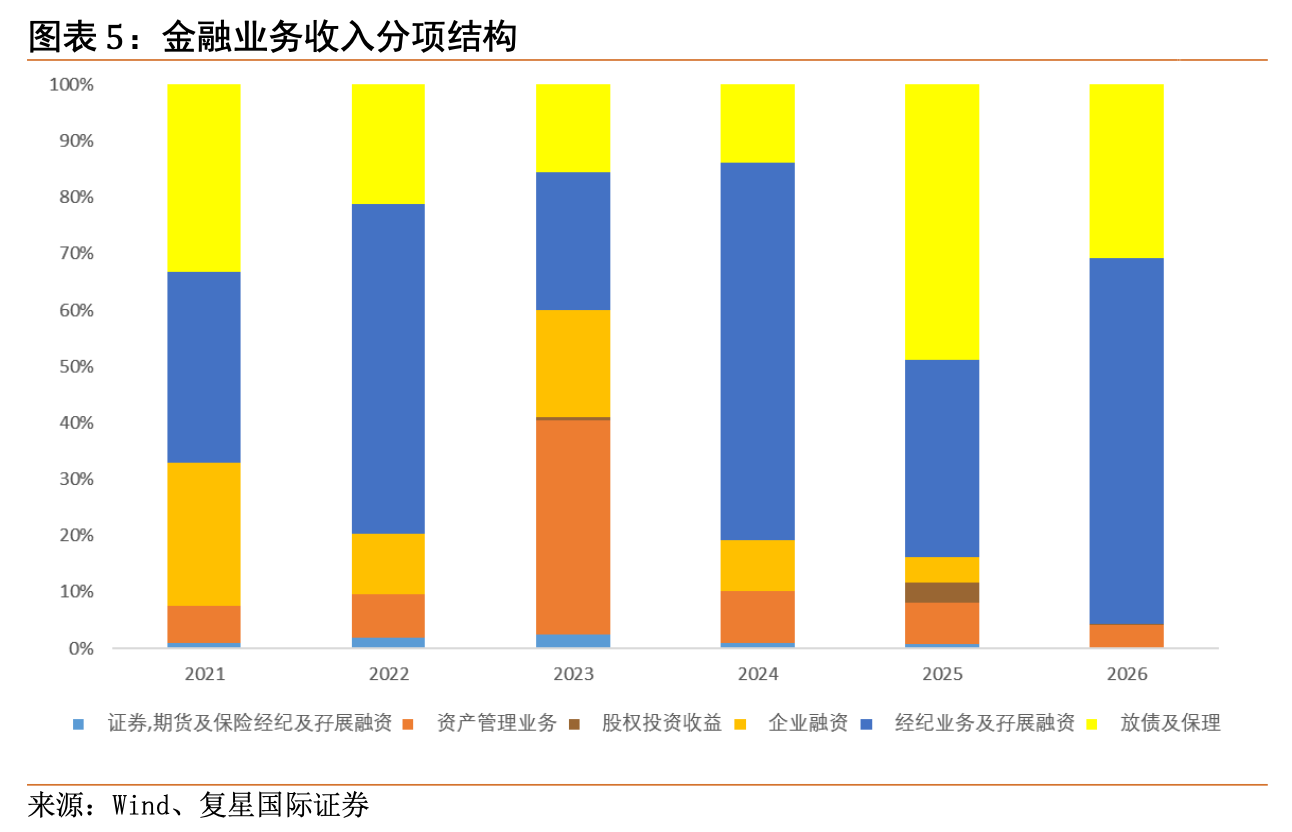
It is worth noting that the company's previous impairment of goodwill due to the acquisition of 22.5% of Southern Dongying's shares once raised market concerns about book losses. However, this impairment is essentially a one-time, non-cash accounting adjustment. It does not involve actual cash outflows; on the contrary, it reflects the significant rise in the company's stock price during the delivery period. According to the Zhitong Finance App, the strong increase in core operating profits after the fog of divesting the books is a reflection of the company's true undertone. The stable cash flow and profit foundation provided by traditional financial services not only strongly supported the company's continued investment in cutting-edge fields such as quantum technology and digital assets, but also provided sufficient capital and ammunition for the subsequent promotion of the Labuan license and the construction of its own public funding platform.
Strategic extension from “Hong Kong full license” to “Hong Kong-Labuan dual hub”
If Yingxi has verified the company's financial resilience, then the conditional approval of the Labuan license marks a key step in its transformation layout at the regulatory level. According to the latest announcement, the Labuan Monetary Authority has granted conditional approval to the company for a Malaysian digital asset finance license, effective October 29, 2026. The company plans to establish two wholly-owned Labuan subsidiaries: GoFinTech Digital Bank Limited (GoFinTech Digital Bank Limited) to handle the banking business in Labuan under section 86 of the Labuan Financial Services and Securities Act 2010 (LFSSA) and conduct digital banking business in accordance with the Labuan digital banking framework; goFintech Digital Exchange Limited (Guofu Digital Exchange Co., Ltd.) was established as an exchange under Part IX of the LFSSA to conduct digital asset trading operations.
Judging from business logic, Labuan, as the Federal Territory of Malaysia and one of the international financial centers, provides a standardized operating environment for digital finance businesses. If the Labuan licensee is finally approved to operate, it will effectively extend the company's offshore financial service capabilities, connect with existing brokerage, asset management and investment banking businesses, and expand customer service from a single transaction to account, cross-border financial and digital asset services. The company currently holds licenses 1, 4, 6, and 9 from the Hong Kong Securities Regulatory Commission, and also has cross-border business qualifications such as QFI, CIBM, QDIE, QFLP and Bond Connect. The promotion of the Labuan license means that the company is building a “Hong Kong-Labuan” dual hub license layout to further expand the digital finance compliance business landscape in Southeast Asia.
Of course, what needs to be clarified is that this approval is only a conditional approval and does not constitute a full operating license. According to the announcement, the company is required to meet all regulatory prerequisites within six months from the date of the approval letter. The official license and license to operate must be completed by the Labuan Monetary Authority after completing on-site verification visits, and digital transactions require the relevant appointment approval of the Ministry of Finance of Malaysia before they can be granted. From obtaining conditional approval to official opening, it is still necessary to cross multiple hurdles such as compliance system construction, technical system implementation, capital implementation, and continuous supervision and acceptance. However, even so, the conditional approval itself is already an initial approval of the company's qualifications and business framework at the regulatory level, removing important institutional barriers to its subsequent commercial operation.
At the same time, the restructuring of the company's assets is progressing simultaneously. On November 13, the company announced that it plans to sell 22.5% of Nanfang Dongying's shares in cash for HK$1.2 billion and return the capital to its own public equity platform; its open-ended fund company and two public equity sub-funds were approved by the Hong Kong Securities Regulatory Commission on September 30. If the transaction is successfully completed and the relevant dividends are fully recovered, the company can receive up to HK$1,451 billion in cash inflows to reserve seed capital for its own public offering business. This move marks the company's shift from participating in shares to self-operated asset management platforms to directly obtain sustainable asset management income that can be compounded. It is also a typical path for the transformation of Hong Kong stock asset management institutions in recent years.
Overall, Guofu Quantum is currently progressing collaboratively along four main lines: traditional securities and asset management businesses provide stable cash flow, profit improvement in the medium term, Labuan regulatory approval opens up room to imagine the growth of digital finance in Southeast Asia, and the sale of shares in Southern Dongying provides sufficient capital and ammunition for business transformation. Among small and medium-sized financial service providers in the Hong Kong stock market, the company is highly recognizable by relying on Hong Kong's full license to expand digital finance and the Southeast Asian market. High revenue growth and medium-term profitability provided basic financial support for the transformation story. It is worth mentioning that since November, the company's stock price has increased by more than 20%, and it can be seen that market sentiment is also reflected.
The degree of implementation of subsequent valuations will depend on the progress of implementation of Labuan's official license and continuous improvement in profit quality, but the direction of transformation is clearly visible. The double verification of fundamentals and regulations is saving momentum for the company's value revaluation.