
New players take their seat and enter the industry: Yurong Group (01536)'s chess game only reached the midfield
In the Hong Kong stock capital market, announcements are often the end of the story, and position migration and chip flows are the prelude to a capital drama written in advance.
And Yurong Group (01536) is exactly the same. With a series of coherent actions such as the old controlling party leaving the market calmly, the new main force taking on chips, consolidating the capital base, and superimposing a strategic narrative of intelligent upgrading, it is silently pushing its capital drama from the market to the front of the stage.
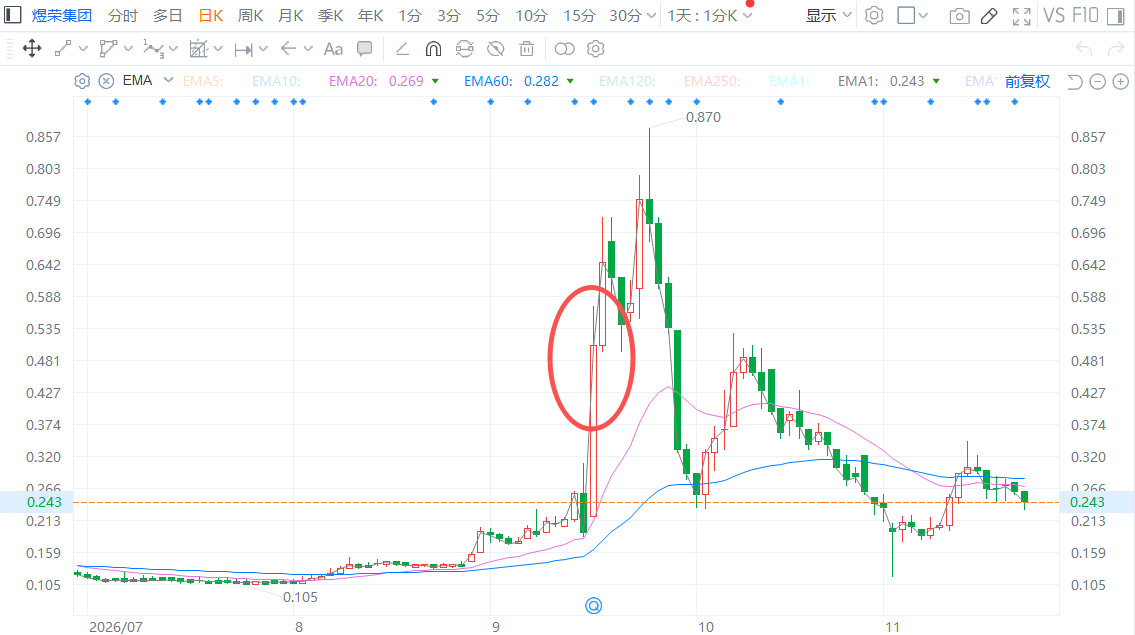
At the same time, its stock price also underwent a drastic revaluation — after the release of the control delivery news on September 15, it soared by more than 70% in a single day, and then the market continued to ferment. The short-term cumulative increase from September 16 to 17 was nearly 2.4 times. At one point, it reached HK$0.72. The transaction also alternated with emotional ups and downs, reaching a total of HK$785.509 million over the two days. By the close of trading on November 23, its share price had fallen back to HK$0.243.
(Market source: Futu)
According to Zhitong Finance, Yurong Group is an investment holding company mainly engaged in the manufacture and sale of downhole drilling tools. Affected by the contraction of regional projects, the Group's operations have been under pressure in recent years: for the fiscal year ending March 31, 2026, it recorded revenue of HK$178 million, a year-on-year decrease of 17.9%; losses attributable to company owners narrowed to HK$4.403 million. The downturn in fundamentals has also reserved a window for capital changes and a revaluation of expectations.
However, the stock price revaluation only answered “whether the market believes it or not.” Whether this capital layout, which is progressing step by step and pointing to long-term transformation, can be completed from expectations to reality is the real test question to be solved.
Collect first, then launder, then set the price, complete the capital shift in three steps
Looking at the intersecting of the three lines of transfer, share supply, and stock price, it can be seen that the Yurong Group's market, fueled by the exchange of control rights, is not short-term emotional hype, but rather a rhythmic shift of capital — that is, the chips are collected first, the structure is cleaned up, and finally the pricing power is returned to the market.
Let's take a look at the chip route first.
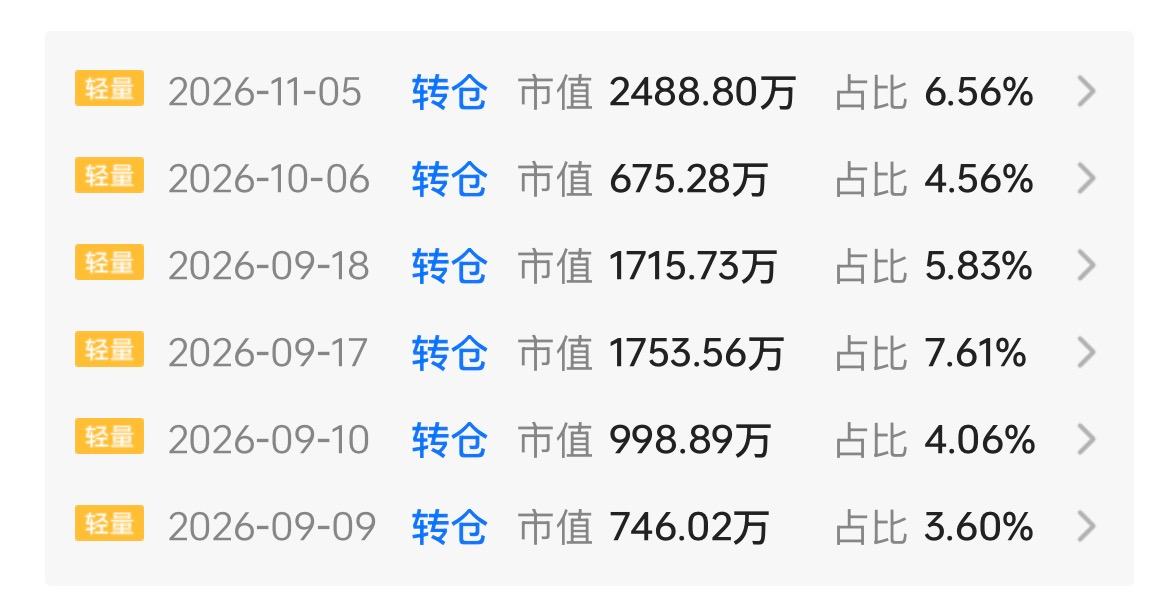
On September 17, 2026, 26.974 million shares were transferred from Jinfeng Securities to Futu Securities International Hong Kong, with a market value of HK$17.5356 million, accounting for 7.61%; on September 18, 124.46 million shares were transferred from Jinfeng, and ABN AMRO Clearing Hong Kong transferred 7.324 million shares, with a transfer market value of HK$17.1573 million, accounting for 5.83%; on November 5, 71.928 million shares were transferred from Huanghe Securities to Citibank, accounting for HK$24.888 million. 6.56%
(Image source: Zhitong Finance)
Jinfeng and Huanghe Securities were transferred out, and Futu, ABN, and Citibank transferred in — this is not an ordinary position adjustment, but a migration of chips from traditional brokerage firms to internet brokerage firms and international custodians. Futu represents retail attention, and ABN and Citibank represent cross-border hosting and institutional interfaces. On the surface, these are three scattered transfer records; looking deeper, this is a chip migration roadmap — it points not to sell, but to close. Centralizing the transfer of large amounts of chips to specific accounts is to gather and lock down scattered shares and reduce scattered game costs in subsequent promotion, which is equivalent to “putting up a good magazine and stabilizing the chassis” for control changes.
Let's look at structural cleaning.
On July 24, 2026, Yu Rong Group announced a share offering based on the “1 to 3” benchmark, issuing a maximum of 1,368 million shares at HK$0.1 per share, with a maximum net income of about HK$135 million. After the share offering was completed, the total share capital surged from 456 million shares to 1,824 million shares. The drastic dilution of the original shareholders' rights is on the surface of financing; the depth is restructuring: old chips have been diluted, new space has been opened up, there is room for maneuver in subsequent shareholders' restructuring, and it also clears up barriers for new shareholders to enter.
The third line is stock prices.
From September 16 to 17, its stock price surged nearly 2.4 times cumulatively. The surge in a single day can be explained as emotion. If it exceeds 2.4 times for two days in a row, it is not something that can be conveyed by the word “emotion.” More importantly, the peak of transfers coincided with the explosion in stock prices, indicating that capital movements have entered the “chip redistribution” stage: diversification of the shareholder base, increased transaction liquidity, and marketization of pricing mechanisms. Three events occurred simultaneously, paving the way for subsequent financing, mergers and acquisitions, or shareholder restructuring.
The bulletin lines also intersect at the same window. “1 for 3” shares were offered in July; in September, the controlling shareholder Caihui sold 176 million shares, and Hellobaby entered 29%; the AI intelligent upgrade announcement was then implemented. The intersection of the three lines of stock price line, transfer line, and announcement line shows that Yu Rong is not “news-driven”, but “structure-driven” — there is chip collection, then structural cleaning, and finally market-based pricing.
At this point, having understood the trend of the above three lines, I can truly understand Yu Rong: for the company, this is not a simple round of stock price changes, but a “pre-engineering” of capital operation: collecting chips first, then cleaning up the structure, and finally starting a value revaluation.
Saiki leaves, Hellobaby enters
The front engineering paved the track, and only then did the transfer of control officially enter the platform. The solution to chip collection and share capital expansion is “how to stabilize the plate”; the next answer is “who to give the steering wheel to.”
From September 8 to 15, 2026, the original controlling shareholder, Caihui Investment Co., Ltd. (Caihui) sold a total of 176 million shares, accounting for about 38.54% of the company's total issued share capital. Following that, Caihui's shareholding ratio plummeted from 41.27% to 2.73%, and it is no longer the company's controlling shareholder.
In this major shareholding transfer, the most critical successor is Hellobaby International Limited. On September 15, 2026, the company purchased 132 million shares from Caihui at a price of approximately HK$0.454 per share, accounting for 29.00% of the company's total issued share capital, and became the main shareholder of the company.
Notably, the 29% shareholding ratio is a very sensitive figure — it is only one step away from the 30% mandatory comprehensive offer threshold stipulated in Hong Kong's “Code of Corporate Acquisitions, Mergers and Share Repurchases”, but it did not trigger a full offer. This “stepping on the line” shareholding arrangement not only ensures that new shareholders have significant influence over the company, but also avoids the huge capital and time costs required to trigger an offer, leaving room for flexibility for subsequent operations.
After the change in control, the “blood exchange” of the governance structure followed.
On November 9, Mr. Liu Qiang was appointed as the executive director of Yurong Group. Liu Qiang is the beneficial owner of Hellobaby International Limited, which holds about 29% of the company's shares. His addition marked the formal entry of corporate governance into a new era, providing a personnel foundation for subsequent industrial integration and capital operation.
On November 16, Yurong Group issued an announcement stating that it plans to intelligently upgrade existing Group products and extend related technology to products in other fields after artificial intelligence technology matures. This is far more than a business upgrade, but a declaration to “change the track.” Comparing Stress Holdings and Contron, the new shareholder Hellobaby is likely to have an industrial background in semiconductors, artificial intelligence, or related fields. The intention is to use this listing platform to introduce new industrial resources and achieve “industry+capital” collaboration.
According to reports, the ultimate beneficial owner of Hellobaby International Limited is Mr. Liu Qiang. Liu Qiang has over 26 years of experience in LCD displays, touch screens, wireless video transmission, IoT electronic products and other industries as well as brand operation and enterprise management. He founded Shenzhen Bennett Technology Co., Ltd. in 2005 and obtained a graduate diploma in listed finance and capital markets from the China School of Business at the University of Hong Kong in 2025. This background clearly suggests its purpose of joining Yurong Group: not simply to hold, but to lay the groundwork for the platform to later introduce industrial resources and activate stock value.
From Caihui to Hellobaby, what has changed is the shareholder register, and what has not changed is the underlying logic of platform value revaluation. The change of control was completed by “name points,” “personnel,” and the completion of the strategic upgrade was “direction.” The combination of the three is the real affirmation of power — the old game is cleared, the new player is in place, and Yu Rong's capital chess game has only just entered the middle market.
epilogue
The capital game of Yurong Group is clearly visible: starting with chip collection, changing control to key execution, and upgrading “artificial intelligence” technology as the main story line. The ultimate goal is to revalue the industry and increase capital value of this listed platform.
The core logic of this operation is in line with cases such as Stress Holdings and Cantelon: within the compliance boundary, by quickly obtaining control of listed companies, avoiding the lengthy and uncertain nature of traditional IPOs, efficiently obtaining financing carriers, and paving the way for introducing new industries and developing new markets.
Key future observations are: Hellobaby's ultimate background and whether its industrial resources can be successfully injected; whether the company can effectively manage the risk of high shareholding concentration while maintaining control; and whether “intelligent upgrading” can be transformed from a single announcement into a real performance growth point, thus completing the closed loop from capital story to value creation.
Only when the strategic narrative is implemented in performance and expectations are settled into assets will the Yurong Group chess game really come to an end.