
Nearly a trillion dollars worth of blood was returned overnight! Hwang In-hoon's lightning reinstatement detonated global AI stocks. Traders lament that “no one can write this script”
The Zhitong Finance App learned that the news that former Nvidia (NVDA.US) CEO Huang Renxun had returned to the helm suddenly fell a few minutes before the opening of the US stock market on Monday, immediately igniting a retaliatory rebound that could go down in history. On Monday, Nvidia's stock price jumped high when it opened, and eventually closed up more than 31%, setting the record for the biggest one-day increase in 23 years and driving the market to the strongest single-day market since April 2025.
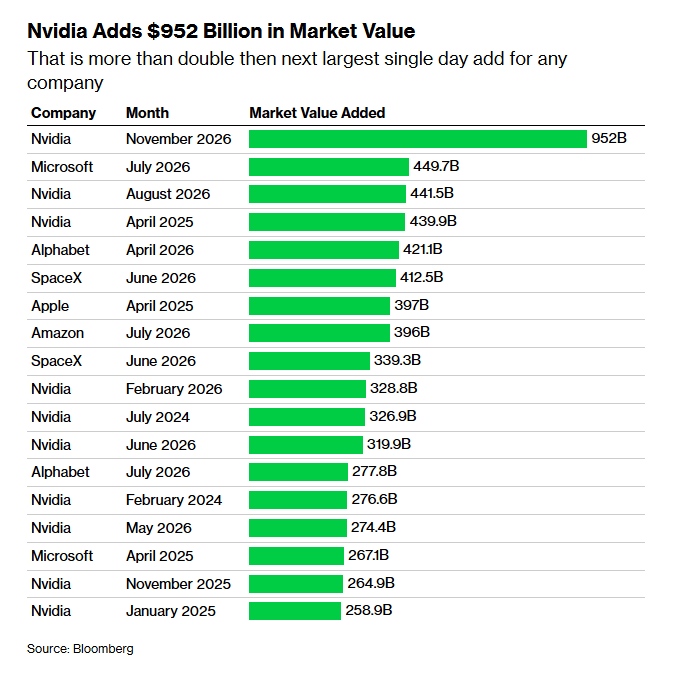
The S&P 500 index surged 4.7% on the same day, ending the previous seven-day decline, recovering the loss of more than half of last week's collapse; the Nasdaq 100 index, which is dominated by technology stocks, surged 6.9%, and its market capitalization increased by more than 2.5 trillion US dollars in a single day. Nvidia led the “Big Seven” portfolio to rise 7.5% overall. According to statistics, this rise increased the chipmaker's market capitalization by more than 952 billion US dollars in a single day, the highest increase in the market value of any company in a single day on record.
A turning point that no one expected
“I didn't expect this kind of plot reversal,” said Ken Mahoney, CEO of Mahoney Asset Management. “You can't write a script like this at all, and my popcorn won't be enough.”
The rebound came after the S&P 500 and Dow Jones Industrial Average both entered a technical pullback range on Friday — the so-called pullback, that is, a retracement of at least 10% from recent highs. Against the backdrop of the Hwang In-hoon scandal unfolding, NASDAQ has just experienced its worst week since 2020.
According to reports, Hwang In-hoon was ousted due to his multiple extramarital affairs, and Nvidia's weekly decline on the day he left office was the highest since 2008. On the trading day before resigning as CEO, Nvidia closed at $173.73, while the stock hit $171.50 intraday on Monday, a sharp recovery from the recent low of around $125 during the storm. Vaneck Semiconductor ETF, which tracks the chip sector, closed at $506.96 the day before Hwang In-hoon's resignation. Momentum declined after rising to an intraday high of $469.35 on Monday.
US President Trump, who personally lobbied Nvidia's board of directors to reinstate Hwang In-hoon, praised the latter's return — even when the big news came to fruition, the company's investigation into the tech giant was still ongoing. “I have always communicated directly or indirectly with the board of directors, and I feel strongly about this,” Trump said in a telephone interview.
Take the lead and move your whole body
The reason why Nvidia's sharp fluctuations can affect the savings of hundreds of millions of Americans is rooted in its huge index weight. The company accounts for more than 6% of the S&P 500 index and nearly 7% of the Nasdaq 100 index. Fluctuations in its stock price directly affect 401 (k) and IRA retirement accounts that invest heavily in index funds and target-date funds.
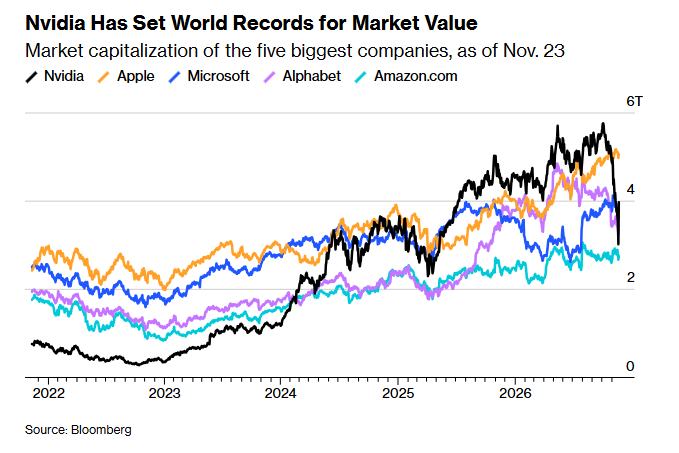
Before OpenAI released ChatGPT on November 30, 2022, Nvidia was still a company focused on gaming graphics chips. It was Hwang In-hoon's strategic choice to transform into an AI “accelerator” that made it one of the companies with the highest market capitalization in the world. In mid-2024, Nvidia surpassed Alphabet (GOOGL.US), Amazon (AMZN.US), and Microsoft (MSFT.US) in market capitalization for the first time; in 2025, it also became the first company to break the 4 trillion and 5 trillion US dollar market capitalization marks successively. At its peak in early October this year, its market value once approached 6 trillion US dollars, surpassing the total economy of Germany alone.
Meanwhile, on November 20, after Wong In-hoon's resignation, Nvidia's market capitalization once shrunk to about 3 trillion US dollars.
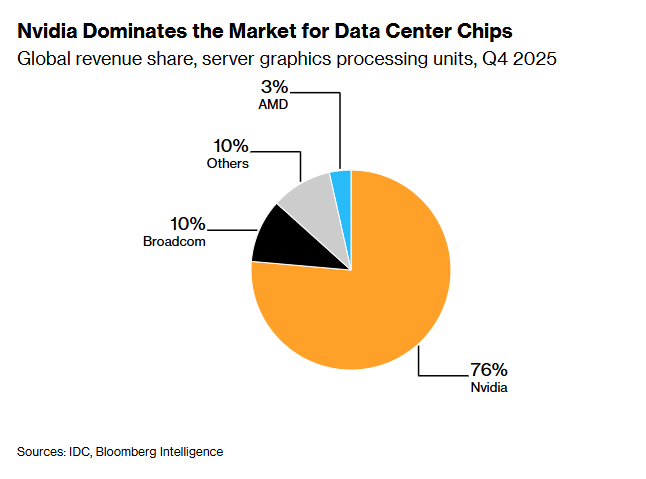
Nvidia has an overwhelming share of AI chip sales, due not only to its first-mover advantage, but also to its pace of launching new designs every year and strong procurement capabilities. But leadership turmoil comes at a sensitive time when competition is intensifying: competitors and even some customers are racing to develop AI chips, and a large number of startups are also raising billions of dollars to bet on the next breakthrough.
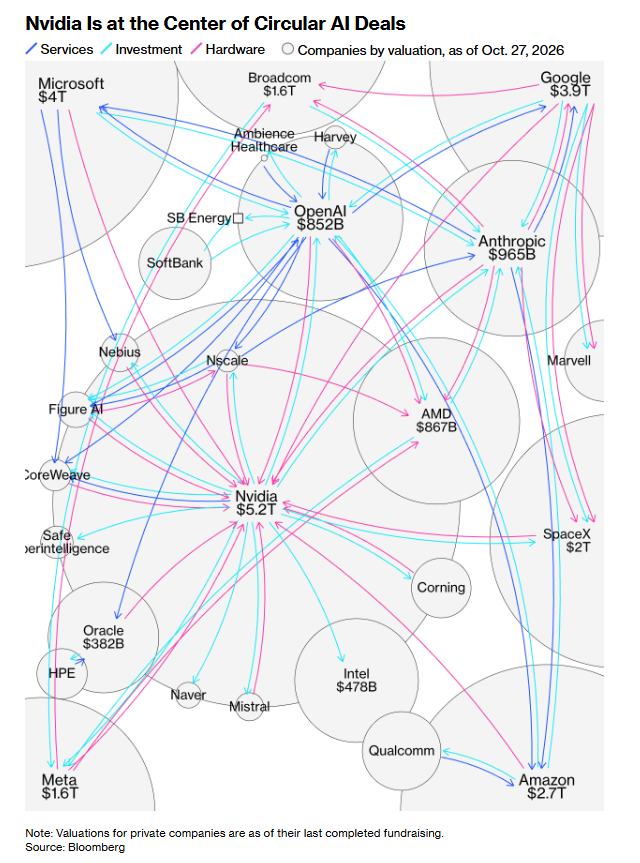
In addition to its role as a chip supplier, since 2024, Nvidia has also become a key funding provider for the AI industry, investing heavily in platform developers and AI data center builders such as OpenAI, Musk's SpaceX (SPCX.US), France's Mistral — while fueling the expansion of AI infrastructure, this symbiotic relationship has also stimulated demand for Nvidia chips.
Carnivals, doubts, and future suspense
On Monday's market, Tesla (TSLA.US, up 11%), Meta (META.US) and Alphabet both rose more than 6%, and an ETF tracking chip maker rose nearly 14%. AI concept stocks strengthened across the board, from chip maker AMD (AMD.US) to electrical equipment supplier Vertiv (VRT.US), to CoreWeave (CRWV.US), which bought Nvidia chips to sublease cloud computing power — the latter surged 22%.
However, this wave of increases driven by “a sigh of relief” and even “cheers” cannot cover up the clouds that still hang over Nvidia's deal with AI as a whole.
Mike Khouw, a yieldmax strategist under Tidal Financial Group, pointed out in an interview on Monday that Hwang In-hoon is not Nvidia's only problem. There are still many weaknesses in AI transactions as a whole, and credit-sensitive companies still face the risk of stalling, and investors should be wary of this.
Dan Niles, founder of Niles Investment Management, has been buying on dips for several weeks, and the fund manager who has used Nvidia as his largest position confessed that he is cutting his positions. He said, “All of the problems that existed before Hwang In-hoon resigned, but now none of them have disappeared.”
Although the Trump administration assured Nvidia's board that the incident did not involve national security, lawmakers in Washington are demanding responses, and Wall Street investors are strategically re-examining how the tech sector is participating.
According to information, Hwang In-hoon is scheduled to testify before the Senate Banking Committee on December 3. The issue of the high cost and high risk of AI construction is still unresolved.
Massachusetts Democratic Senator Elizabeth Warren worded harshly in a statement issued on Monday: “The reckless decision to restore Hwang In-hoon to the position of CEO does not change the fact that Wong In-hoon, Nvidia executives, and the company's board of directors still need to account to Congress about the company's compliance with US export controls. The Trump administration also needs to explain to Congress which senior US government officials actually provided what kind of 'opinions' to support their reinstatement.”
Democrat Richard Neal, a senior member of the House Fundraising Committee, emphasized the importance of congressional oversight in determining the way forward. Given the size of Nvidia's international business, the final results of the congressional investigation are likely to have a decisive impact on the company's long-term value as an investment target. “The core issue is export control,” Neal said on Monday. “Congress is not subordinate to the current president or any president when it comes to trade and tariff policies.”
Institutional views are clearly divided. Morgan Stanley strategist Michael Wilson advised investors to “actively increase their positions” on Monday, believing that the current valuation of the S&P 500 already implied negative profit growth in 2027, while the bank expected a 14% increase; the J.P. Morgan trading department was cautious about US stocks after the S&P 500 entered a pullback.
According to the observation of Thomas Thornton, president of Hedge Fund Telemetry, Goldman Sachs tracks the most dense basket of stocks for short surged 7.7% intraday on Monday, reflecting that some bears were forced to make up.
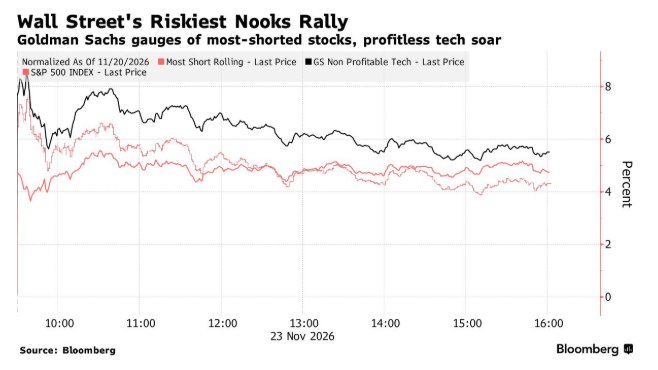
Jeff Buchbinder, chief stock strategist at LPL Financial, said, “If the S&P 500 stabilizes around 7,000 points this week, we will consider increasing our positions, but we are currently on hold and waiting for the dust to settle.” The agency maintained a slight overallocation of US technology stocks and increased its holdings of energy stocks to hedge against the risk of another decline, while increasing dividend-paying healthcare stocks. “We need more clarity on the AI story and Nvidia side.”
Data center ban still in suspense
Many of the same Democrats are also calling for a slowdown in data center construction. This topic is quite appealing to the public, and partly contributed to the “blue wave” that led to a rift in AI transactions earlier this month. Dan Niles put it bluntly: “You have to gradually digest what these data center bans actually mean. Now I think the market will continue to rise, but for those with data centers as the core, I'm no longer so sure about future market trends.”
It is worth mentioning that on Monday, a large number of Wall Street analysts were still in a hurry to raise Nvidia's ratings after Hwang In-hoon's reinstatement. Most of the target prices returned above $200, with the highest reaching $270. However, many traders believe that the rebound in stock prices may have aborted before these targets are reached.
Michael Burry, known for his shorting — who made a huge profit with put options during Nvidia's collapse — told his Substack readers that this round of rebound could be “extraordinary” given the poor overall volume due to the Thanksgiving holiday this week.
But he also believes that the rally will eventually lose momentum. “Hwang In-hoon's return without more information will probably only pull NVDA back to the high range above $100,” Burry wrote. “With the information I have so far, I'm not going to short the stock price until it approaches or even breaks through $200.”
Undercurrents surged during the holiday week
Finally, trading will also be shortened this week due to the Thanksgiving holiday, and light liquidity may amplify fluctuations. S&P 500 trading volume is more than one-third below the 30-day average. The Cboe Volatility Index (VIX), which measures market pressure, once surged to a 19-month high of nearly 36 last weekend, then fell below 27 on Monday. The market was closed for Thanksgiving on Thursday and closed early on Friday.
In terms of economic data, this week will be followed by Tuesday's consumer confidence index, the PCE deflator index favored by the Federal Reserve on Wednesday, consumer spending for October, and revised GDP for the third quarter. Retailers such as Best Buy (BBY.US) and Dollar Tree (DLTR.US) will release earnings reports later this week to hand over strong profit guidance ahead of the critical holiday shopping season or bring much-needed help to the market.
Investors are also closely monitoring the results announced by Dell (DELL.US) on Tuesday to assess the sustainability of AI infrastructure investments. After the US stock market on Monday, another AI server manufacturer, HPE.US (HPE.US), announced strong Q4 earnings, but since its guidelines fell below the market's most optimistic expectations, some investors betting that the AI boom would bring stronger growth to the company were disappointed, and the stock fell nearly 8% after the market.
Furthermore, Anthropic (ANT.US), which went public last week and received much attention, has also increased market volatility. The Claude chatbot developer rose 17% from the issue price on the first day of listing, but closed down 8.5% last Friday, and its unanticipated performance dragged down the entire stock market; on Monday, the stock fell another 1.4%, contrary to the overall rebound in the tech sector.