
Elon Musk Equated It to ‘Taking Michael Jordan Off Your Team.’ 11 Days Later, Jensen Huang Is Back. Here’s What It Means for NVDA Stock.
On Nov. 23, Nvidia (NVDA) reinstated Jensen Huang as president, CEO, and board member, effective immediately. The board voted unanimously to bring him back following a series of discussions and meetings with Huang, after which it was satisfied with his “candor and ability to lead Nvidia.” What's funny is that just six days earlier, the board said it had no intention of reinstating him and was alarmed by his lying and “lack of candor.”
Jensen Huang had said that he would love to have his old job back. In his first statement since resigning, he said he “would be honored to answer these calls and return as CEO.” Hours later, during Nvidia's earnings call, the chairman said the board had no intention of bringing Huang back as CEO.
Elon Musk was among the loudest voices calling for his return. In an interview, he spoke quite strongly in Huang's favor, saying Nvidia made a mistake letting him go. Musk said Huang is irreplaceable and even gave a hypothetical of the Chicago Bulls being on a winning streak and then deciding to take Michael Jordan off the team. He stated that Huang used to single-handedly take on several roles, including handling supply chain deals and building decades-long relationships with key suppliers. Interestingly, he told the interviewer that many people at Nvidia absolutely love Huang and have even turned down better offers due to their loyalty to Huang. Musk admitted that Huang has “certainly made some mistakes,” but he didn't think Huang is disloyal to the United States.
About Nvidia Stock
Nvidia makes the chips that most of the world's AI runs on, along with the networking gear and software that tie them together. Huang co-founded the company in 1993 and ran it for over three decades, which is a big reason why both his exit and his return have moved the stock so much. Nvidia is based in Santa Clara, California, and is once again led by co-founder and CEO Jensen Huang.
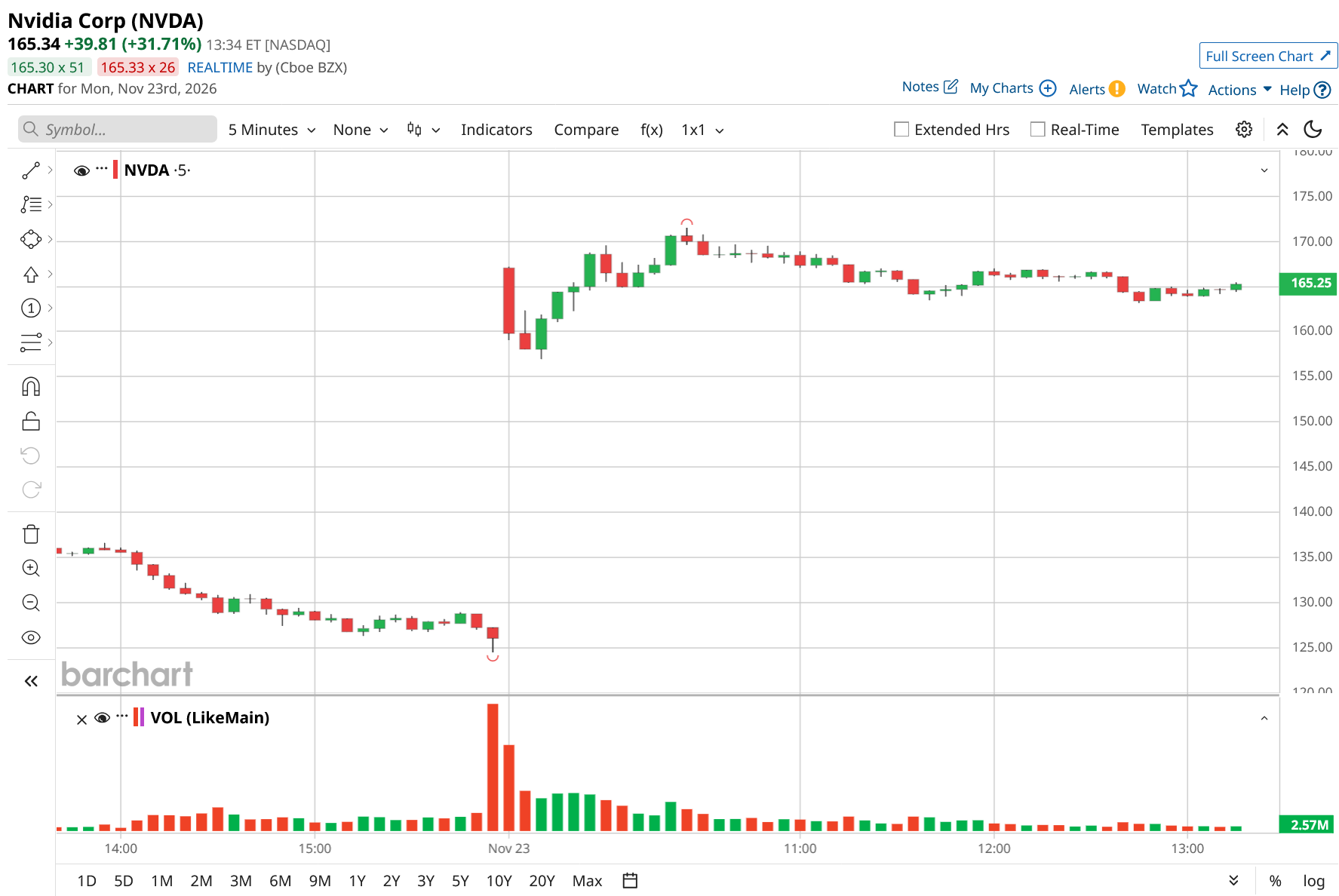
Nvidia's stock is down 12% this year, far underperforming the S&P 500 ($SPX), which is up about 6%. Most of the damage has come recently, with the stock falling 22% in the past month. The broad AI chip stock selloff, Huang's scandal and resignation, and worries about AI spending all weighed on the stock. But NVDA stock has surged about 32% today after the news of Huang's return.
Nvidia now looks cheap by its own standards. Its forward non-GAAP price-to-earnings (P/E) of 17.70x is about 57% below its five-year average of 41.05x, and its forward price-to-sales (P/S) ratio of 9.7x is around 50% below its 19.32x average. Analysts expect earnings to roughly double this fiscal year and grow another 72% in fiscal 2028, pushing the P/E down to about 10.3x. The balance sheet is strong too, with $97.73 billion in cash against $38.15 billion in debt. Even after the Nov. 23 jump, the stock still trades well below its usual valuation. Much of that discount came from the leadership uncertainty, and with Huang back, I think the gap could keep closing.
Why Nvidia's Board Changed Its Mind
Chairman Harvey Jones is now saying that the board thinks Huang is the “right person to lead Nvidia.” He further stated that the decision was made keeping the best interests of stockholders, employees, partners, and customers in mind. The national security worries also seem to have eased. President Trump said the government had “no reason to believe” Huang's return posed a national security risk. Colette Kress, who stepped in as interim CEO, is going back to her role as CFO.
That said, the security questions haven't fully gone away yet. Huang is still due to answer questions in a closed-door interview with three House committees on Dec. 1, including the Select Committee on China. They are keen to know more about the national security concerns tied to his departure, including whether Nvidia chips allegedly reached China through a Singapore company linked to alleged spy Alice Huang.
Q3 Was Another Record Quarter
Nvidia reported its third-quarter fiscal 2027 results on Nov. 17. Revenue came in at $115.8 billion, roughly double the same quarter last year and well above management's own guidance of $108 billion. The data center business alone brought in $107.6 billion, up 110% from a year ago. Adjusted EPS of $2.68 also beat the $2.48 consensus estimate.
For the fourth quarter, the company guided revenue of about $130 billion, and that outlook doesn't assume any data center compute revenue from China. Then interim CEO Colette Kress also told investors that Nvidia's product roadmap remains on track.
As I wrote when Nvidia reported those first earnings without Huang, the company posted record numbers. But those results don't mean the company can function just as well without him, because Huang led that quarter from start to finish, even though he wasn't there to present the results. Now, the $130 billion forecast for next quarter is again Huang's to deliver.
What Do Analysts Expect for NVDA Stock?
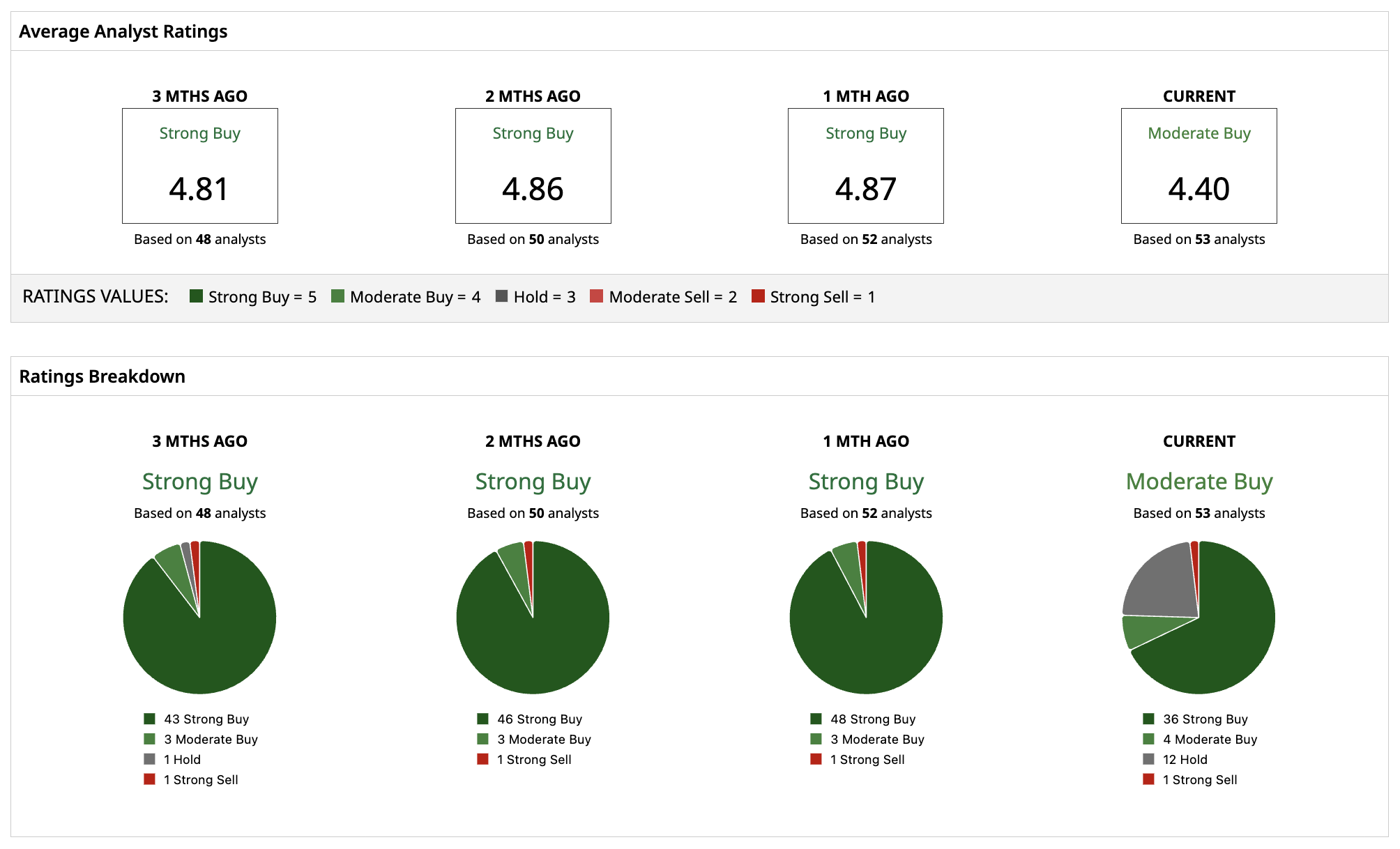
Based on 53 Wall Street analysts, NVDA stock holds a “Moderate Buy” rating. Even after the recent rally following Huang's return, its mean price target of $244.23 indicates about 48% upside.
On the date of publication, Jabran Kundi did not directly have a position in any of the securities mentioned in this article. All information and data in this article is solely for informational purposes. For more information please view the Barchart Disclosure Policy here.