
Dear HPQ Stock Fans, Mark Your Calendars for November 24
HP (HPQ) is a familiar name in households worldwide, with its computers, laptops, and printers becoming staples of everyday life. Over the past year, shares of the personal computing and printing giant have delivered solid gains, buoyed by resilient demand for commercial PCs and growing enthusiasm for artificial intelligence (AI)-enabled devices. However, mounting competition and escalating memory and storage costs have presented fresh challenges, putting pressure on profitability.
Now, all eyes are on HP as the company prepares to report its fiscal 2026 fourth-quarter results on Tuesday, Nov. 24, after the market closes. While HP surpassed Wall Street's expectations in its previous earnings report, rising component costs and softness in its printing business continued to weigh on margins. Strong PC sales, meanwhile, prompted the company to raise its full-year earnings guidance.
With another earnings update just around the corner, investors will be eager to see whether PC momentum can sustain growth, how effectively HP is navigating cost pressures, and what management signals about its prospects heading into fiscal 2027. Thus, ahead of the company’s fourth-quarter earnings report, here’s a closer look at the stock.
About HP Stock
HP traces its origins to 1939, when Bill Hewlett and Dave Packard founded Hewlett-Packard in a small garage in Palo Alto, California. Over the decades, the company grew into one of the world's leading technology players. However, in a major corporate restructuring in 2015, Hewlett-Packard split into two independent publicly traded companies: HP Inc. and Hewlett Packard Enterprise (HPE). While HP retained the company's personal computing and printing businesses, HPE took over its enterprise technology infrastructure, software, services, and financing operations.
Headquartered in Palo Alto, California, HP today focuses on personal computing and printing solutions, offering laptops, desktops, workstations, printers, monitors, accessories, and related services to consumers and businesses worldwide. With a market capitalization of roughly $25.21 billion, HP has been a notable outperformer on Wall Street, delivering solid returns despite a recent pullback.
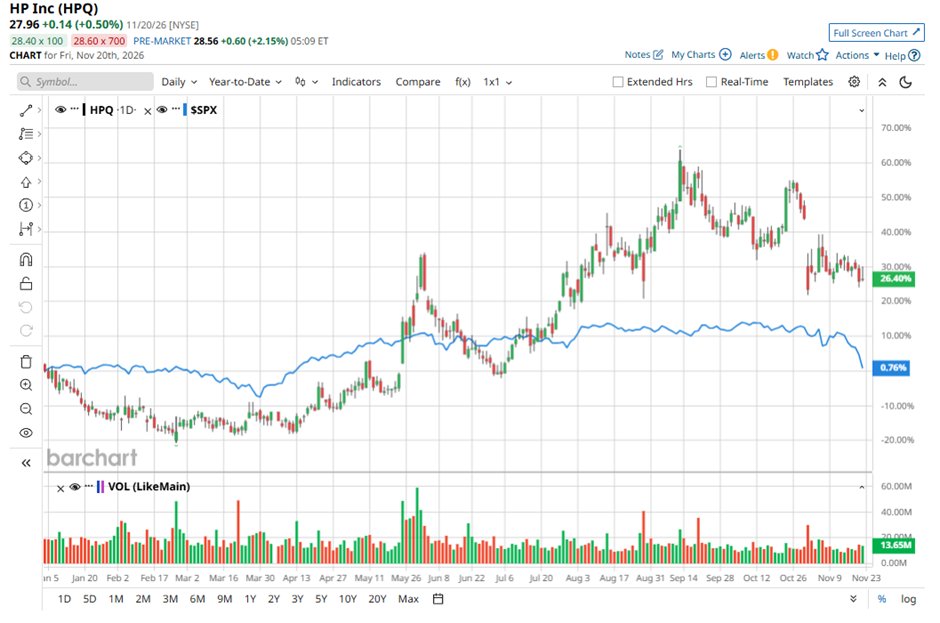
HPQ stock has slipped nearly 23% from its 52-week high of $36.22, reached in September, reflecting some cooling in investor sentiment. Nevertheless, HP remains firmly in positive territory, with shares climbing 23.7% over the past year and gaining 25.6% so far in 2026. The stock has comfortably outperformed the broader S&P 500 Index ($SPX), which has advanced just 9% over the past year and posted relatively modest gains in 2026.
Inside HP’s Q3 Earnings Report
HP reported its fiscal 2026 third-quarter results in August, delivering a strong earnings beat as both revenue and adjusted earnings comfortably surpassed Wall Street expectations. The company posted record net revenue of $15.68 billion, up 12.5% year over year and well ahead of analysts’ estimates of $14.43 billion. Non-GAAP EPS came in at $0.83, marking an approximately 11% increase from the year-ago quarter and comfortably exceeding the consensus estimate of $0.69.
However, a closer look at HP’s business segments revealed a widening divide between robust PC demand and continued softness in printing. The Personal Systems segment emerged as the primary growth engine, with net revenue surging 18% year-over-year (YoY) to $11.8 billion, accounting for approximately 75% of HP’s total revenue. The segment reported an operating margin of 4.6%, with Commercial Personal Systems leading the way through 22% revenue growth, while Consumer Personal Systems revenue increased 10%.
Growth was largely driven by a shift toward higher-value premium products, workstations, and AI-enabled PCs, even as overall PC unit shipments declined 16%. On the other hand, HP’s Printing segment continued to face structural headwinds, with net revenue slipping 2% year over year to $3.9 billion. Both major divisions remained under pressure, as Consumer Printing revenue declined 2% and Commercial Printing revenue fell 1%, highlighting the challenges facing this traditionally important business.
Beyond revenue growth, HP demonstrated solid cash generation and disciplined capital allocation during the quarter. The company generated $1.74 billion in net cash from operating activities and $1.57 billion in free cash flow, representing year-over-year increases of 4% and 7%, respectively. Strong cash generation allowed HP to return approximately $600 million to shareholders, comprising roughly $300 million in share repurchases and $274 million in cash dividends.
HP ended the quarter with $4.2 billion in gross cash, including $4.2 billion in cash and cash equivalents and $3 million in short-term investments classified under other current assets. Looking ahead, HP provided its fiscal 2026 fourth-quarter earnings outlook, projecting GAAP diluted net EPS of $0.74 to $0.84 and non-GAAP diluted net EPS of $0.69 to $0.79. Both estimates include an estimated favorable impact of $0.08 per share from tariff refunds.
For full-year fiscal 2026, the company also raised its earnings guidance, projecting GAAP diluted net EPS of $2.52 to $2.62 and non-GAAP diluted net EPS of $3.19 to $3.29. Both full-year estimates incorporate a favorable impact of $0.19 per share from estimated tariff refunds. The upward revision reflects management's confidence in HP's earnings trajectory, although the extent to which underlying business growth can offset rising costs remains an important factor to watch.
How Do Analysts View HPQ Stock?
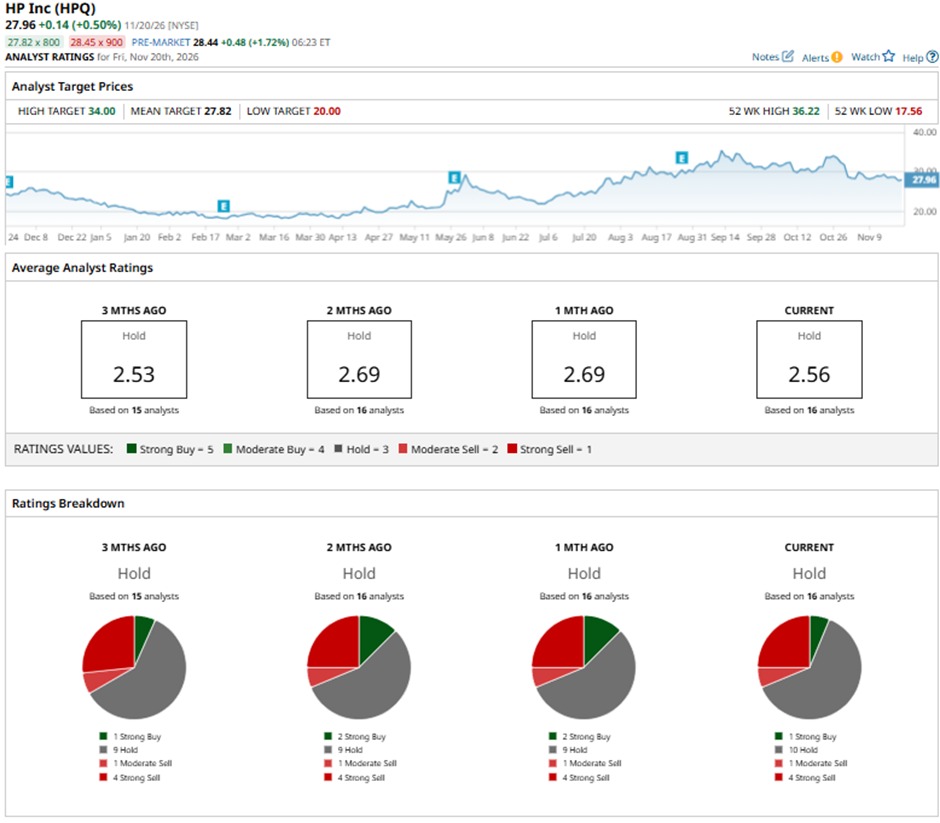
As HP approaches its upcoming earnings announcement, Wall Street sentiment remains largely cautious, with the stock carrying a consensus “Hold” rating. Of the 16 analysts covering HPQ stock, one recommends a “Strong Buy,” 10 maintain a “Hold,” one assigns a “Moderate Sell,” and four rate the stock a “Strong Sell.”
With shares trading slightly above the average price target of $27.82, further upside appears limited at current levels. However, the Street-high target of $34 points to a potential 22% upside, suggesting that some analysts still see room for growth.
On the date of publication, Anushka Mukherji did not directly have a position in any of the securities mentioned in this article. All information and data in this article is solely for informational purposes. For more information please view the Barchart Disclosure Policy here.