
Zscaler’s Q3 CY2026 sales top estimates, stock soars
Cloud security platform Zscaler (NASDAQ:ZS) reported revenue ahead of Wall Street’s expectations in calendar Q3 2026 [fiscal Q1 2027], with revenue up 20.5% year on year to $949.3 million. Its non-GAAP profit of $1.23 per share was 5.9% above analysts’ consensus estimates.
For more on Zscaler, read our free full research report.
Zscaler Q3 CY2026 highlights:
- CrowdStrike to acquire Zscaler in a $43.9 billion all-stock deal, the biggest cybersecurity acquisition on record. Zscaler shareholders get 1.135 CrowdStrike shares worth $260.41 each, a roughly 34% premium. CrowdStrike shareholders will own about 84% of combined company after closing.
- Revenue $949.3 million vs S&P analyst consensus of $937.7 million (20.5% year-on-year growth, 1.2% beat)
- Adjusted EPS $1.23 vs S&P analyst consensus of $1.16 (5.9% beat)
- Adjusted operating income $230.2 million vs analysts’ consensus estimates of $216.8 million (24.3% margin, 6.2% beat)
- Operating margin -3.5%, up from -4.6% in the same quarter last year
- Free cash flow margin 43.9%, up from 6.8% in the previous quarter
- Annual recurring revenue $3.88 billion vs analysts’ consensus estimates of $3.87 billion (21.2% year-on-year growth, in line)
- Billings $705.7 million at quarter end, up 5.1% year on year
- Market capitalization $31.77 billion
“AI is driving the most significant security transformation in our lifetime – it is rapidly uncovering hidden vulnerabilities and enabling malicious actors to execute automated exploits at unprecedented speed and scale, causing organizations to rethink how to defend against autonomous AI agents. Our Zero Trust architecture was essential for the shift to cloud and mobility, but in the agentic AI era, it is non-negotiable,” said Jay Chaudhry, CEO, chairman and founder of Zscaler. “We delivered a strong start to the fiscal year as enterprises increasingly recognize the importance of hiding their attack surfaces and eliminating lateral movement, which are foundational to our Zero Trust Exchange platform. Security done right is an AI accelerator. With CrowdStrike’s proposed acquisition of Zscaler, we believe we will create the most expansive cybersecurity platform for the AI era, bringing together protection across the cloud, network, and endpoint to deliver superior protection for customers.”
Revenue growth
A company’s long-term performance is an indicator of its overall quality. Any business can deliver a good quarter or two, but many enduring ones grow for years. Zscaler’s 35.8% annualized revenue growth over the last five years was strong. Its growth beat the average software company and shows its offerings resonate with customers.
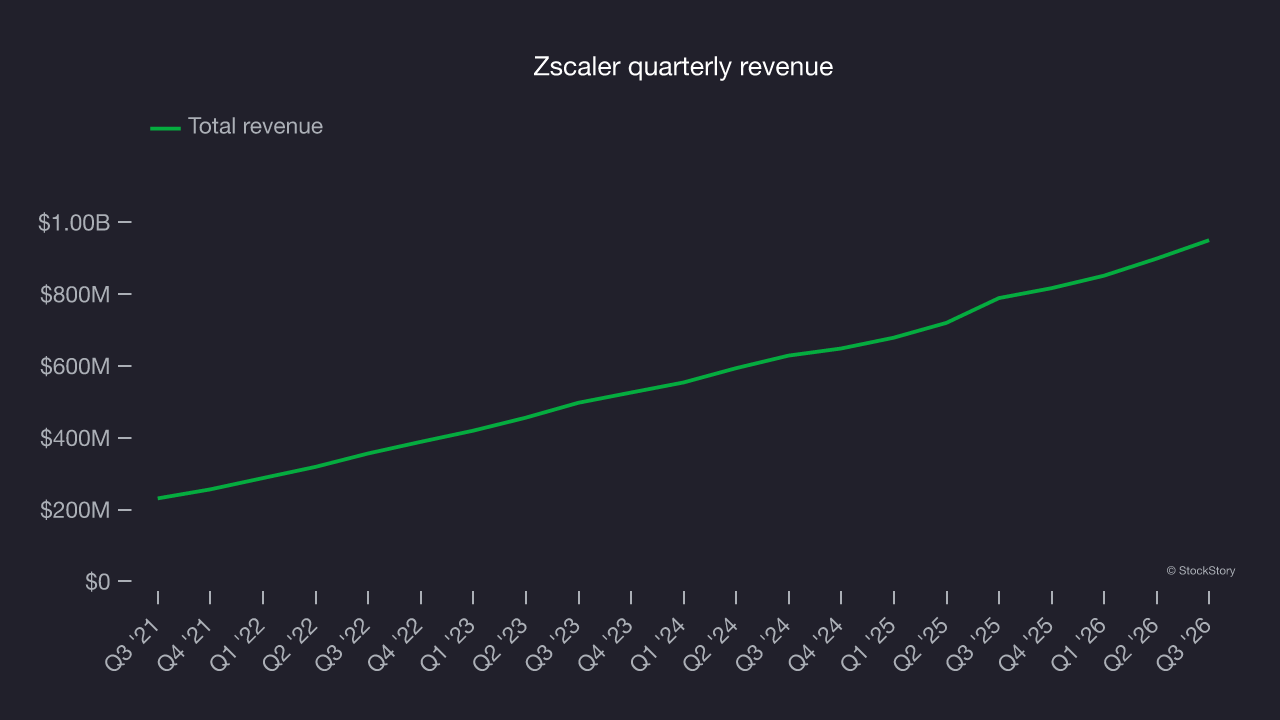
Long-term growth matters most, but within software, a half-decade historical view may miss recent innovations or disruptive industry trends. Zscaler’s annualized revenue growth of 23.6% over the last two years is below its five-year trend, but the results still suggest healthy demand.
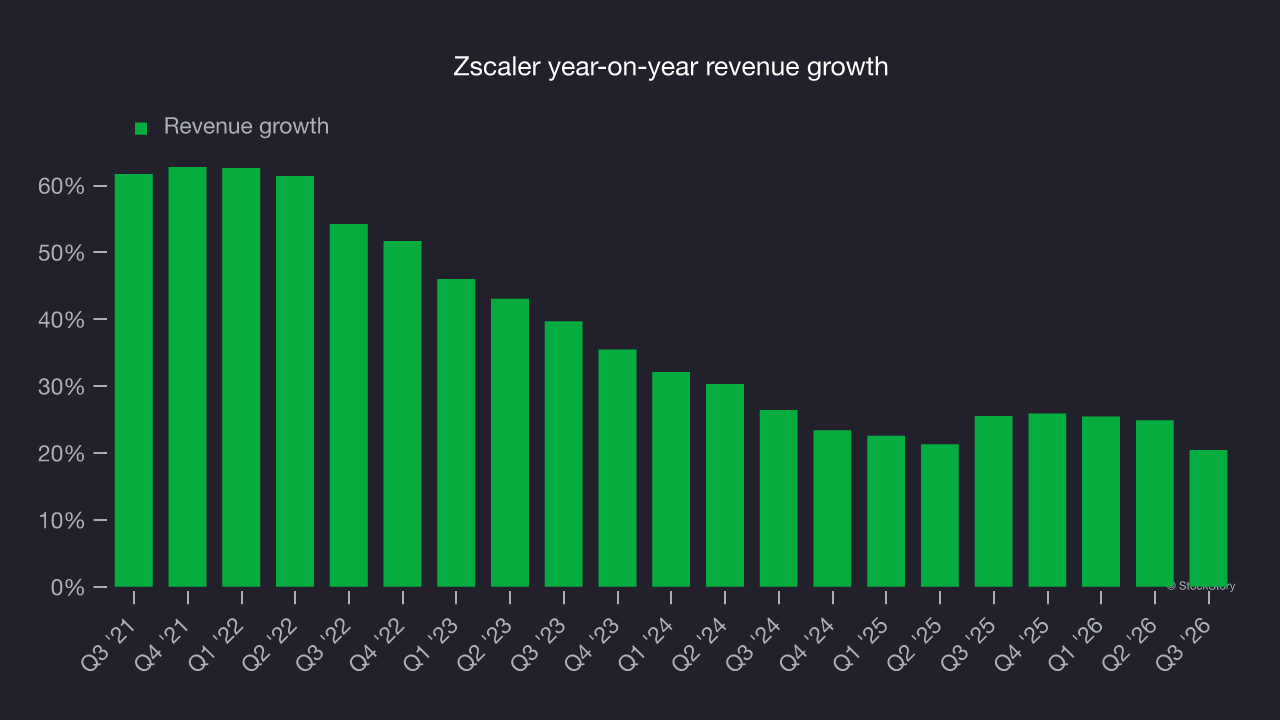
This quarter, Zscaler reported year-on-year revenue growth of 20.5%, and its revenue of $949.3 million topped Wall Street’s consensus estimates by 1.2%.
Looking ahead, sell-side analysts expect revenue to grow 16.2% over the next 12 months, according to S&P, a deceleration versus the last two years. Still, this projection is above the sector average and suggests the market sees some success for its newer products and services.
Annual recurring revenue
While reported revenue for a software company can include low-margin items like implementation fees, annual recurring revenue, or ARR, is a sum of the next 12 months of contracted revenue purely from software subscriptions, or the high-margin, predictable revenue streams that make subscription software businesses valuable.
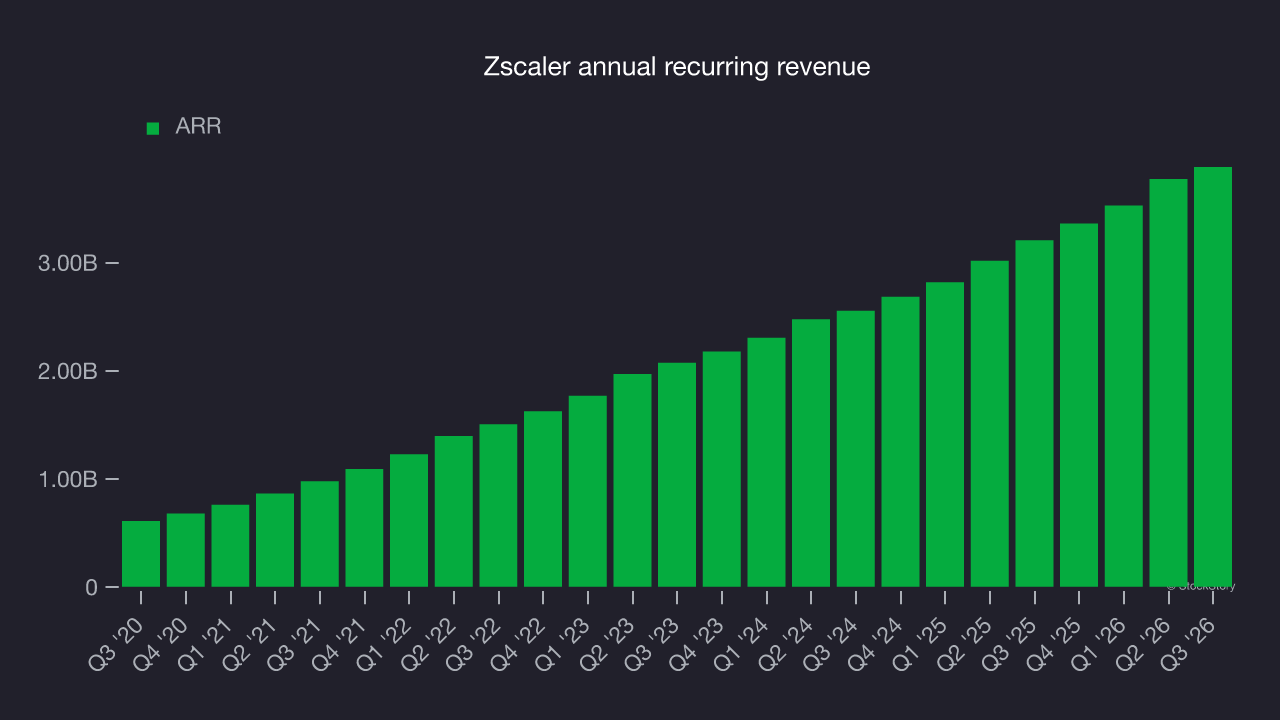
Zscaler’s ARR reached $3.88 billion in Q3, and over the last four quarters, its growth was strong, averaging 24.1% year-on-year increases. This performance aligned with its total revenue growth and shows that customers are willing to commit to the company’s technology for multiple years. Its growth also makes Zscaler a more predictable business, a tailwind for its valuation as investors typically prefer businesses with recurring revenue.
Customer acquisition efficiency
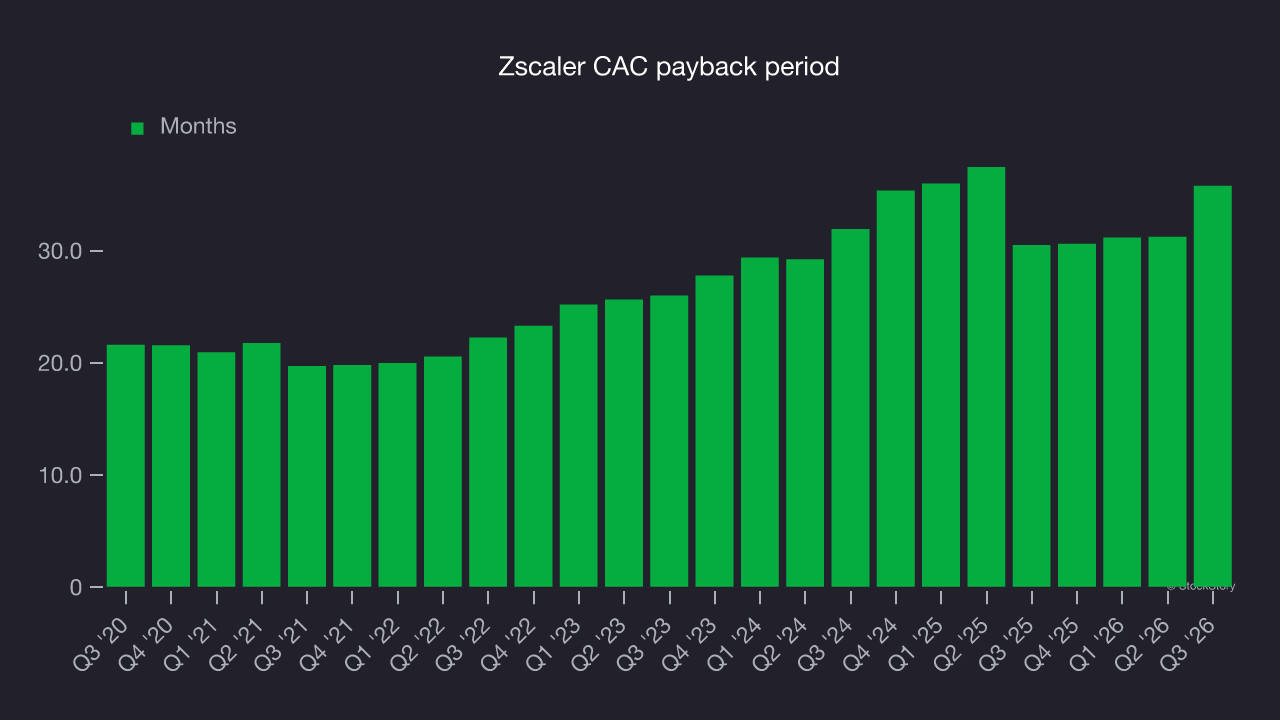
The customer acquisition cost, or CAC, payback period represents the months required to recover the cost of acquiring a new customer. Essentially, it’s the break-even point for sales and marketing investments. A shorter CAC payback period is ideal, as it implies better returns on investment and business scalability.
It’s relatively expensive for Zscaler to acquire new customers as its CAC payback period was 35.8 months this quarter. The company’s slow recovery of its sales and marketing expenses indicates it operates in a competitive market. On the positive side, once it acquires customers, they typically stay and increase their spending, a sign of high switching costs.
Key takeaways from Zscaler’s Q3 results
Zscaler, which reported early due to the deal announcement, reported a mixed quarter: Adjusted operating income beat analysts’ consensus estimates and revenue narrowly topped Wall Street’s consensus, but billings fell short. Shares surged 8.6% to $224.82 immediately after the report.
Is Zscaler a buy at its current price? That decision calls for a look at valuation and business quality as well as the latest earnings. For more on Zscaler, read our full research report here (it’s free).