
Q3 earnings outperformers: Liberty Energy and the rest of the oilfield services stocks
Wrapping up Q3 earnings, we look at the numbers and key takeaways for the oilfield services stocks, including Liberty Energy NYSE:LBRT and its peers.
Oilfield services companies provide equipment, technology, and services enabling exploration and production activities, including drilling, completion, well intervention, and reservoir evaluation. Their fortunes closely track upstream capital spending cycles. Tailwinds include increased drilling activity during favorable commodity environments, demand for efficiency-enhancing technologies, and growing offshore and unconventional resource development. Headwinds include significant revenue volatility tied to oil and gas price swings and producer spending discipline. Intense competition pressures pricing and margins, while the energy transition may structurally reduce long-term demand. Workforce availability and technological disruption require continuous adaptation.
The 25 oilfield services stocks we track reported a mixed Q3. As a group, revenues beat analysts’ consensus estimates by 2.3% while next quarter’s revenue guidance was 2.3% above.
Amidst this news, share prices of the companies have had a rough stretch. On average, they are down 17.4% since the latest earnings results.
Liberty Energy NYSE:LBRT
Operating approximately 40 active fleets across North America's most productive shale basins, Liberty Energy (NYSE:LBRT) provides hydraulic fracturing services that help oil and gas companies extract resources from shale formations.
Liberty Energy reported revenues of $1.20 billion, up 26.3% year on year. This print exceeded analysts’ expectations by 1.6%. Despite the top-line beat, it was still a sluggish quarter for the company with EPS in line with analysts’ estimates and a miss of analysts’ EBITDA estimates.
“Liberty's completions trajectory has improved meaningfully from early year cyclical lows. Strong customer engagement and strengthening market fundamentals provide a more constructive outlook as we close out the year. Third quarter revenue of $1.2 billion and Adjusted EBITDA of $142 million reflected strong operational execution and modest price increases, partially offset by drilling-related delays and cost inflation headwinds,” commented Ron Gusek, Chief Executive Officer. “During the quarter, we delivered significantly lower fuel costs for our customers. Record natural gas substitution of over 60% of the total fuel consumed by our fleets provided annualized fuel savings of over $1 billion for our customers. This achievement reflects continued investment in natural gas fueled equipment and a concerted focus on the digital intelligence layer that drives meaningful operational optimization of equipment and widens the performance gap amongst industry frac fleets.”
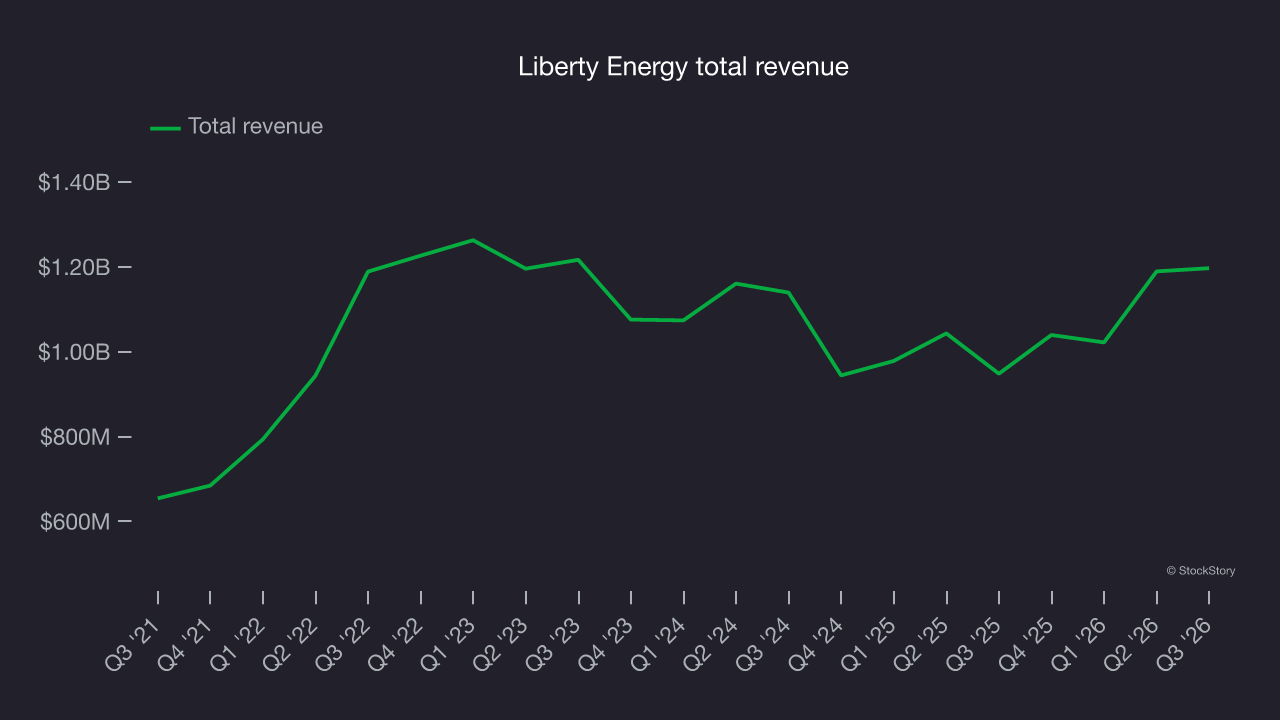
The market seems disappointed with the results as the stock is down 34.5% since reporting and currently trades at $10.93.
Read our full report on Liberty Energy here, it’s free.
Best Q3: ProPetro (NYSE:PUMP)
Operating exclusively in the Permian Basin—one of America's most prolific oil-producing regions—ProPetro (NYSE:PUMP) provides hydraulic fracturing services that pump high-pressure fluid and sand into oil wells to release trapped hydrocarbons.
ProPetro reported revenues of $355.4 million, up 20.9% year on year, outperforming analysts’ expectations by 14.1%. The business had an impressive quarter with a beat of analysts’ EPS estimates and a solid beat of analysts’ EBITDA estimates.
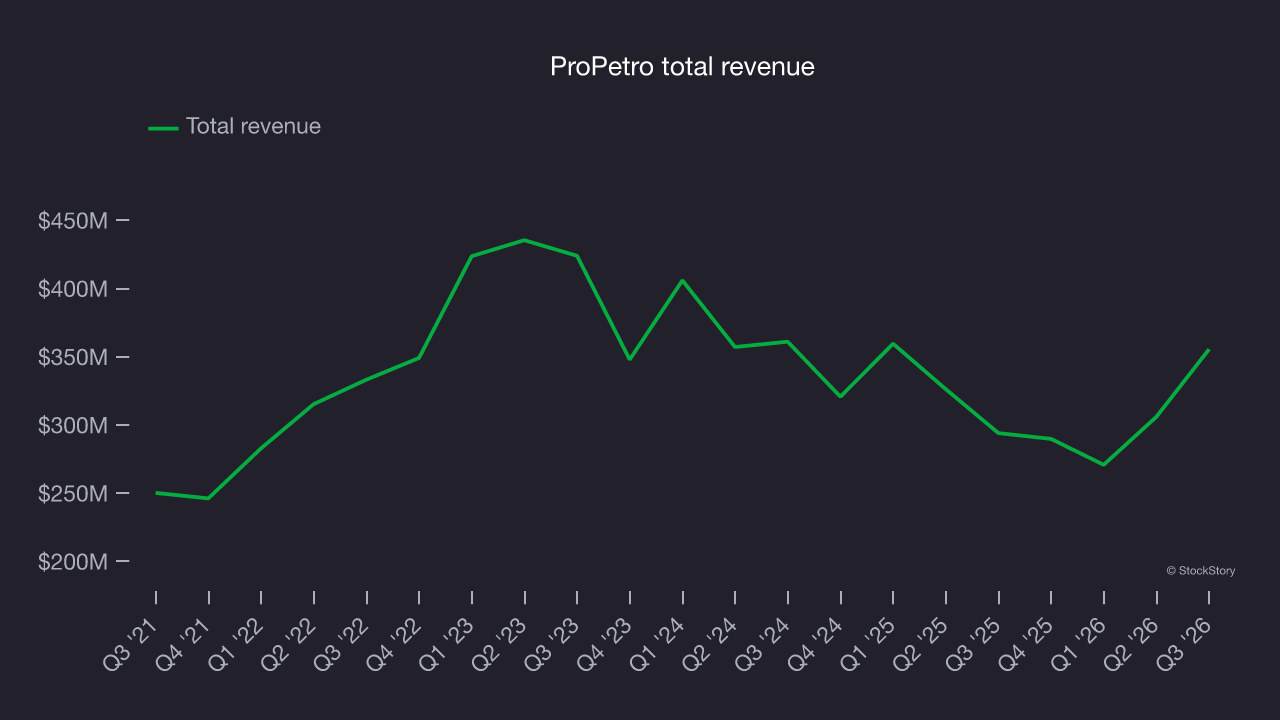
ProPetro delivered the biggest analyst estimate beat of the whole group. Although it had a fine quarter compared to its peers, the market seems unhappy with the results as the stock is down 15.7% since reporting. It currently trades at $6.37.
Is now the time to buy ProPetro? Access our full analysis of the earnings results here, it’s free.
Weakest Q3: ProFrac (NASDAQ:ACDC)
Operating one of the largest electric-powered fracturing fleets in North America, ProFrac (NASDAQ:ACDC) provides hydraulic fracturing services that help oil and gas companies extract hydrocarbons from underground shale formations.
ProFrac reported revenues of $511.1 million, up 26.8% year on year, falling short of analysts’ expectations by 4.8%. It was an underwhelming quarter as it posted a significant miss of analysts’ EBITDA estimates and a significant miss of analysts’ EPS estimates.
ProFrac delivered the weakest performance against analyst estimates among its peers. As expected, the stock is down 30.6% since the results and currently trades at $2.76.
Read our full analysis of ProFrac’s results here.
Atlas Energy Solutions (NYSE:AESI)
Building the world's first long-haul proppant conveyor system to reduce truck traffic, Atlas Energy Solutions (NYSE:AESI) mines and processes sand used as proppant to prop open fractures in oil and gas wells during hydraulic fracturing.
Atlas Energy Solutions reported revenues of $267.8 million, up 3.1% year on year. This print beat analysts’ expectations by 0.9%. Aside from that, it was an underwhelming quarter as it logged a significant miss of analysts’ EBITDA estimates and a significant miss of analysts’ EPS estimates.
The stock is down 39.5% since reporting and currently trades at $4.98.
Read our full, actionable report on Atlas Energy Solutions here, it’s free.
Borr Drilling (NYSE:BORR)
Operating one of the world's youngest jack-up fleets with an average age under eight years, Borr Drilling (NYSE:BORR) operates jack-up rigs that drill oil and gas wells in shallow waters up to 400 feet deep for exploration and production companies.
Borr Drilling reported revenues of $263.1 million, down 5.1% year on year. This result surpassed analysts’ expectations by 1.2%. Taking a step back, it was a sluggish quarter as it recorded a significant miss of analysts’ EPS estimates.
The stock is up 9.9% since reporting and currently trades at $3.48.
Read our full, actionable report on Borr Drilling here, it’s free.
Market update
Over the past year, investors have been forced to repeatedly answer the same question: What is the market’s biggest risk? The answer has changed several times, and each shift has reshaped market leadership.
Late in 2025 and early 2026, artificial intelligence became the market’s primary uncertainty. Investors questioned whether AI would erode software pricing power and weaken competitive moats as AI made it easier to replicate once-differentiated products.
By the spring, technology took a back seat to geopolitics. The U.S. conflict with Iran briefly became the market’s dominant narrative, raising concerns about oil prices, inflation, and global growth. But as energy markets remained orderly and fears of a prolonged supply disruption faded, investors quickly turned their focus back to fundamentals.
Want to invest in winners with rock-solid fundamentals? Check out our Top 5 Growth Stocks and add them to your watchlist. These companies are poised for growth regardless of the political or macroeconomic climate.