
The Xiaomo trading department abandons tactics and is bullish on the S&P 500: it may rebound now, and the bottom has not been reached
The Zhitong Finance App learned that J.P. Morgan's trading department is cautious about the US stock market. Following a sharp correction in the S&P 500 index last week, J.P. Morgan's trading department, led by US market intelligence chief Andrew Tyler (Andrew Tyler), has moved from being tactical bullish to cautious, believing that the stock market will fluctuate in the next few weeks, but emphasizes that the fundamentals of the market from economy to profit are still intact.
Taylor wrote in a weekly client report: “In hindsight, we should obviously keep watching, but like the market, we regard Nvidia (NVDA.US) and capital market activity as necessary support for technology stocks to form the bottom, so we failed in our tactical bullish judgment. We do think a rebound is imminent, but we're not sure if any rebound will evolve into a sustainable rise.”
AI concerns evolve into a full-scale sell-off
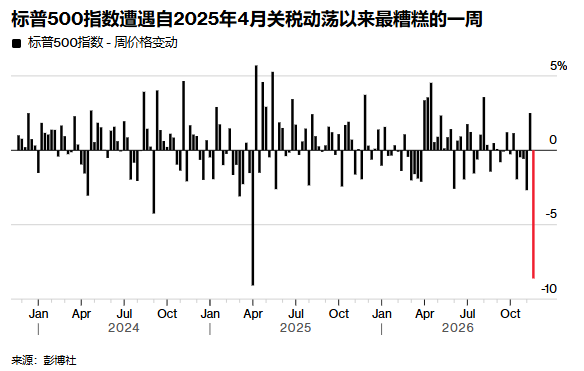
Wall Street shook violently last Friday. AI trading, which has been driving US stocks higher throughout most of this year, evolved into a full-scale sell-off after market concerns heated up. The S&P 500 index fell more than 10% from its record high in October, and the Nasdaq 100 index fell 5.6%, the worst one-week performance since March 2020. It turned into a decline during the year, and fell nearly 20% from its recent high.
Taylor pointed to interest rate uncertainty and its potential impact on the S&P 500 earnings outlook for 2027 and 2028.
As to when Taylor will turn bullish again, he believes that several conditions need to be met at the same time: the market completes position resets, the US economic growth logic is verified (the observed signal is that cyclical stocks outperform defensive stocks), volatility falls, and the Federal Reserve suspends interest rate hikes in December to delay interest rate hikes until January or March next year.
Taylor anticipates a further shift in funding from tech stocks to other areas. However, he believes that as such technology withdrawal transactions become increasingly crowded, once there is a tactical rebound, these crowded positions may cause a new round of pain. He also added that if technology stocks continue to weaken, it is unclear whether the S&P 500 index can rebound to the extent that it can rise sharply.
J.P. Morgan's US market intelligence team previously maintained a tactical bullish outlook after the US midterm elections, believing that the sell-off in technology stocks would create opportunities for immediate recovery, even though investors became more selective about AI winners and losers. Taylor adopted the right prudent strategy before the US stock market experienced a wave of sell-offs for several weeks in early June.
Taylor said, “Currently, the uncertainty of Nvidia and its peers, as well as the uncertain outlook for 2028 and beyond, makes the technology bulls very uncertain in the short term. “Given the strength of this sell-off, a tactical rebound seems likely, but given recent uncertainty about technology fundamentals, we don't think it will bottom out anytime soon.”
Wall Street veterans cut target price twice in two months
According to reports, Wall Street veteran Ed Yardeni (Ed Yardeni) lowered the target price of the S&P 500 index at the end of the year for the second time in two months after a sharp sell-off in the stock market. He expects the index to close at 7,500 points in 2026, which is lower than his target of 7,900 points after the September cut, but this still means an increase of more than 8% from last Friday's closing.
Adney said that semiconductor stocks have been hit hard by news of stricter US export controls, and outsiders are worried that stricter export controls will reduce demand for chips and lower their prices.
He believes the index is unlikely to fall into a bear market because there is currently no imminent threat of a recession. He remains optimistic about next year, predicting that the S&P 500 will close between 8,500 and 9,000 points by the end of 2027, up 30% from current levels.
Last week's sharp sell-off also caused the stock market's key volatility indicators to soar. The Chicago Board Options Exchange Volatility Index (VIX), known as the “Panic Index,” rose to its highest level since April 2025. However, Adney said that since “no recession is in sight,” he doubts whether this index will rise even more sharply.