
Did the AI sell-off bring a “blow to fat beauty”? The hedge fund “gave up” and got out of the clearance position, and Damo shouted to buy
The Zhitong Finance App learned that last week's sell-off in US stocks and the Asia-Pacific stock market completed a qualitative upgrade: it only reduced risk for hedge funds, then evolved into an exponential “systematic sell-off.” Morgan Stanley's latest weekly hedge fund report estimates that as of November 19, the Asia Pacific Equity Long and Short Fund's estimated loss for the month had increased to 2.9%, and its US counterpart may have lost 1.6% during the same period. This weekly report, which was released on November 20, is still far from over — it failed to capture the biggest one-day percentage decline in a year and a half since the MSCI World Index appeared last Friday.
In addition to the numbers, what is more noteworthy is the overall shift in the position coordinate system: long bets on momentum stocks were still at a multi-year high in June, but now hedge funds as a whole have turned bearish, and the position weight of artificial intelligence companies has dropped below their market value. Meanwhile, Morgan Stanley strategists said that the S&P 500 index and the Dow Jones Industrial Average both entered a pullback range, providing investors with an unmissable buying opportunity.
The ebb line of the momentum market
Over the past two years, from the US and China to South Korea and Japan, momentum stocks have driven round after round of growth — investors have flocked to AI and robotics concepts. This enthusiasm has clearly cooled down in recent weeks. There are two triggers: after the US midterm elections, concerns about the tightening of AI regulations have heated up; and doubts about whether huge AI spending will continue to ferment in the market.
The regional and industry breakdown given by Dama Weekly is quite clear: the Asia-Pacific region led the global sell-off last week, and the selling pressure was almost evenly divided between China, Japan, and Taiwan Province of China; the three industries of semiconductors, hardware, and the Internet together accounted for 75% of the sell-off volume. This round of sales reduced hedge funds' net exposure to the Asia-Pacific region by 11 percentage points since mid-year to 22% of the global level — below the ten-year average. As defined in the report, net exposure measures the dollar difference between long and short bets.
Semiconductors, hardware, and the internet happen to be the three main locations for hedge fund momentum holdings — in other words, this sale is not scatter-based risk control, but the targeted dismantling of momentum positions themselves. Looking at the market context since 2026, this momentum line extends all the way from American AI giants to Chinese technology, Korean robotics, and Japanese semiconductor equipment, and is the strongest consistent transaction in the global stock market in the past two years; when consistent trading begins to collapse, its entry path is often not a uniform decline, but rather focuses on a few of the most crowded names to quickly vent — 75% of the sell-off is concentrated in the three industries, which is direct evidence of this “centralized clearance” pattern. This also explains why the Asia-Pacific region has become the epicenter: in the past two years, Asia Pacific Momentum stocks have accumulated the highest increase and congestion, and the slope at the time of clearance is also the steepest.
The nature of the sell-off has changed: from individual stocks to indices
What is interesting is the change in selling methods: although hedge funds have once again ended the week with net sales, their impact on prices is less than October — the selling pressure has moved from individual stocks to index products. In other words, position cutting is changing from “active clearance at the stock selection level” to “passive risk reduction at the systemic level.”
Another set of data on position structures also points to radicalization: net leverage for US equity hedge funds has plummeted to 41%, and Asia-Pacific equity long and short funds have dropped to 48% — both of which are at the low end of the range observed since 2010.
J.P. Morgan's comparison: It's time for a rebound in history, not this time
On the same day, J.P. Morgan's asset data and excess income (alpha) team presented a historical comparison in the research report: “Judging from historical experience, the period when large-scale net sales of hedge funds occur at the same time as market sell-offs, often accompanied by a rebound in the next month — but so far, this has not been the case.”
J.P. Morgan also added a quantitative judgment: the speed and magnitude of net leverage falling from a 12-month high “can be compared to some of the most extreme scenarios since 2018.” Reading the two reports together, the conclusion is harsh: the reduction in positions is already deep, but the decline in the market has not given the historical “oversold rebound” return — either the macro-driver of this sell-off (AI regulation and AI spending narrative) is more structural than before, or the rebound is still awaiting a trigger.
Looking at the timeline longer, this round of clean-up occurred at several points where the narrative was shaken at the same time: the uncertainty of AI regulation after the midterm elections, the debate over the sustainability of AI capital expenditure, and the impact of the Nvidia leadership change crisis on confidence in the entire AI supply chain — many investment bank research teams have listed these as common causes of sector sell-offs. A hedge fund's position reduction is not so much a vote on fundamentals as a repricing of the “narrative uncertainty premium”: when the core narrative driving the two-year market enters the verification period at the same time, the corresponding action on the position is to reduce leverage first, then lower exposure, and finally shift to systemic risk reduction at the index level — this is completely consistent with the three stages of sell-off described by Morgan Stanley.
What does it mean to invest?
For readers who track money, this weekly report gives at least three actionable signals. First, the reversal of Momentum's position was “dramatic” — the overall bearish period from a high position in June to the current bearish period was completed within half a year, which means that the risk release of crowded transactions was quite sufficient; second, the shift in AI holdings from overallocation to underallocation indicates that hedge funds are not “digging the bottom of AI” but “waiting for the story”, which is consistent with Morgan Stanley's previous cautious tone on the AI infrastructure sector; third, index products have taken on selling pressure and individual stocks have weakened, which is usually interpreted as panic A sign of the end — but J.P. Morgan's historical comparison just reminds us, this time” “It is a rebound without a rebound”, which indicates that the trigger conditions have not yet been met.
Taken together, this set of data depicts a textbook-style position clearance: momentum reverses, leverage falls to a ten-year low, and selling pressure shifts to an exponential level. Historically, this combination often corresponds to the eve of a rebound — but both reports acknowledge that this “in history” hasn't materialized this time. For observers, instead of betting on when to rebound, it is better to focus on two leading variables: the pace of implementation of AI regulations and whether net leverage will stop declining.
Another detail that is easily overlooked is worth pointing out separately: Dama Weekly admits that it “didn't photograph Friday” — that is, the biggest one-day percentage drop in the MSCI World Index in a year and a half occurred after the data cutoff dates for the two reports. This means that the November 21 market is likely to further deepen all of the above indicators: larger monthly losses, lower net leverage, and more thorough clearance of momentum. In other words, all the numbers quoted in this article are probably the “median values” of this round of clean-up rather than the “final values” — the next weekly report is the first complete sample to test whether “systemic sell-off has peaked.”
Damo Wilson: After seven consecutive declines, it was a “fat hit”. The forward price-earnings ratio fell below the long-term average, so the buying opportunity is not to be missed
However, the S&P 500 and Dow Jones Industrial Average both fell into a pullback range last week, but Morgan Stanley strategists believe that this round of sell-off has brought investors an unmissable buying opportunity. The team led by Michael Wilson said that both profit and valuation sides supported the rebound, and the recent market capitulation sell-off provided just the background. The team's level of optimism on a tactical level is the highest since the beginning of April this year.
“This is a fat hit we've been waiting patiently for, and we won't miss it,” the Wilson team wrote in a report released on Monday. “The market always bottoms out in the midst of bad news and deleveraging. We've experienced both of these a lot lately. ”
S&P 500 futures strengthened ahead of Monday's session. Previously, the spot index fell for seven consecutive trading days, the longest continuous decline since the outbreak of the epidemic in February 2020; from the previous record high in early October, the S&P 500 has fallen 12%, entering a pullback range amid intense rotation in technology stocks.
According to the Wilson team, the valuation has fallen back to a level that supports increased exposure to stocks. While analysts continue to raise profit expectations, the S&P 500 forward price-earnings ratio has dropped from a peak of nearly 23 times at the end of October to 16.5 times the current average, below the long-term average of 17.4. The forward price-earnings ratio of the Nasdaq 100 Index, which is dominated by technology stocks, is less than 17 times, and lower than its low during the pandemic.
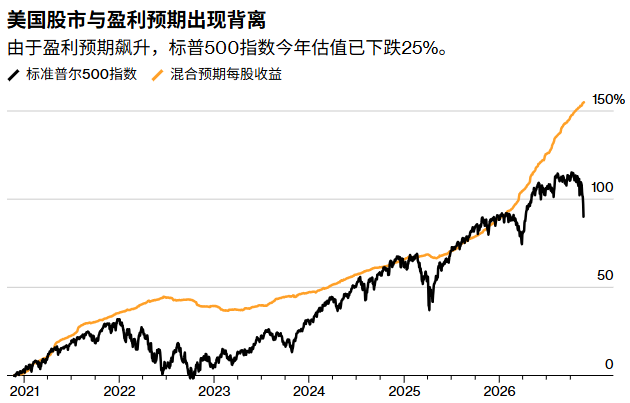
“This round of sell-off improved entry points for hyperscale cloud vendors, industrial stocks, high-quality cyclical stocks with rising profit expectations, and beneficiaries of AI applications,” the team wrote.
Wilson and his colleagues believe that the current stock price implied a profit decline of about 6% in 2027, while Morgan Stanley itself predicted a 14% increase, and the market consensus was a 17% increase. The positive factors they cited include the spread of industrial activity, the resilience of high-end consumption, the advancement of AI applications, lower energy prices, and the prospect of declining interest rate volatility.
According to the Morgan Stanley team, the main risk facing the stock market is still the hawkish US Federal Reserve, but they think investors have already set a price for it.
“In our opinion, market pricing is far more hawkish than the Federal Reserve's final path,” they wrote. “Faster austerity cycles may present credit and growth risks, but we expect the Fed to pay attention to these risks, and the information released at the December meeting will be more restrained than some investors expected.”