
Why This Drone ETF Stands Out From The Crowd
Drones are no longer just toys; they have changed the face of modern warfare.
A drone that costs less than $10,000 is capable of taking out a militarized tank whose cost can be estimated to be in the millions.
Add in artificial intelligence and autonomous systems, and the modern battlefield looks very different from the troops, tanks, ships, and fighter jets that have dominated conflicts for decades.
This has led to drone stocks, as well as companies offering technology to defend against drones, and autonomous and artificial intelligence defense technology becoming very popular amongst investors.
One vehicle that looks to make investing in the segment easier is the Defiance Drone & Modern Warfare ETF (JEDI).
A drone ETF built for the modern battlefield
The JEDI ETF is made up of around 47 companies that are responsible for the technology changing the modern battlefield.
This includes companies that manufacture military drones, as well as companies producing AI-driven warfare technology, military information systems, electronic and communication warfare solutions, and other advanced defense technology from companies around the world.
The fund’s annual management fee is 0.69%.
| Company name | Symbol | % of net assets |
| Shield AI | Private company | 7.81 |
| Ondas Inc | ONDS | 7.66 |
| Redwire Corp | RDW | 7.19 |
| Intuitive Machines | LUNR | 6.16 |
| Blacksky Technology | BKSY | 5.10 |
Top five holdings as at 11/18/2026
Major listed holdings include Ondas (ONDS), which develops autonomous aerial and ground platforms; Redwire Corp (RDW), which provides critical space infrastructure as well as autonomous uncrewed systems; and AI and advanced military technology company, Intuitive Machines (LUNR) and BlackSky (BKSY), which combines its satellite network with analytics software to provide intelligence to government and commercial customers.
The drone ETF with private company exposure
One thing that the Defiance Drone & Modern Warfare ETF offers that differs from most ETFs is its ability to invest in private companies.
At the advisor's discretion, the fund can invest up to 15% of its net assets into unlisted companies that fall into the theme of drones and modern warfare.
This is evidenced by the fund’s indirect exposure to Shield AI, which it holds through a special purpose vehicle (SPV).
Shield AI is an American defense-technology business located in San Diego, California, founded by a Navy SEAL, and builds autonomous software and aircraft for defense applications. Its core product, Hivemind, is a software platform that allows aircraft to operate without GPS or communication links in environments where such technology could be jammed or denied.
The most-followed narrative on the Simply Wall St community sees this as one of the ETF’s key attractions.
Rather than simply holding established defense contractors, the ETF provides exposure to businesses developing technologies that could become increasingly important to military operations. This includes companies working on autonomous systems, AI, satellite intelligence and the infrastructure supporting modern warfare.
Drone defense technology takes flight
According to research firm Grand View Research, the military drone market is estimated to grow from US$47.4 billion in 2025 toward US$98.0 billion by 2033, implying annual growth of over 9.5% per year, but other forecasts also point to higher or lower estimates.
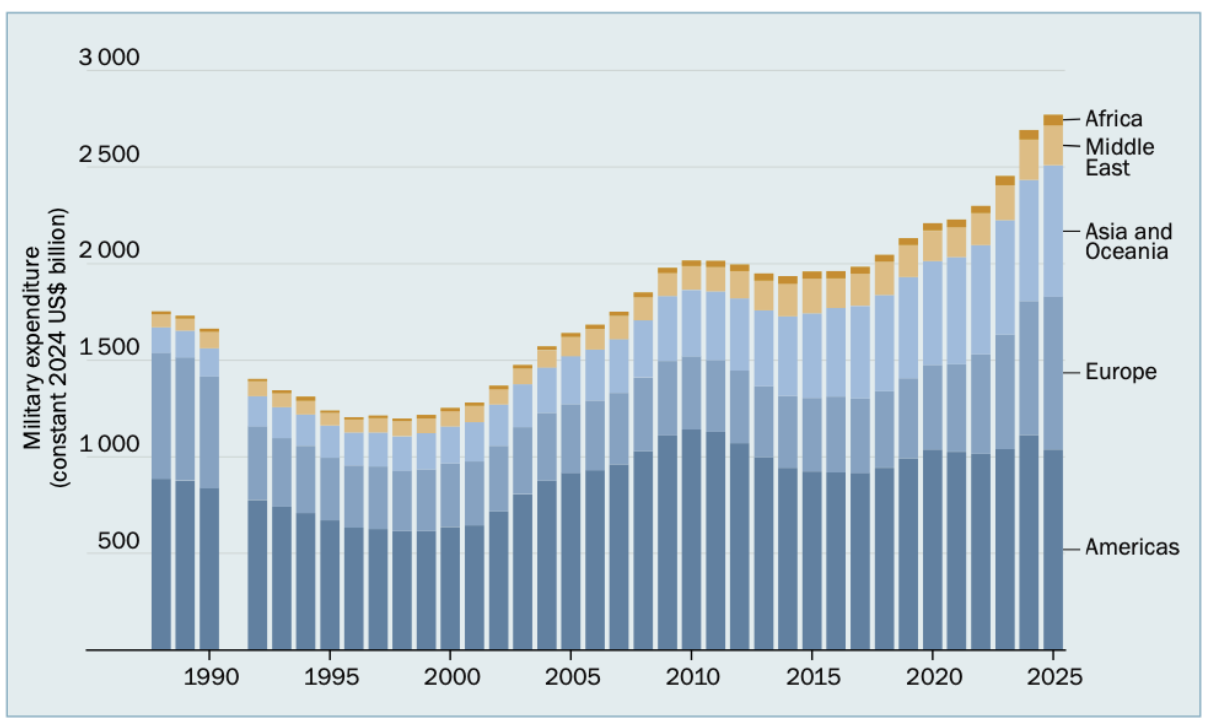
What is verifiable is that governments across the world are investing more in defense. World military spending has increased by over 41% in the last decade. Of particular note, the 2.9% increase in defense spending in 2025 versus the previous year happened in an environment where the US, which spends more on defense than any other country, actually spent less.
Increasingly, more of the increased military spending is devoted to drone and counter-drone technology.
A presidential executive order in June 2025 established the “Unleashing American Drone Dominance” program, which is aimed at establishing advanced drone manufacturing and export of US-made drones. This was followed up by a US$1 billion plan by the Department of Defense to purchase as many as 340,000 drones over two years.
As more money is spent on equipping global militaries with drone technology, so is money being invested in technology to defend against drones, as shown by Fortune Business Insight’s estimate that the counter-drone or CUAS market is expected to grow from US$14.4 billion in 2026 to US$55.3 billion by 2034, or a compound annual growth rate of 22.4%.
What to consider before investing in a drone ETF
Drones are an increasingly critical technology on the battlefield. So much so that Ukraine’s military estimates that drones account for 96% of Russia's battlefield losses.
With more money being invested into drones, artificial intelligence and autonomous systems for defense technology, this trend is likely to continue for some time yet.
The Defiance Drone & Modern Warfare ETF offers investors a way to access this shift through companies developing everything from autonomous aircraft to AI-driven intelligence and counter-drone systems.
But with emerging technologies, private company exposure and a relatively concentrated portfolio, investors will need to weigh the growth opportunity against the risks of an evolving industry.
Disclaimer
This article was written independently by the author, without issuer input or approval. Simply Wall St may provide the securities issuer or related entities with website advertising services for a fee, on an arm's length basis. Details on compensation and other important information can be found in the disclosure and disclaimer at the end of this narrative.
Have feedback on this article? Concerned about the content? Get in touch with us directly. Alternatively, email editorial-team@simplywallst.com