
From technical narration to value implementation, Weiyuan Intelligent Manufacturing (03275) redefines the “value coordinate system” of industrial embodied intelligence
After experiencing capital fervor and technological exploration from 2024 to 2025, the Embodied Smart Circuit is ushering in a critical window period of crossing from “technological singularity” to “commercial singularity”. Entering 2026, the industrial value anchor has undergone a profound structural shift: the core logic of the capital market is completely shifting from early “technical imagination” to “delivery certainty.”
This is not a simple cooling of the industry; it is a necessary path for the industry to mature. The current flow of capital is undergoing a profound process of “deception and preservation of truth”, moving from broad casting of technical concepts to precise drip irrigation for enterprises with closed-loop capabilities and real profitability. This paradigm shift from “theme-driven” to “verification-driven” is speeding up the selection of leading targets with real engineering implementation capabilities and commercial monetization potential.
The Zhitong Finance App learned that recently, Weiyi Intelligent Manufacturing (03275) has restarted its stock offering. The current offering period is from November 23 to December 1, 2026. It is proposed to sell 37.275,800 H shares globally. The Hong Kong public sale accounts for about 10%, the international offering accounts for about 90%, and the additional 15% over-allotment rights. The offering price was HK$12.07 to HK$15.69 per share offered. Each lot is 100 shares. H shares are expected to start trading on the Stock Exchange at 9:00 a.m. on December 4, 2026.
As an industry benchmark for pioneering the engineering implementation gap and achieving a closed loop of commercialization, Weiyi Intelligent Manufacturing's development path not only verified the commercial viability of industrial transformation intelligence, but also established a pricing coordinate system centered on fundamentals for the entire circuit.
Using Weiyi Intelligent Manufacturing as an example, this article will thoroughly analyze the three major value verification dimensions of the artificial intelligence industry in the process of commercialization and disruption.
Scenario differentiation is remarkable: industrial manufacturing has become the “first stop” for commercialization of physical AI
In the context of the industry generally facing an “engineering implementation gap”, the commercialization process of physical AI has shown significant scene differentiation. In 2026, the domestic physical AI market will enter the stage of large-scale implementation. The technical route around general physical AI brain, physical intelligence, and multi-brain collaboration has gradually become clear, but the fields with the fastest commercialization progress are highly concentrated in industrial scenarios such as 3C electronics, automobiles, logistics and warehousing.
The core reason why industrial manufacturing has become the first to run through embodying intelligence is the computability of its return on investment cycle (ROI). Unlike consumer-level or service-level scenarios, procurement decisions for industrial customers are based on predictable payback cycles, quantifiable acceptance standards, and benchmarking of input and output.
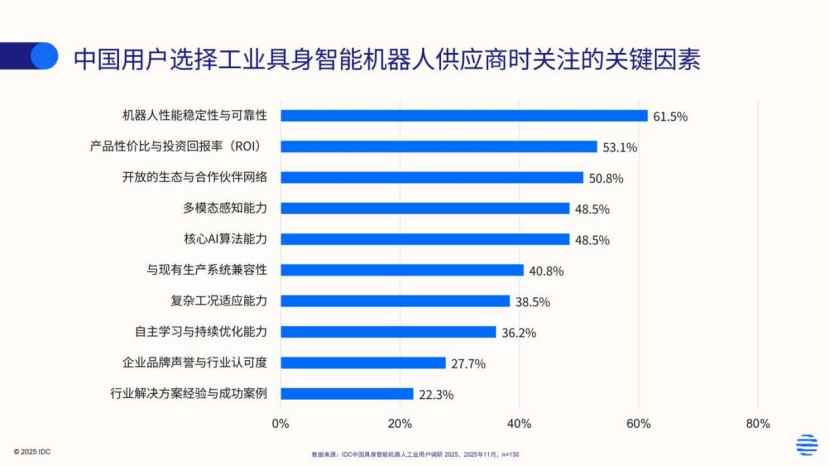
According to IDC user research, more than 80% of manufacturing companies hope that industrial embodied intelligent robot projects can achieve return on investment within two years, and ROI has become the core indicator of commercial implementation.
(Source: IDC)
The judgment of Jiazi Lightyear's “2026 China Embodied Intelligence Industry Insight Report” is consistent with this: commercialization of embodied intelligence will not begin with the most complex scenarios, but will prioritize scenarios where requirements are clear, tasks can be defined, and values can be calculated.
In line with industry needs, Weiyi Intelligent Manufacturing uses “real customer implementation value” as the core yardstick for physical AI implementation.
In terms of product form, the company has long understood that humanoid robots are not necessarily the optimal solution for industrial sites. Zhang Zhiqi, chairman and CEO of the company, once calculated an account: “A wheeled two-armed humanoid robot that costs 5.6 million yuan can actually replace only 0.2 to 0.3 people's workload, so you can choose a more economical route.”
In response, Weiyi's intelligent manufacturing solution is the development direction of “one brain polymorphism”: a unified physical AI brain, with two arms, four arms, or even six arms at the front end, and the shape is determined by process requirements. This pragmatic strategic choice not only avoids the “false demand” trap of humanoid robots in industrial scenarios, but also establishes a commercialization path of “defining products by scene.”
In terms of technology, the company is also oriented towards cost reduction and efficiency. Traditional AI projects require lengthy processes such as data collection, labeling, model training, and deployment, which take an average of at least 2 to 3 months. Using a human-computer interaction system, Weiyi's Industrial Embodied Intelligent Robot (EIIR) project can provide real-time feedback and integrate human experience and judgment, fundamentally solving the “cold start” problem and drastically reducing the average delivery cycle to 21 days.
In an application field that focuses on the return on investment (ROI) cycle (ROI), this ability to deliver measurable commercial returns has established a definite lead in industrial smart circuits. According to the consulting caliber, according to the revenue of industrial embedded intelligent robot products in China in 2025, Weiyi Intelligent Manufacturing is the largest provider of industrial embedded intelligent robot products in China, with a market share of about 20.0%; under the IDC caliber, its market share in 2025 was 11.8%, which also ranked first.
While the industry is generally stuck at the bottleneck from demo to mass production, Weiyi Intelligent Manufacturing has completed batch delivery in many complex industrial scenarios. Its EIIR products cover processes such as appearance inspection, welding, polishing, and assembly, and extend to tasks such as sorting, caging, and palletizing in logistics scenarios. In terms of industry distribution, it has entered high-value fields such as 3C electronics, automobile manufacturing, new energy, FMCG and semiconductors, and has achieved batch deployment in more than 25 Fortune 500 companies and industry leaders.
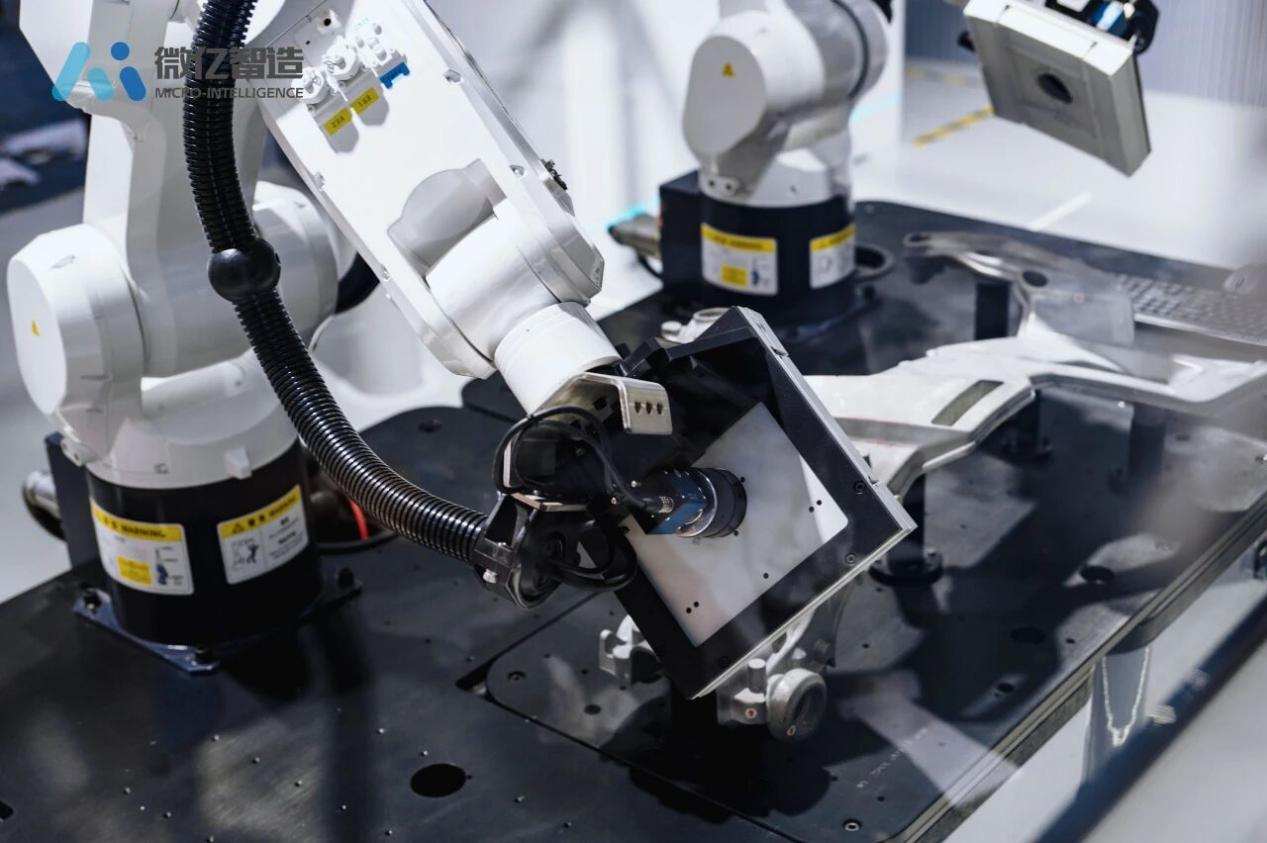
(Weiyi Intelligent Manufacturing Physical Quality Inspection | Multi-arm Collaborative Robot Field Work Scene, Source: Official Account)
What supports this delivery density is the accumulation and reuse of data assets. According to the company's disclosure, as of the last practical date of the data collection after the hearing, its unstructured precision label database exceeded 23 TB, containing more than 1.6 billion accurate label records. According to data from Insight Consulting, most industrial intelligent robot companies in the industry will have less than 5 TB of similar real industrial scene data in 2025. Huge data assets drive it to continuously reduce marginal delivery costs and achieve large-scale profits.
Logical shift in market valuation: profit certainty and order visibility become the core of pricing
Currently, the physical intelligence industry as a whole is still in a period of rising profits. According to the China Academy of Information and Communications Technology's “Embodied Intelligence Development Report (2026)”, most enterprises are still in the exploration stage of “growth has been established, profit has not been established”, and a closed loop of sustainable business has not yet been formed.
Sheng Xitai, founding partner and chairman of Hongtai Fund, also pointed out that embodied intelligence is still in the early stages of industrialization. From single-point technological breakthroughs to system engineering, from scientific research orders to real commercial orders, to large-scale implementation, the industry still needs to cross multiple thresholds.
Because of this, when the capital market's valuation logic shifts from market sales ratio (PS) and conceptual narrative to actual orders, cash flow, and adjusted profits, companies with real profitability will become scarce targets and receive significant deterministic premiums.
Compared to real smart enterprises that have already been listed or submitted for listing in Hong Kong stocks, Weiyi's intelligent manufacturing business focuses on the industrial segment and has surpassed the peak of early deployment costs. It is one of the few companies on the racetrack that have achieved profits and positive cash flow. Its financial characteristics form a reference coordinate.
From 2023 to 2025, the company's total revenue increased from 434 million yuan to 796 million yuan, with a compound annual growth rate of 35.4%. Adjusted net profit (non-IFRS) in 2025 was 48.73 million yuan; in the first five months of 2026, revenue increased 22.6% to 424 million yuan, profit increased sharply to 22.528 million yuan, adjusted net profit reached 33.84 million yuan, an increase of 41.5% year on year, and the trend of continuous improvement in profit was clear.
Changes in operating cash flow provide another dimension of signals. In 2025, the net cash from the company's operating activities changed to 141 million yuan; in the first five months of 2026, net operating cash flow was 12.69 million yuan, compared with a net outflow of 108 million yuan in the same period last year. The reversal from net outflow to net inflow indicates that revenue is being converted into disposable cash.
The increase in gross margin occurred simultaneously with the upgrading of the product structure. In 2025, the company's overall gross profit margin was 48.4%, and the EIIR business line gross profit margin was 53.5%; in the first five months of 2026, EIIR gross margin rose further to 54.8%. EIIR's revenue share rose from 26.3% in 2023 to 61.4% in the first five months of 2026, and the product model was upgraded from single-process equipment to composite workstations, and the customer unit price increased accordingly.
Order data supports revenue visibility. As of May 31, 2026, the value of the company's reserve orders increased sharply to 665.7 million yuan; in the first five months of 2026, the amount of new orders received was about 530 million yuan, an increase of 49.3% over the previous year. Overseas direct delivery orders have also begun to take shape. Currently, the contract value for overseas backlog orders is about RMB 36.3 million.
At the technical level, the company's “think fast and slow” and “humans are in the loop” design. At the beginning of deployment, the human-computer interaction system supports review and correction model output, and the algorithm development platform supports data governance and model iteration during the continuous optimization phase. Combining immediate adaptation and long-term optimization, this design reduces the site's dependence on advanced programming, and also allows the company to continuously accumulate and reuse its own data, process methods and model development experience, and the marginal delivery costs continue to decrease.
As Weiyi Intelligent Manufacturing restarted its stock offering, its already profitable financial characteristics just provided an interface for using traditional financial indicators for intelligent pricing. This means that Weiyi Intelligent Manufacturing is securing a starting point for pricing the industrial transformation intelligence segment based on fundamentals rather than topic popularity.
Hong Kong stock companies are piling up to hand in forms: pricing effectiveness and scarcity premiums for “first shares”
Since 2026, Hong Kong stocks have formed a wave of smart companies queuing up for listing, and the Hong Kong Stock Exchange has reviewed more than 50 intelligent enterprises. Weiyi Intelligent Manufacturing restarted its stock offering at this time. Its market position with the largest market share and the “Hong Kong Stock Industrial Embodied Intelligence No. 1” identity label meant that it took the lead in the “Industrial Embodied Intelligence” segment in the institutional investors' industry map.
For a segment where there is no mature valuation consensus, the first company to establish a coordinate system will receive a benchmark position for all subsequent pricing conversations and enjoy a higher scarcity premium.
Recently, the popularity of financing in the primary market, which embodies the smart circuit, has cooled down, reflecting that investors place more importance on the ability to land, deliver and continuously obtain orders for intelligent enterprises, and that investment logic accelerates the return to the fundamentals of industrial development. In the first half of 2026, the total amount of financing for the Smart Circuit was around 100 billion yuan. The amount raised in June exceeded 30 billion yuan. Since the second half of the year, the amount of financing has gradually declined, falling back to about 10.1 billion yuan in October.
Using Weiyi Intelligent Manufacturing as a reference, in the future, a valuation verification framework with intelligent targets has been initially formed — market share, profit certainty, order visibility, cash flow quality, and technology reuse. An intelligent valuation coordinate system is shifting from “who has a better story” to “who can stand the test of commercialization better”. For companies that have already broken through the closed loop of commercialization, this is the beginning of a premium; for most players who are still looking for a scenario, this is the beginning of differentiation.
In the future, only enterprises that truly cross the gap from laboratory to application can obtain long-term value recognition in the rational return of the capital market.
epilogue
The Smart Race Track completed a typical theme rotation in just two years. From 2024 to 2025, the industry was in a typical “narrative pricing” stage. The generic vision of humanoid robots opened up a broad financing window for teams with demonstration capabilities, and capital hedged the uncertainty of early technology with a strategy of diversification of bets.
However, entering 2026, the market completely switched to a “verified pricing” logic. Fluctuations in total financing and the flow of single large sums of money clearly indicate that capital is rapidly converging to those top targets that have been initially verified by real scenarios, repeated orders, and mass production records. In contrast, companies that have not yet crossed the delivery capacity verification threshold are facing the double squeeze of lengthening financing cycles and declining valuation expectations.
This shift in valuation logic is not a denial of long-term industrial trends that embody intelligence; it is an inevitable result of capital being used at an inflection point in large-scale commercial use of the industry and recalibrating risk and return.
In the medium to long term, embodied intelligence is the core engine of intelligence in the physical world, and the underlying logic of industrial evolution has not changed. In the future, the smart industry will usher in a golden cycle of continuous rapid development, and leading targets with the ability to verify and deliver real industrial scenarios are expected to refine their true golden background in this “big wave” process and win the long-term favor of market investors.