
Market segmentation after “Black Friday”: NASDAQ futures rushed, emerging markets nearly erased annual gains, and South Korea's storage duo led the decline in Asian technology stocks
The Zhitong Finance App learned that as global institutional investors increasingly worry about whether the “trading frenzy around artificial intelligence technology” can continue, a round of global AI computing power and semiconductor sell-offs from the US stock market to Asia seems to be facing a situation where the benchmark stock index for emerging market stocks is erasing all of its strong gains this year.
An MSCI index that tracks emerging market stocks dominated by the Asian market fell 1.4% to 1,400.75 points during the intraday session on Monday, then narrowed part of the decline. The index is likely to decline for eight consecutive trading days, or it will set a record for the longest continuous decline since 2023. On Friday, the index fell sharply by more than 20% from near its all-time high in June, entering what is known as a technical bear market in the technical analysis genre.
In early trading in the Asian market on November 23, Samsung Electronics and SK Hynix, with a market capitalization of around a trillion US dollars, both fell more than 5% to lead the Asian stock index. The Korea Composite Index once fell sharply by more than 5%, and the Taiwan Weighted Index fluctuated between ups and downs after falling sharply by about 18% last week. The MSCI Emerging Markets Index once fell 1.4% to 1,400.75 points intraday, and is on the verge of erasing annual gains. Meanwhile, S&P 500 futures rose 2.2% at one point, while Nasdaq 100 futures rebounded nearly 3%.
Saxo pointed out that the closing of crowded AI trades and the tightening of global financial conditions are simultaneously squeezing emerging markets. Wall Street's judgment on Asian computing power stocks has also been divided — Goldman Sachs maintains an “overallocation” in the Korean stock market, but has reduced the Taiwanese market, which has leaders in chip manufacturing and packaging such as TSMC, to “neutral,” while J.P. Morgan Chase Private Bank is still optimistic about the storage and advanced chip supply chains in the two regions. The rebound in Nasdaq stock index futures shows that institutional capital focusing on technology stocks has entered the market at an exploratory bottom-up pace. Whether bottom-down buying can expand from US stock index futures to Asian AI computing power infrastructure construction theme stocks still depends on when leverage risk appetite picks up. From an industrial chain perspective, it still depends on whether North American data center financing projects and AI infrastructure production capacity plans can proceed according to plan, and whether GPU and high-bandwidth memory (HBM) orders can support next year's profit expectations.
Recently, the benchmark stock index in the Asian market, which has extremely high AI computing power and the weight of semiconductor-type stocks, has suffered a severe setback. Investors are worried that the AI trading frenzy will not continue, and this is one of the main forces driving the rise in global stock markets for most of this year. The round of global tech sell-off that swept Wall Street pushed the S&P 500 index into a technical adjustment range, and the Nasdaq 100 index also recorded its worst weekly performance since March 2020. Governments in many parts of Asia took measures over the weekend to stabilize the market.
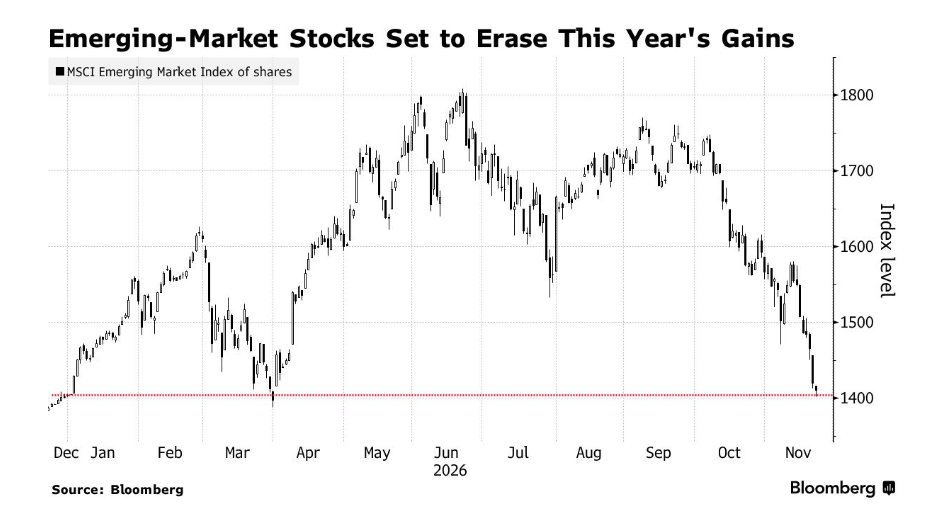
As shown in the chart above — the benchmark stock index for emerging market stocks is likely to erase this year's gains.
Charu Chanana, chief investment strategist at Saxo Markets, said, “Emerging markets are being doubly squeezed. On the one hand, crowded AI deals are being closed, and on the other hand, global financial conditions are tightening. I expect volatility to remain high, and even if there is a recovery, the performance of various markets may be uneven, making it difficult to form a general rebound.”
Emerging markets are approaching the current market, and US stock futures are the first to rebound
The MSCI Emerging Markets Index once fell 1.4% to 1,400.75 points during the intraday period, close to erasing all gains last year. If it closes lower, it will record eight consecutive declines. In South Korea, the shares of Samsung Electronics and SK Hynix, the two major beneficiaries of the last round of AI trading, fell sharply, dragging down the Korea Composite Index by more than 3%. On the Taiwanese stock market, government departments said they are considering reducing the margin ratio required for investors to finance stock purchases in order to curb the sell-off, and the Taiwan Weighted Index immediately fluctuated between ups and downs. The index plummeted 18% last week, the worst weekly performance since 1991.
In early Asian trading on Monday, US stock index futures rose, indicating that some investors may start looking for opportunities in stocks that have fallen sharply. S&P 500 futures rose 2.2%, while Nasdaq 100 futures rose nearly 3%.
Chanana said that the market stabilization measures announced by the Taiwan stock market and South Korea may slow down sell-off, and may in turn attract bargain buying, but “continued recovery ultimately depends on the stabilizing risk appetite of the global market on AI computing power topics and the restoration of investors' confidence that the profits of these leading companies in the AI computing power industry chain will continue to grow strongly.”
In other important trading markets, US Treasury futures declined as US stock index futures rebounded and safe-haven demand weakened. Brent crude fell below $92 per barrel, supporting the assets of emerging market countries dependent on energy imports.
On Friday, VIX rose above 40 in the intraday period, and safe-haven purchases drove the 10-year US Treasury yield to about 4.95%. When US stock futures rebounded in the Asian session on Monday, US bond futures turned down, while Brent crude oil fell below $92 per barrel. South Korea said that if the decline continues, it can immediately use capital to stabilize the market. The China Stock Exchange introduced regulatory loosening measures such as easing financing requirements, and the Taiwanese supervisory authority tightened some short selling rules and studied reducing financing deposit requirements. These measures can change short-term trading power. Whether the Asian AI computing power and semiconductor sector can break out of a continuous rebound also depends on whether the long-term AI computing power infrastructure financing, commissioning, and procurement plans for the North American data center project continue to be successfully implemented.
Wall Street is still optimistic about the AI computing power theme, and the differences focus on profit prospects for the next two years
In terms of large US technology stocks, Cetera's chief investment officer Gene Goldman (Gene Goldman) ** said after the November 20 sell-off that he still advocates retaining a long-term allocation for large technology stocks because the spread of AI is expected to continue to drive productivity and economic growth. He believes that if large cloud vendors slow down capital expenditure in the near future, the investment cycle may be lengthened, while freeing up space for free cash flow.
Mark Haefele (Mark Haefele), chief investment officer of UBS Global Wealth Management, predicted in the November outlook that global AI-related investment will rise from about $1 trillion in 2026 to $1.4 trillion in 2027, with computing power supply constraints and cloud revenue growth still providing support. The same outlook lowered US stocks, Asian (excluding Japan), and emerging market stocks as a whole to neutral, reflecting his two judgments that AI investment continues to grow and that stock market valuation multiples continue to be pressured against the backdrop of the Democratic Party controlling the Senate and House of Representatives and the Federal Reserve's new interest rate hike cycle.
In terms of Asian AI infrastructure hardware stocks, the strategy team led by Goldman Sachs senior strategist Timothy Moe (Timothy Moe) maintained the “overallocation” of the Korean stock market in mid-November, believing that memory chip-related stocks had taken into account market expectations that were too pessimistic about the 2027 profit trajectory compared to 2026. At the same time, the Taiwan stock market was reduced to “neutral” to reduce the excessive concentration of AI hardware in the portfolio.
Cameron Chui (Cameron Chui), an Asian stock strategist at J.P. Morgan Private Bank, and Weiheng Chen, a global investment strategist, are also optimistic about the South Korean and Taiwan stock markets in the November report. The former benefits from storage supply and demand that demand for advanced logic chips will remain tight until at least 2028, while the latter benefits from AI training and reasoning. J.P. Morgan Chase Private Bank then maintained a positive judgment on the two regions in its monthly outlook, and pointed out that if data center capacity expansion is delayed in 2028, the risk that semiconductor profits will be under pressure has clearly increased.
These opinions can be established simultaneously. For cloud vendors, delaying the commissioning of a batch of computer rooms can temporarily ease the pressure on capital expenditure. For Korean storage companies and Taiwan's advanced process supply chain, the same delay may only push delivery and revenue confirmation of AI infrastructure core hardware such as trillion-dollar GPUs, high-bandwidth memory (HBM) and DRAM/NAND memory chips, and high-performance optical interconnect hardware systems to 2028 or later, rather than completely terminating or reducing AI infrastructure orders. Therefore, whether this round of rebound can continue, what is most worth observing is whether the delay in computer rooms has further evolved into a reduction in orders, and whether AI payment revenue can support the continued expansion of customers. The former determines whether the profit expectations of the Asian computing power supply chain can be stabilized, while the latter determines how much room US cloud vendors have to re-invest their cash flow into AI.