
Jensen Huang Has Lost $92 Billion and Nvidia's Board Does Not Intend to Bring Him Back. Here's What 9 Stocks Did the Year After Their Founder Handed Over
Jensen Huang has lost $92 billion on paper since Nvidia’s (NASDAQ: NVDA) record close on Oct. 6, and the board of the company he led for 33 years says it "does not intend to reinstate Jensen as CEO." In the 9 big founder handoffs that came before his, the stock beat the S&P 500 over the next year 4 times and trailed it 5 times.
Apple beat the market by 55 points in the year after Steve Jobs handed the company to Tim Cook. Microsoft trailed it by 43 points after Bill Gates handed over to Steve Ballmer.
If you are a long-time shareholder who owns Nvidia because of Huang, and the stock has grown into a large share of your retirement savings, that record is the closest guide you have to the years without him. Read as a forecast for Nvidia, it says the first year after a founder leaves is close to a coin flip; the limit on that reading is that none of those handoffs followed a scandal, and Nvidia’s did.
Nvidia’s board accepted Huang’s resignation on Nov. 11, and its chair, Harvey C. Jones, made the statement about reinstating him on Nov. 17. The stock closed Friday at $125.53, down from a record $239.24 on Oct. 6.
What 9 founder handoffs did to the stockThe figures come from 24/7 Wall St.’s new research report, "Nvidia Without Jensen," which used Nasdaq and New York Stock Exchange closing prices. Each line is the stock’s total return in the year after its founder stepped aside as chief executive, minus the S&P 500’s, in percentage points.
- Apple, August 2011 (Steve Jobs to Tim Cook): ahead by 55
- Netflix, January 2023: ahead by 27
- Alphabet, December 2019: ahead by 22
- Qualcomm, July 2005: ahead by 14
- Oracle, September 2014: behind by 8
- Nike, December 2004: behind by 9
- Starbucks, April 2017: behind by 13
- Amazon, July 2021 (Jeff Bezos to Andy Jassy): behind by 25
- Microsoft, January 2000 (Bill Gates to Steve Ballmer): behind by 43
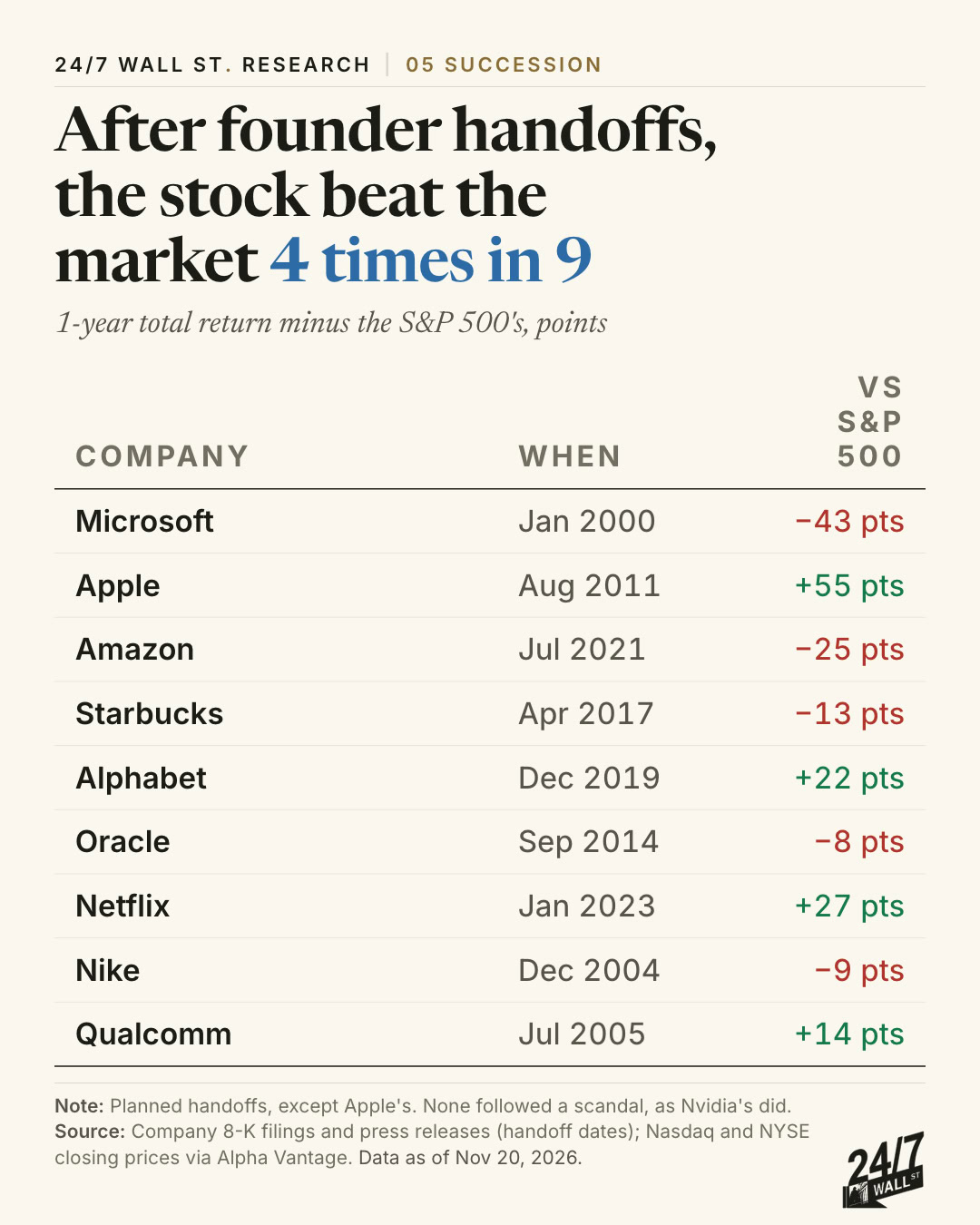
The gap between the best year and the worst is 98 points. Apple and Microsoft sit at the two ends of the list, and each had just seen a celebrated founder give up the top job.
Time helped. Three years after the handoff, 6 of the 9 stocks were ahead of the market. Starbucks and Nike trailed after one year and led after three.
My reading of that record: the business and the successor decided how those stocks did once the founder was gone, and the first year told you little about the third.
Why Nvidia’s handoff is harder to readAll but Apple’s were planned, and each company named its next chief executive when the founder stepped aside. Nvidia’s took four days from Huang’s note to his staff to the company’s announcement, and the board has not named a permanent successor. Here is the month in order. Press reports are marked as reports.
- Late October: The New York Times reported that U.S. officials suspect a Megaspeed executive who was close to Huang of spying for China. China denies it.
- Nov. 8: Huang told staff he had been "unfaithful" to his wife, CNN reported. The board opened an independent investigation and said it did not believe national security or company secrets were compromised.
- Nov. 9 and 10: The stock fell 9.5% in two trading days.
- Nov. 11: The Times reported a second affair, with an Nvidia executive. Nvidia, Huang and the executive have not confirmed it. The board met into the night and accepted his resignation, according to the company’s 8-K filing and Bloomberg.
- Nov. 12: Nvidia named Colette Kress interim CEO.
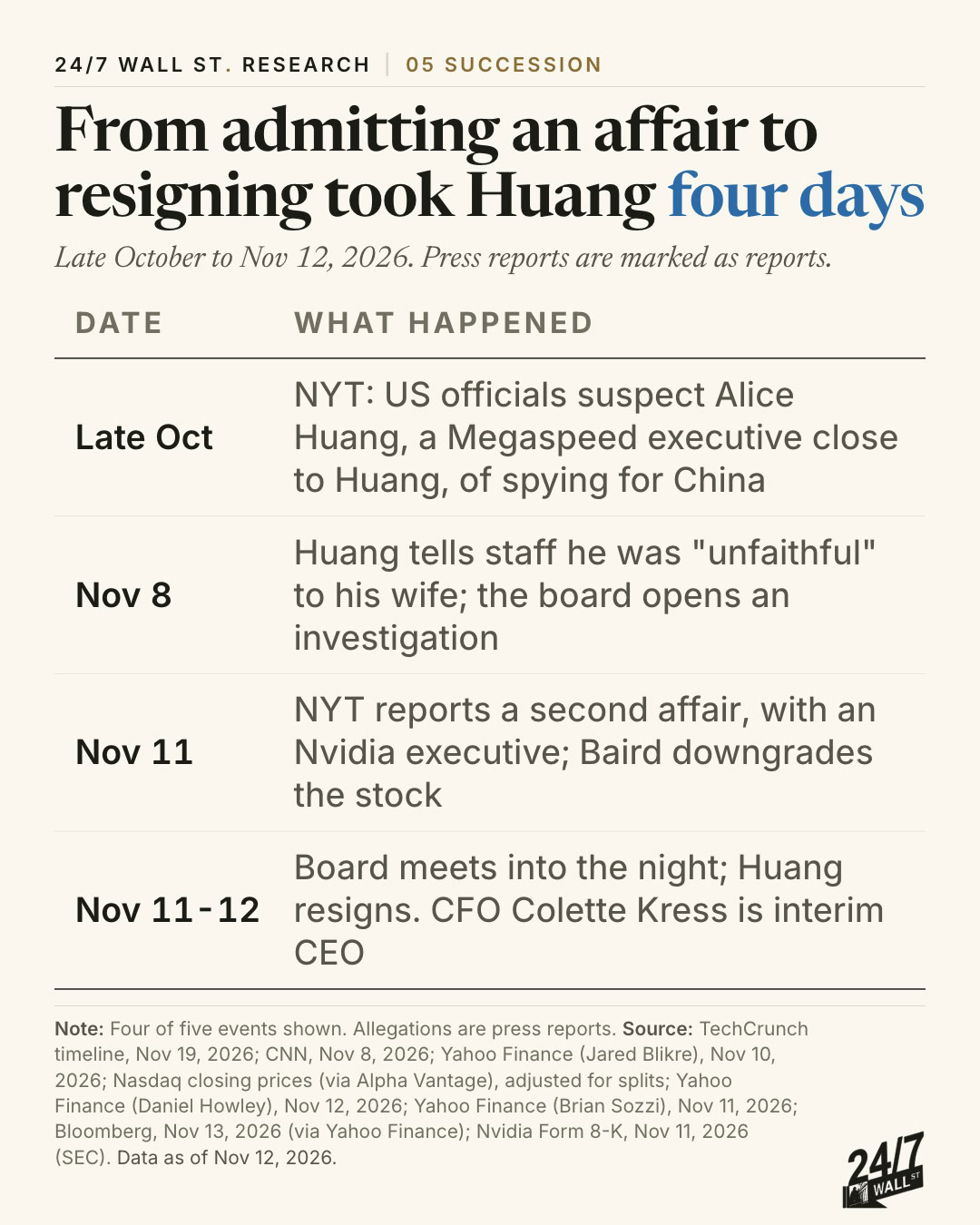
- Nov. 13: The Financial Times reported that the board had approached Rene Haas, the chief executive of Arm.
- Nov. 15: The Financial Times reported that Huang had discussed a comeback with allies.
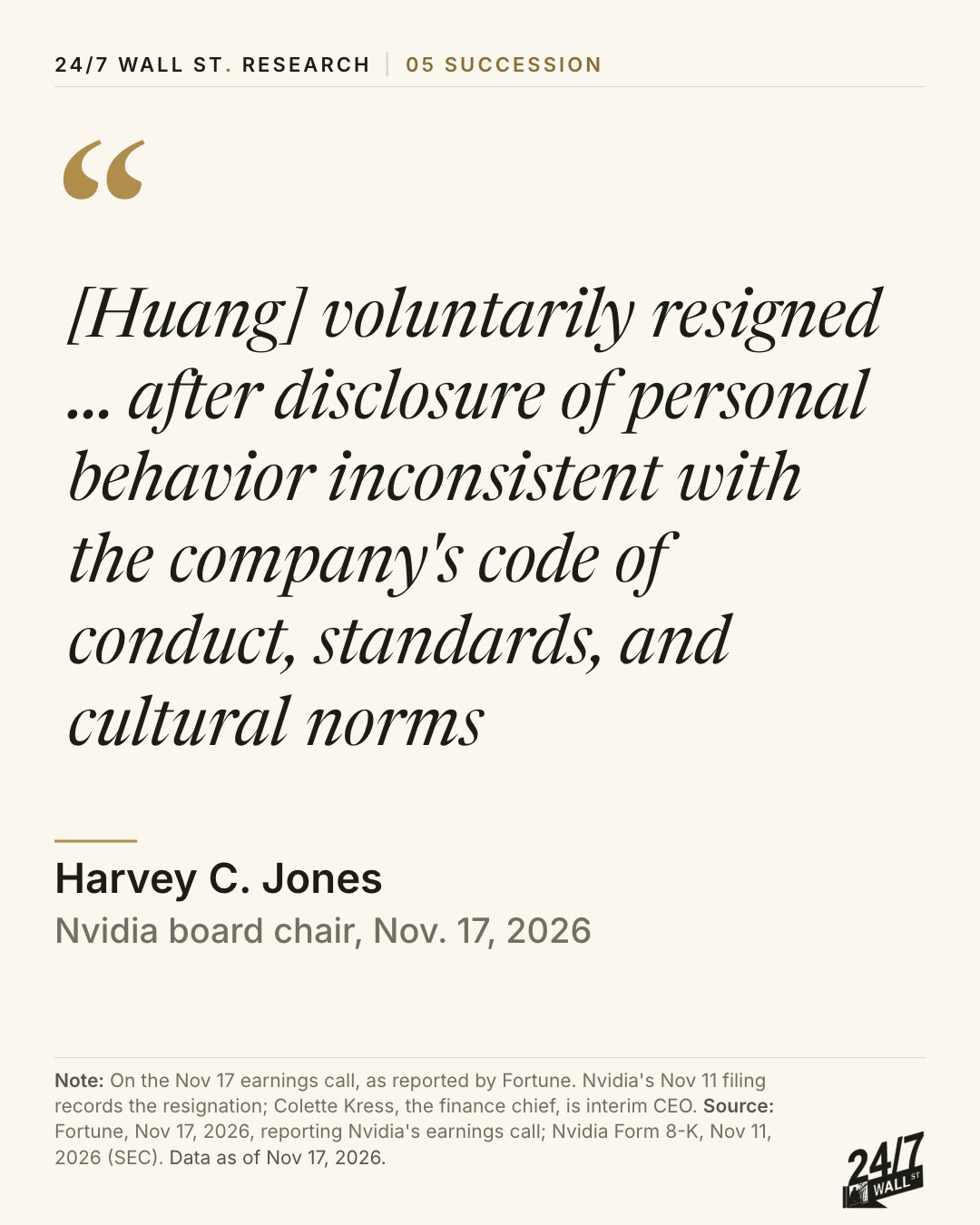
- Nov. 17: Huang said he would be "honored" to return. On Nvidia’s earnings call the same day, Jones said Huang resigned "after disclosure of personal behavior inconsistent with the company’s code of conduct, standards, and cultural norms," Fortune reported.
- Nov. 18: Huang agreed to testify to the Senate Banking Committee.
- Nov. 20: Reuters reported that Securities and Exchange Commission staff are examining potential accounting issues at Nvidia, and the stock fell 14% that day. An inquiry is not a finding of wrongdoing.
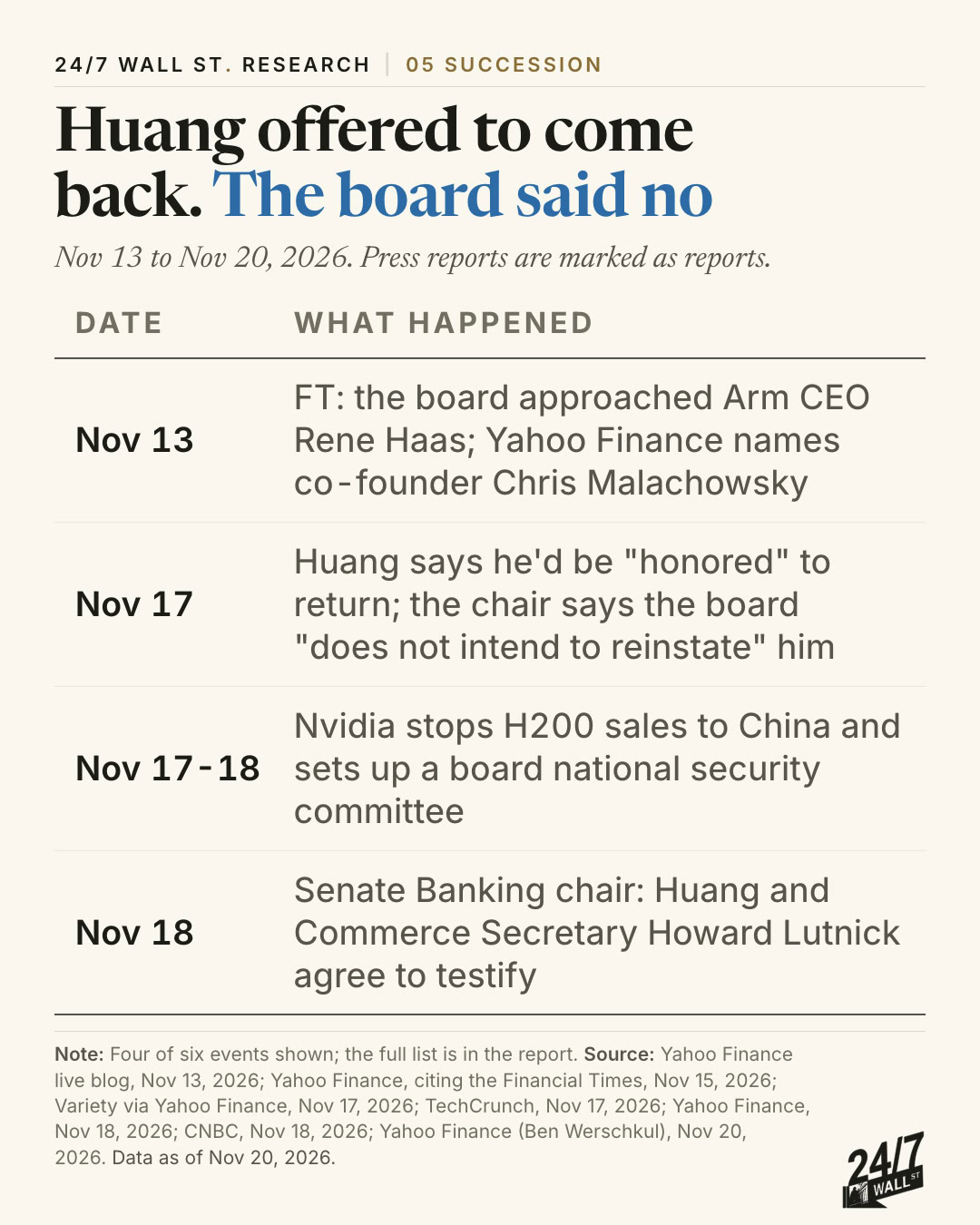
That leaves you with three open questions the earlier handoffs never carried: who will run Nvidia, what the board’s investigation will find, and what the SEC is examining.
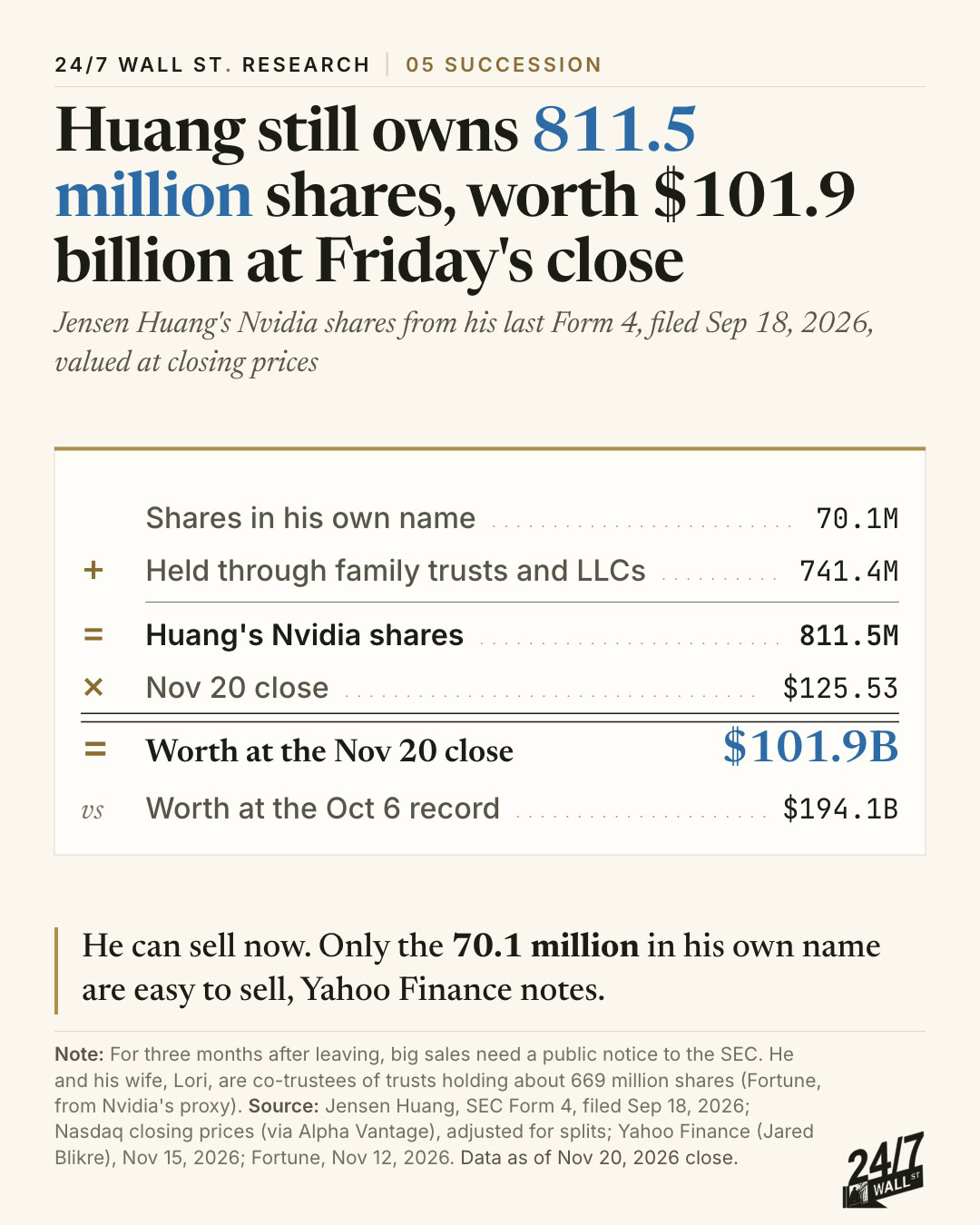
What to watch if you still own NvidiaHuang still owns 811.5 million Nvidia shares, according to his last Form 4 filing with the Securities and Exchange Commission: 70.1 million in his own name and 741.4 million through family trusts and LLCs. At Friday’s close that stake was worth $101.9 billion, down from $194.1 billion at the Oct. 6 record. The difference is his $92 billion paper loss.
He can sell now. For three months after leaving he still counts as an insider, so large sales come with public notice.
Three things will tell you where this goes:
- The successor. In every one of the earlier handoffs you knew the next chief executive on day one. Nvidia has an interim CEO and a search.
- The two inquiries. The board has not reported what it found, and Reuters could not determine which accounting issues the SEC is examining.
- Huang’s filings. If he sells a large block in the next three months, you will see the notice.
We’ll track all three in The Daily Profit, our free weekday email, starting with any large sales Huang reports over the next three months. Sign up free here.
My view, as analysis: expect the uncertainty to weigh on Nvidia’s price until the board names a successor and both inquiries are settled. The history gives you no reason to sell a great business only because its founder is gone. It also gives you no promise of a quick rebound, since most of those stocks trailed the market in their first year.
The bottom line: if Nvidia has grown into a large share of your savings, set the size of your position by how long you can wait. The record favored shareholders who could give a new chief executive three years.