
The S&P 500 index fell seven times in a row, and the “Wall Street Prophet” lowered its year-end target again after only two months
The Zhitong Finance App learned that as of the close of November 20 EST, the benchmark stock index for US stocks, the S&P 500 index, fell 3.70% to 6,910.39 points, closing lower for seven consecutive trading days, retreating 11.6% from the historical closing high on October 6. AI computing power and semiconductors can be described as leading global risk assets. The Philadelphia Semiconductor Index fell 17.13% throughout the week, the Nasdaq 100 Index fell 10.43%, and the MSCI Global Stock Index fell 8.1%. Following this round of sharp sell-off of global technology stocks, Ed Yardney, a senior strategist and “long-term majority” in the market, lowered the S&P 500 index target by the end of 2026 from 7,900 points to 7,500 points in a November 21 research report. This is the second time he has lowered his target from 8,400 points to 7,900 points in September.
However, from another perspective, the new target given by Adney, who holds the title of “Wall Street Prophet,” is still 8.53% higher than Friday's closing, but even if realized, S&P will still be lower than the pre-October high at the end of the year. Adney is more optimistic about 2027. The index is expected to close at 8,500 to 9,000 points at that time, up 23.0% to 30.2% from Friday's close.
The title “Wall Street Seer” comes from an American media cover report on August 4, 1997, describing him as a “Wall Street Seer.” Ed Yardney has made accurate judgments for decades that technology investment will increase US labor productivity, making the economy expected to maintain low inflation while the unemployment rate falls, thus creating conditions for the continuation of the long-term bull market in US stocks.
The impact of Adney's remarks and investment opinions on the market is mainly reflected in how Wall Street's top institutional investors judge the economic cycle and how high a valuation they are willing to pay for corporate profits. He was the chief investment strategist for Deutsche Bank's US stock business. He founded Adney Research in 2007 to provide independent research for institutional investors for a long time. The term “bond police” he proposed in 1983 is still being used by large asset management institutions such as BlackRock and Pimco to explain how investors can restrain government borrowing by requiring higher yields.
In this round of US stock adjustments, he lowered the S&P 500 target twice, but he still believes that the probability of an overall bear market is low. This is also worth paying attention to: he believes that investors have lowered the price-earnings ratio they are willing to pay, and what determines whether the decline will further deepen is whether the profit pressure on the global AI computing infrastructure semiconductor industry will spread further to a wider range of US companies.
Adney lowered the S&P 500 target again, but he thinks it is unlikely that US stocks will enter a bear market
After a round of intense sell-off pushed the S&P 500 index into a technical adjustment range, Wall Street strategist Ed Yardney lowered his year-end forecast for the index for the second time in about two months.
After experiencing a correction in US stocks last week, the president and chief investment strategist of Ardney Research predicts that the S&P 500 index will close at 7,500 points by the end of 2026, which is lower than his target of 7,900 points after the September cut. Even so, compared to last Friday's closing level, this target still means that US stocks are expected to rebound by more than 8%.
Investors' concerns about whether the AI market will continue have driven the S&P 500 index down for seven consecutive trading days. The Nasdaq 100 Index, which has a high weight in technology stocks, has just recorded its biggest weekly decline since March 2020.
Adney said that stocks in the semiconductor sector have also been hit hard by news that the US is tightening export controls. Earlier, Nvidia and other US chip companies were accused of selling chips indirectly to the Chinese market, and the US side tightened the relevant restrictions based on this.
Adney wrote in the latest research report: “The market fears that stricter export controls will weaken demand for chips and lower chip prices. If this is the case, after the semiconductor industry's valuation multiples fall, there will soon be a slowdown in profit growth, or even a decline in profit itself.”
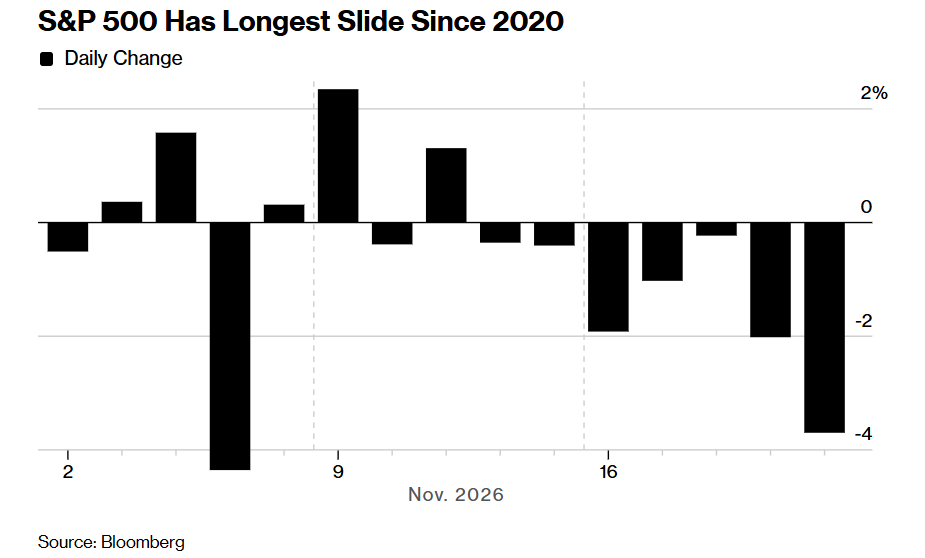
As shown in the chart above — the S&P 500 index recently recorded its longest continuous decline since 2020. The last time Adney lowered the S&P 500 target was in September. At the time, his views on the stock market, particularly global technology stocks, became cautious. At the same time, he anticipated that the market's sell-off response to this month's US midterm elections would bring buying opportunities.
He wrote, “The buying opportunity presented by the market this time was greater than we had originally anticipated. We had anticipated a fall in the stock market, but now the decline has reached the standard of technical adjustment.”
He said it is unlikely that the S&P 500 index will fall further into a bear market since there is no immediate threat of the economy falling into recession.
Adney remains optimistic about next year's prospects. He expects the S&P 500 index to close at 8,500 to 9,000 points by the end of 2027, with room for growth of about 30% from the current level based on the upper limit of the range. Among Wall Street strategists tracked by Bloomberg, this is one of the most optimistic predictions.
Last week's large-scale sell-off also boosted the most watched volatility index for US stocks. The Chicago Board Options Exchange Volatility Index, known in the market as VIX, rose to its highest level since April 2025. However, Adney said that since “there are no signs of economic recession” at present, he believes it is unlikely that this “panic index” will rise sharply further.
S&P 500's price-earnings ratio is expected to drop to 16.4 times. Will the tightening of chip exports drag down semiconductor profits?
US bond yields rose in September, and Adney significantly lowered the reasonable valuation multiplier for the S&P 500. By November, the market sell-off had crushed the index's expected price-earnings ratio to 16.4 times. He emphasized that if export restrictions weaken chip demand and lower sales prices, the semiconductor sector, which accounts for an important weight in US stocks, may be pressured by downward profit expectations after falling valuations.
In September, Adney cut the price investors were willing to pay for every dollar of profit. US bond yields rose at the time. He maintained the S&P 500's 2027 earnings forecast of 425 US dollars per share and lowered the expected price-earnings ratio used to estimate the year-end point from 19.8 times to 18.6 times. As a result, the target was lowered from 8,400 points to 7,900 points.
By November 20, S&P's price-earnings ratio had fallen to 16.4 times, the lowest since the 2022 bear market, but Wall Street analysts agreed that analysts' unanimous expectations for earnings per share for the next 12 months hit a new high of $421.84. This set of divergences explains why he is still optimistic about the rebound, and also points out where the bullish judgment is most worth testing: the stock price already reflects investors' doubts about profit predictions; the next step is whether the company can deliver on this profit.
Semiconductors are the industry that first faced this test of judgment. The expected price-earnings ratio for the S&P 500 semiconductor industry has dropped 9.4 times. The new US regulations include some arrangements for remotely obtaining advanced computing power through overseas data centers in the scope of the license. If restricted orders cannot be accepted by other customers, the pressure will spread from delivery volume to chip sales price and gross profit margin, and today's seemingly cheap price-earnings ratio may also pick up due to revised profit forecasts.
Goldman Sachs chief US stock strategist Ben Snyder recently predicted that as global AI capital expenditure growth slows and previously invested equipment depreciates one after another, the S&P 500 index's overall earnings per share growth rate will slow from about 30% in 2026 to 11% in 2027, but this is still enough to support its target of 8,700 points at the end of 2027. UBS Global Wealth Management expects profit growth of about 15% over the same period, with a target of 8,200 points, while adjusting the US stock allocation rating to “neutral.” The joint judgment of the three top Wall Street institutions can be described as the fact that corporate profits still have room to grow. The differences are whether this growth can continue to be realized and how high the valuation is worth paying for investors.