
Capital flocked to US debt to help the “anchor of global asset pricing” fall below 5%! Can tech stocks take advantage of the momentum to rebound after “Black Friday”?
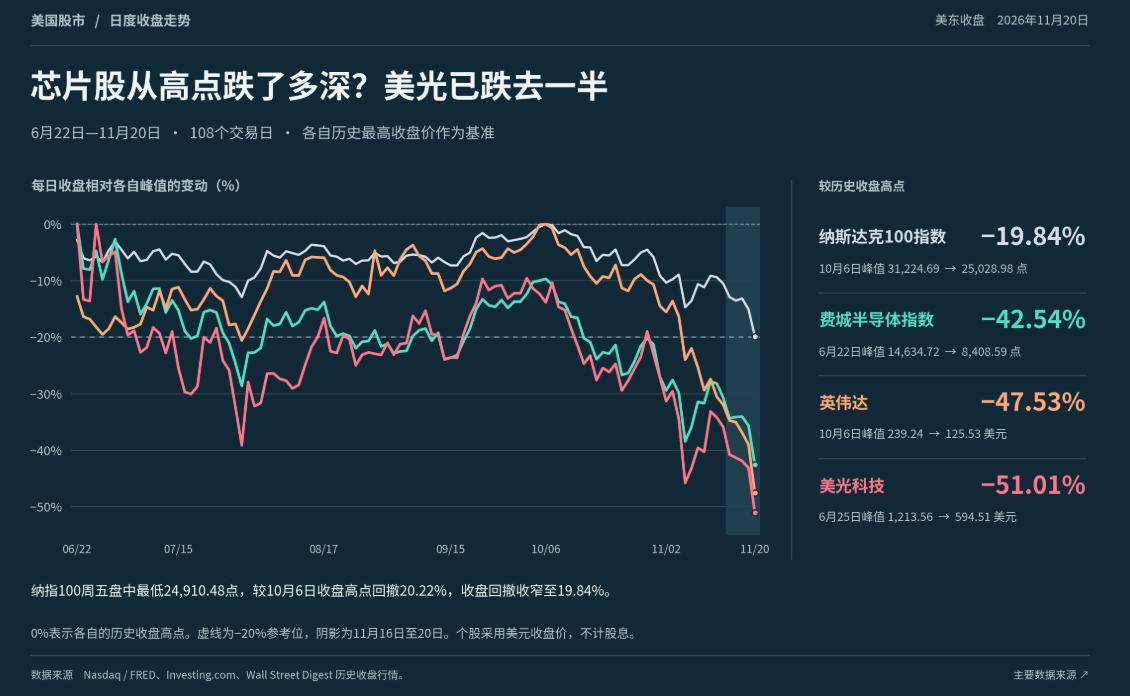
The Zhitong Finance App learned that by the end of the US stock market on November 20, the tech stock sell-off on Thursday had evolved into a “Black Friday” for global stock markets. The S&P 500 index fell 3.70% to 6,910.39 points, closing lower for seven consecutive trading days, and the Dow, which fell 1.93%, both entered technical adjustments. The Nasdaq Composite Index fell 5.28%, the Nasdaq 100 Index fell 5.61% and fell 10.43% throughout the week. The Philadelphia Semiconductor Index fell sharply by 10.73% in a single day on Friday, up to 43% from its historical closing high on June 22. This benchmark index, which can be called the “global AI computing power trading weather vane,” can be described as being mired in a bear market.
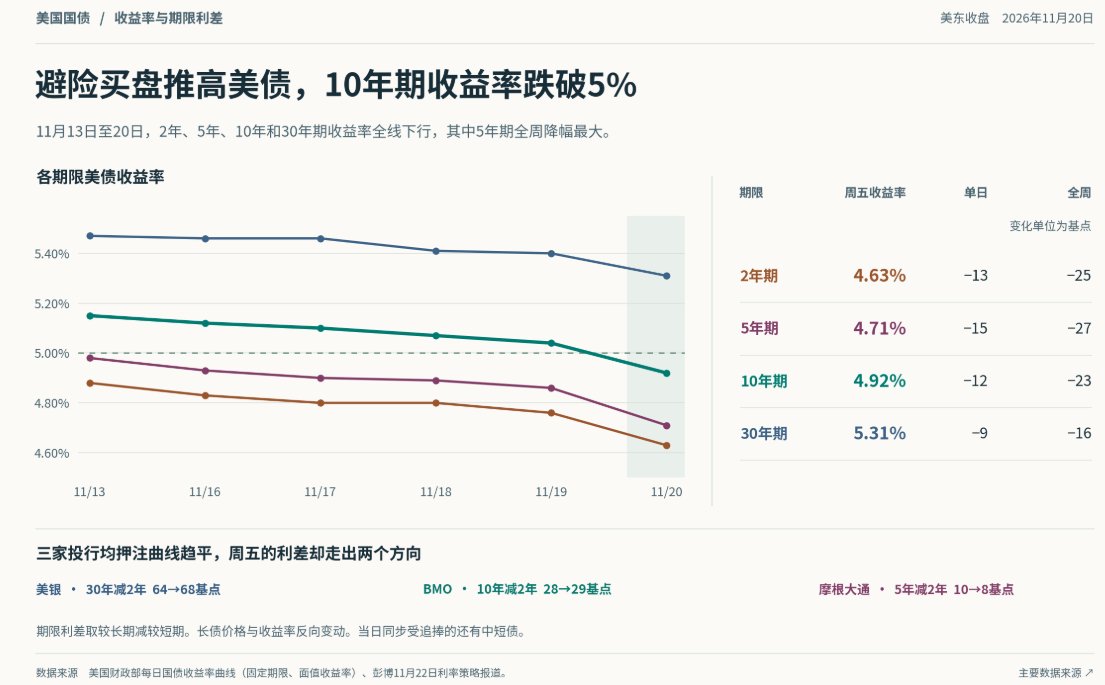
At the same time, long-term US bond yields continued to decline under the expectation that safe-haven purchases continued to flock to US bonds, and the Federal Reserve's hawkish anti-inflationary attitude and stock market collapse might cause the US economy to decline. The 10-year and 30-year US bond yields fell to 4.92% and 5.3%, respectively.
Although the decline in global stock markets is beginning to cast a stronger shadow over America's economic growth prospects, Wall Street strategists seem to be gradually forming a consensus, favoring the bond market to bet that the Federal Reserve will continue to forcefully fulfill its anti-inflation promises.
The strategists at Bank of America, BMO Capital Markets, and J.P. Morgan Chase continue to firmly support so-called US Treasury yield curve flattening transactions — that is, betting that short-term US Treasury bonds will perform less well than longer-term treasury bonds. The core logic behind this is that the Federal Reserve's continued interest rate hike will drive up short-term US bond market yields, while austerity measures to suppress economic growth and inflation will eventually reduce long-term benchmark borrowing costs for 10-year and 30-year terms.
As global technology stocks dominated by AI computing power and semiconductors continue to plummet, and the S&P 500 index enters an adjustment range, these market suggestions, which presuppose that the Federal Reserve maintains hawkish interest rate hikes, have attracted particular attention. They reflect a near unanimous judgment among strategists: under Chairman Kevin Walsh, the Federal Reserve will do whatever is necessary to curb inflation, even at the cost of slowing economic growth. The US inflation rate has been above the Federal Reserve's 2% target for more than five years.
Mark Cabana, head of US interest rate strategy at Bank of America, said, “When the Federal Reserve decides to raise interest rates, admits that it must firmly raise interest rates to fight inflation, and also acknowledges that this will have a certain impact on economic growth, a flat curve transaction works best. “Concerns about growth will drive capital flows to safe assets with the highest yield. At that time, long-term treasury bonds of 10 years or more may perform well for a long time — rising 10-year US bond prices mean that the yield on 10-year US bonds, which is the anchor of 'global asset pricing', continues to decline.”
As Wall Street's top fixed income strategists are betting on the accelerated decline in long-term US bond yields, some institutions are also beginning to simultaneously bet that this safe-haven driven long-term bond market may evolve into a new round of stock bonds to rebound soon after “Black Friday.” This is why NASDAQ 100 futures and S&P futures showed a sharp rebound after starting trading in the Asian market on Monday. In other words, some optimistic stock market strategists believe that soon after the global stock market plummeted, the yield on US bonds of 10 years or more will continue to decline, which may further reduce the valuation pressure on AI computing power and technology stocks such as semiconductors by driving the downward trend in the denominator side of the DCF risk asset valuation model and the heavy pressure on AI financing costs that have recently greatly heated up, ultimately contributing to a new round of growth in the price of long-term US bonds and AI computing power and semiconductor themes.
However, in order for this safe-hedge-driven long-term debt market to evolve into AI computing power rising along with semiconductor-centered technology stocks and long-term US debt, the key is that while inflation has cooled significantly and expectations of a “soft landing” for the US economy have strengthened, AI application revenue generation has exceeded expectations, profit expectations in the AI computing power industry chain continue to expand, and AI infrastructure financing costs continue to decline.
US stocks experienced “Black Friday,” and global safe-haven funds tacitly poured into long-term US bonds
Thursday's tech stock sell-off has evolved into “Black Friday” for global stock markets. The S&P 500 index fell 3.70% to 6,910.39 points, closing lower for the seventh consecutive trading day, and the Dow, which fell 1.93%, both entered technical adjustments. The Nasdaq 100 index plummeted 5.61% in a single day, about 19.84% lower than its historical closing high on October 6. At one point, the intraday decline of more than 20% entered the so-called “technical bear market zone.” In terms of the Nasdaq Composite Index (NASDAQ), which covers a wider range of technology stocks, the total market value of the NASDAQ Composite Index components shrunk by more than 4 trillion US dollars in the week ending November 20 EST.
To measure the depth of this round of stock market adjustments, the US stock Philadelphia Semiconductor Index, which has the title of “AI computing power weather vane,” is more representative than the NASDAQ index in recent years. Fee Half fell 10.73% to 8,408.59 points on Friday, down 42.54% from its all-time closing high on June 22. The weekly decline reached 17.13%, the worst week since September 2001. The total loss of the constituent companies was about 2.3 trillion US dollars in market value.
The decline in individual stocks with popular AI computing power themes in the US stock market was even more severe. Micron Technology, a leader in memory chips headquartered in the US, plummeted 13.89% to $594.51 in a single day, falling as fast as 51.01% from the all-time high closing price set in June, and experienced a fall of about 14% on Friday, evaporating a cumulative market value of about 2.7 trillion US dollars since the high on October 6, which is equivalent to the total market value of Amazon, a technology giant during the same period.
Global safe-haven funds can be described as a collective shift to long-term US bonds, and the 10-year yield has once again fallen below 5%. Bank of America, BMO, and J.P. Morgan still believe that inflation is enough to keep short-term interest rates high, and that slowing growth will further reduce yield trends over a longer period of time.
According to the US Treasury's daily yield curve, the prices of 2-year, 10-year, and 30-year US bonds all rose. Yields fell 13, 12, and 9 basis points, respectively, to 4.63%, 4.92%, and 5.31%, respectively, and declined by 25, 23, and 16 basis points, respectively, throughout the week. All three levels of yield were the lowest since November 9. What is really rare is the rate of decline. According to US bond market quotes tracked by the Wall Street Journal, the 2-year yield recorded the biggest weekly decline since September 2024.
Wall Street financial giants are beginning to outline a path for equity and debt to rise. Profit cashing in the global AI industry chain is a key factor
On “Black Friday,” long-term bonds realized their safe-haven value, while technology stocks with AI computing power and semiconductors as the core weights are still digesting investors' concerns about the return on AI capital expenditure.
Mark Cabana, head of US interest rate strategy at Bank of America, is betting that 30-year US bonds will outperform 2-year bonds, mainly based on the possibility that subsequent interest rate hikes may boost short-term yields. Mark Heifer, chief investment officer of UBS Global Wealth Management, suggested a path for equity and debt growth: if inflation gradually eases and profits continue to grow, UBS expects that by the end of 2027, the 10-year US Treasury yield will drop to 4.75%, and the S&P 500 index will rise to 8,200 points.
As shown in last week's market, there are still many questions about the impact of artificial intelligence on the economy, stock market, and monetary policy path. The specific entry timing of the deal that Wall Street's top fixed-yield strategists are beginning to bet on (that is, a transaction to flatten the US bond yield curve, that is, selling shorter term US bonds and buying longer-term US bonds, betting that the yield difference between the two narrows) is also becoming more and more difficult to grasp. On Friday, the decline in global stock markets led to safe-haven purchases. 2-year US bonds are particularly sought after, which instead drove the yield curve steeper.
Take the combination recommended by BMO as an example: sell 2-year US bonds, buy 10-year US bonds, and bet that “10-year yield minus 2-year yield” will become smaller. On Friday, safe-haven purchases lowered the 2-year yield by 13 basis points and the 10-year yield by 12 basis points. Instead, the spread between the two widened from 28 basis points to 29 basis points.
As the stock market fell, traders cut their bets on the Federal Reserve's rate hike. Currently, the market anticipates that the subsequent cumulative interest rate hikes will be less than three times, 25 basis points each time. By January next year, the market will have fully included a 25 basis point rate hike. After that, it may be added again in March as soon as possible, and then interest rate cuts will not begin until 2028. This means that the contraction cycle expected by the market is shorter than before.
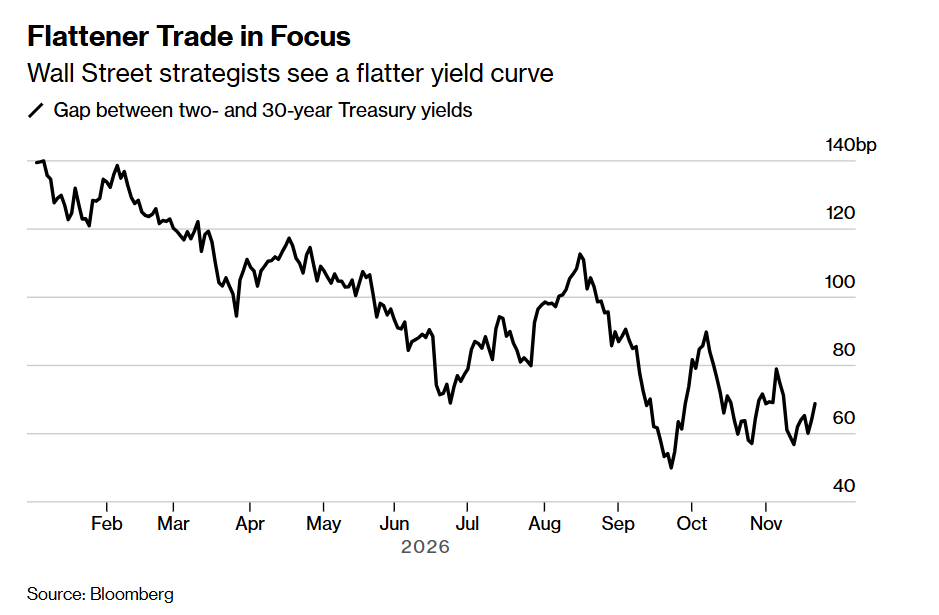
As shown in the chart above, flattening the US bond yield curve has become the focus — Wall Street strategists agree that the yield curve will flatten.
Strategists still believe that there is limited room for the Federal Reserve to completely let go of its way in fighting inflation, so concerns about the economy are more likely to be reflected in a decline in US bond yields over a longer period of time. At a time when the stock market fell sharply on Friday, Federal Reserve officials once again stated that it is still necessary to raise interest rates.
Cabana from Bank of America proposed flattening the 2-year and 30-year US debt layout curves. He anticipates that this change will be mainly driven by rising short-term yields. J.P. Morgan recommended selling 2-year US bonds and buying 5-year US bonds. BMO prefers a combination of 2-year and 10-year terms. It believes that when risk assets weaken, 10-year US bonds may benefit more from safe-haven needs.
Since this year, the oil shock has heightened concerns about inflation, AI has driven a boom in investment and debt issuance, and the market's expectations for the Federal Reserve's policy are constantly changing. Several forces are intertwined, causing investors to be repeatedly impacted by the market.
These forces have significantly flattened the curve. Since this year, 2-year US Treasury yields have risen by nearly 120 basis points, 10-year yields have risen by nearly 80 basis points, and the spread between the two has narrowed by about 40 basis points.
Ed Husseini, a portfolio manager from Tianli Investment Management in Colombia, is still betting on a further flattening of the curve. He said, “The yield curve tells us that monetary policy is being tightened. I don't think this process is over yet, but the curve will flatten much more slowly.”
However, another group of investors believes that at a time when the stock market is in turmoil, a steeper curve will become the new direction. At TCW Group, Jamie Parton manages a portfolio with long term holdings, with interest rate exposure concentrated on short- and medium-term bonds. Recently, she has been using bond market pullbacks to increase her holdings. The co-head of global interest rates said, “The market is already under so much pressure, and it is increasingly difficult to imagine that the Federal Reserve will raise interest rates in a big way.”
However, if the Federal Reserve does tighten its policy further, historical experience shows that there may still be room for a flat curve transaction.
Since the 1980s, in the six months since the Federal Reserve first raised interest rates, the difference between 10-year and 2-year US Treasury yields narrowed by an average of about 25 basis points, and narrowed by an average of 47 basis points within 12 months. Since the Federal Reserve raised interest rates in September this year, this spread has instead widened by about 1 basis point. Currently, it is about 29 basis points.
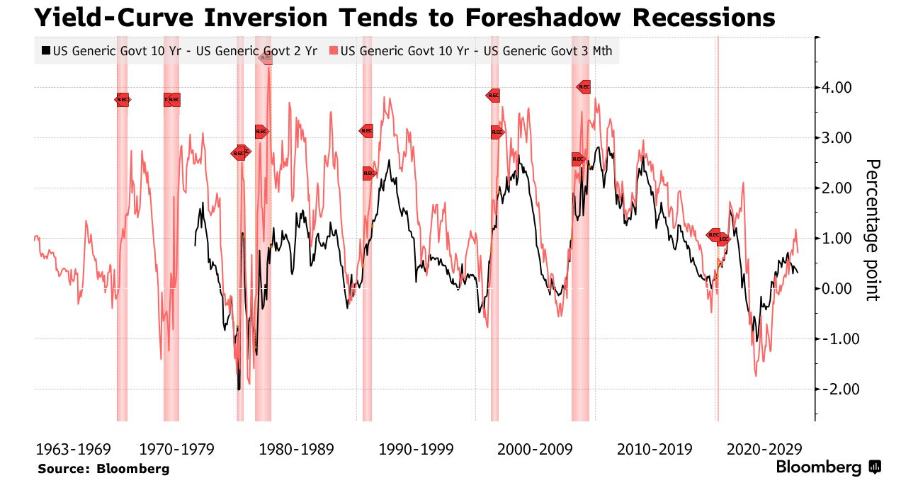
As shown in the chart above, an inversion of the yield curve often indicates a recession.
Arif Hussain, head of global fixed income at Puxin Group, is actively arranging flat curve transactions. He anticipates that next year the curve will be further inverted, that is, short-term returns will be higher than long-term yields. Communication with business people convinced him that price pressure had become more stubborn and that the Federal Reserve might need to take more aggressive action.
This inversion is an important sign for investors. As far back as the 1960s, the yield curve was inverted before the past eight recessions in the US. However, the inversion from 2022 to 2024 raised a false alarm.
Barclays anticipates that after the Federal Reserve raises interest rates further, it will be difficult to maintain its austerity stance for a long time. The bank's strategists Anshur Pradhan, Demi Hu, and Samuel Earle advised customers to plan ahead of schedule earlier this month, betting that the market would take into account the expectation that the Federal Reserve would cut interest rates sharply within 12 months after June next year.
As mentioned above, in order for the long-term debt market driven by safe-haven to evolve into a rise in equity and debt, the key is whether the profit expectations of the AI industry chain can be maintained while inflation cools down. If long-term interest rates fall due to easing inflation, and equity risk premiums and corporate credit spreads remain stable, the denominator side cash flow discount rate of technology stocks based on the DCF model and the long-term fixed interest rate financing costs of new AI infrastructure for computing power projects are expected to drop at the same time. If paid revenue from AI applications can also support computing power rents and the next round of GPU procurement, high-quality computing power and semiconductor companies may simultaneously benefit from reduced valuation pressure and profit fulfillment, and emerge from the same round of growth as long-term US bonds.
UBS Global Wealth Management's Chief Investment Officer team gave a stark contrast to this — in a benchmark scenario with steady growth and moderate inflation, UBS expects 10-year US bond yields to fall to 4.75% and the S&P 500 index to rise to 8,200 points by the end of 2027; while in a scenario where computing power supply exceeds payment demand and AI profit forecasts are drastically lowered, even if US bond yields fall to 3.00%, S&P may drop to 5,500 points.
Pathstone's chief investment strategist Michael McGowan has begun to selectively increase holdings focusing on hardware companies after the sharp decline in AI infrastructure, and anticipates that the stock price performance of companies capable of investing their own funds to build data centers and operators that rely on external financing will be further divided.
The derivatives research and strategy team at the Carson Wealth Management and Finance Research Center clearly bullish this week's technology stock market in the trading outlook released last Friday. He pointed out that at the time of writing, the S&P 500 and Nasdaq Composite Index's Relative Strength Index (RSI) had both dropped to 26, while the VIX had risen above 30, indicating that short-term sell-off was close to extreme, and the probability of a technical rebound was higher than usual. He is particularly concerned about acceptance strength after the opening of the market next Monday — if the stock index can close strongly after opening low, or if it continues to be under pressure on Monday and quickly recovers lost ground on Tuesday, it will be more indicative that buying is willing to catch up with sales than simply opening higher.