
Unilever (LSE:ULVR) Faces Court Scrutiny, Is The Stock Fully Valued?
Unilever (LSE:ULVR) is back in focus after a German court in Hamburg blocked the use of the term sustainably grown on potatoes in its Pfanni dumpling mix, highlighting how marketing claims intersect with regulatory scrutiny.
The verdict in Hamburg lands at a time when Unilever’s 1-year total shareholder return of 3.1% and 3-year total shareholder return of 33.0% point to steady compounding. A 4.4% 90-day share price return suggests momentum has started to rebuild after recent sector-driven swings.
Spot opportunities beyond Unilever by scanning a curated 6 resilient stocks with low risk scores that aligns with the kind of resilient profile many investors look for in large consumer staples.After a 4.4% 90 day rise and modest 1 year gains, Unilever still trades at a 5% to 7% discount to some fair value markers. Is that caution misplaced, or perfectly sensible?
Most Popular Narrative: 16% Overvalued
At a last close of £48.88 against a narrative fair value of £42.28, Unilever is framed as modestly expensive, which raises a simple question for investors about what kind of business they would be paying for if they bought in at today’s level. According to Robbo, an investor in the Simply Wall St Community, the key issue is how a reshaped Unilever might look after planned portfolio changes.
Unilever (LSE:ULVR) is changing. It has plans to no longer simply be the mature consumer staples business it has been for decades. The plan is to demerge its food businesses, the creation of the Magnum Ice Cream Company already occurred. As such it is worth exploring what this means for the company and its case as an investment going forward.
See why 16 investors see Unilever as 16% overvalued.
In that view, the food demerger and tighter focus on Beauty & Wellbeing, Personal Care and Home Care could reshape how investors think about Unilever’s cash flows and risk profile over time, especially given the current discount rate of 8.35% used to reach the £42.28 fair value. The same narrative points to brand strength, margin potential and cash generation as reasons the shares are not seen as extremely mispriced, even if they screen as 16% above that intrinsic estimate today.
Result: Fair Value of £42.28 (OVERVALUED)
Still, the Unilever story could be knocked off course if the food demerger delivers fewer efficiencies than hoped, or if future acquisitions prove hard to integrate.
Find out about the key risks to this Unilever narrative.
Another View: Unilever Through A Cash Flow Lens
Unilever looks slightly expensive against a £42.28 narrative fair value, yet our DCF model points in the opposite direction. At £48.88, the shares sit about 5.3% below an estimated future cash flow value of £51.61, which frames today’s price as a mild discount instead of a premium. So which story do you trust when both use reasonable assumptions but land on different answers?
For a closer look at how those future cash flows are modeled and where the sensitivities really lie, take a few minutes to walk through the Look into how the SWS DCF model arrives at its fair value.
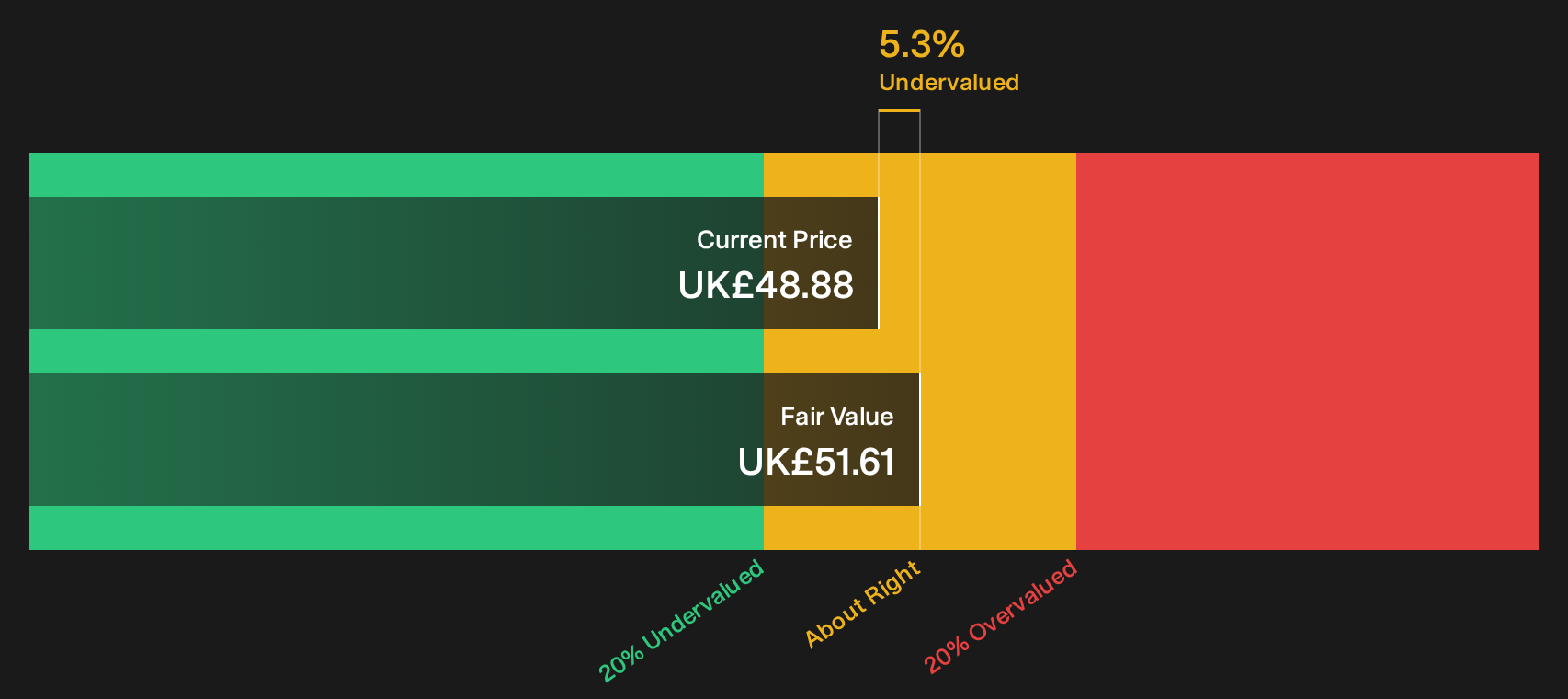
Simply Wall St performs a discounted cash flow (DCF) on every stock in the world every day (check out Unilever for example). We show the entire calculation in full. You can track the result in your watchlist or portfolio and be alerted when this changes, or use our stock screener to discover 18 high quality undervalued stocks. If you save a screener we even alert you when new companies match - so you never miss a potential opportunity.
Next Steps
With Unilever attracting both concerns and optimism, do not leave the verdict to headlines alone. Instead, review the data yourself with 4 key rewards and 2 important warning signs
Looking for more investment ideas beyond Unilever?
If you only stop at Unilever, you risk missing other opportunities that might suit your goals or risk comfort even better.
- Zero in on quality at a discount by scanning our 18 high quality undervalued stocks that highlights companies combining solid fundamentals with appealing prices.
- Build a payout focused portfolio by reviewing a curated set of income ideas in the 6 dividend fortresses designed for investors who care about yield and resilience.
- Strengthen your watchlist with financially robust choices by using the list of solid balance sheet and fundamentals (7 results) to focus on businesses with sturdier balance sheets.
Have feedback on this article? Concerned about the content? Get in touch with us directly. Alternatively, email editorial-team@simplywallst.com