
How Leadership Changes Will Impact Home Depot (HD) Investors
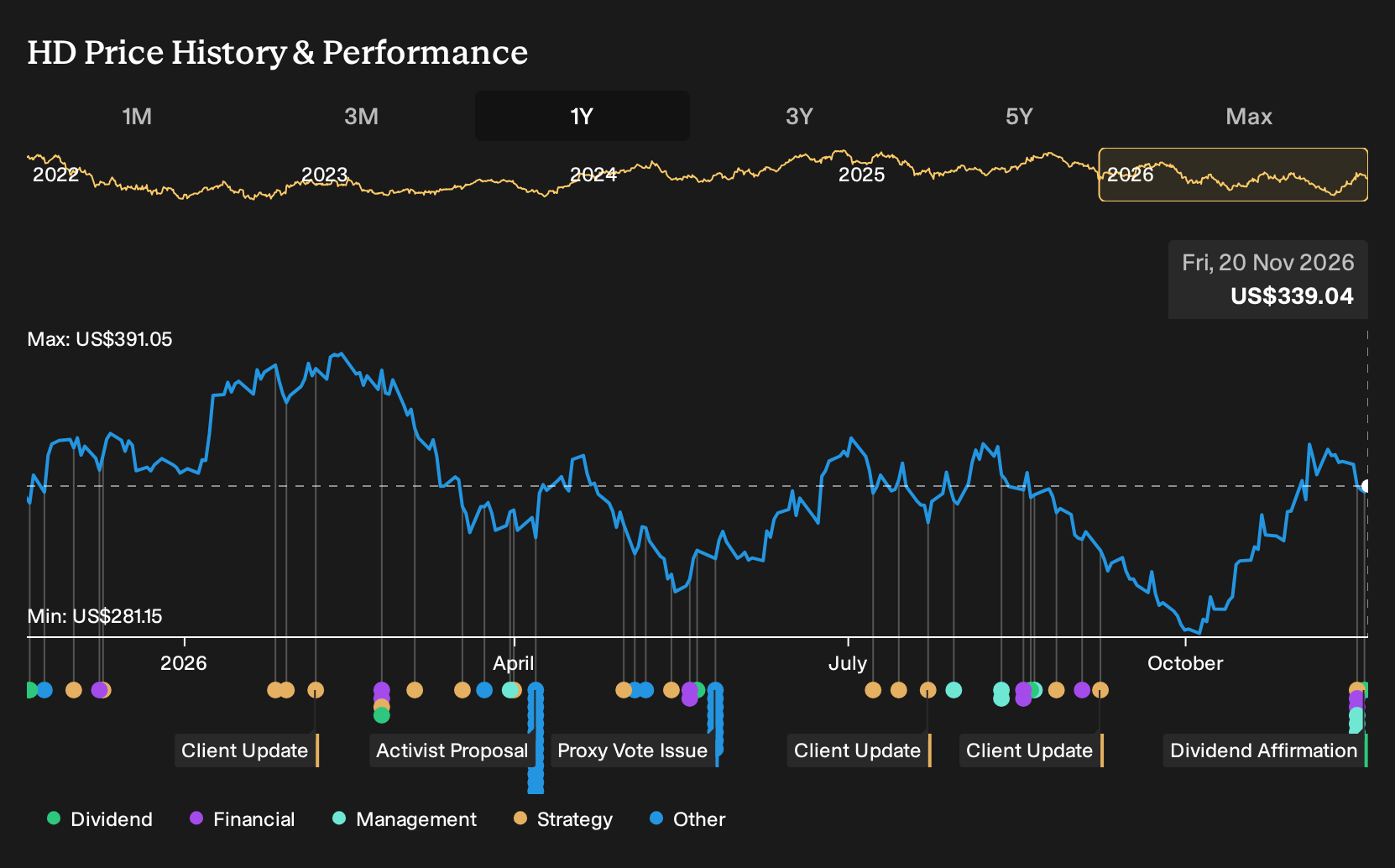
- Home Depot reported third quarter 2026 sales of US$43,398 million and net income of US$3,713 million, affirmed its 2026 outlook for roughly 4.5% total sales growth and 1.5% diluted EPS growth from fiscal 2025, and confirmed a US$2.33 quarterly dividend payable on December 17, 2026.
- The board approved a leadership overhaul, naming long-time CFO Richard McPhail as CEO, promoting Ann-Marie Campbell to President and COO, and appointing Jordan Broggi as CFO, with executive roles aligned to the push into Pro-focused distribution, AI tools like Magic Apron, and expanded last mile delivery capacity.
- This overview examines how Home Depot's Pro focused expansion strategy is being shaped by the CEO transition and the reaffirmed 2026 guidance.
Scan how Home Depot's mix of Pro expansion, AI tools and a 159 quarter dividend streak compares with other potential opportunities in our curated 40 high quality undervalued stocks.
Home Depot Investment Narrative Recap
To own Home Depot, an investor needs to believe the shift toward a full Pro ecosystem, supported by acquisitions and tools like Magic Apron, can offset a softer housing backdrop and mix pressure from lower margin distribution. According to Andrei_Niculescu, an investor in the Simply Wall St Community, the appeal rests on scale, brand, and deep contractor relationships rather than rapid growth.
Right now, the key short term catalyst is execution on integrating SRS, GMS and last mile capacity so Pro focused sales and margins track the reaffirmed 2026 outlook. The biggest near term risk is that higher debt, cost pressure and slower big ticket projects keep profitability tight even if reported revenue guidance is met.
The leadership reshuffle around Richard McPhail as CEO and Jordan Broggi as CFO looks central to that catalyst. McPhail oversaw acquisitions such as HD Supply, SRS Distribution, GMS, Construction Resources and Mingledorff's. Those deals push Home Depot deeper into roofing, drywall, HVAC and other complex Pro categories, where job site fulfillment and capital discipline are both critical.
Broggi brings experience from running interconnected retail, loyalty and payments. That background ties directly into stitching Pro distribution, AI tools such as Magic Apron, and online channels into one experience. For shareholders, the question is less about the headlines and more about whether this team can keep integrating new branches, protect margins under a heavier debt load, and deliver on the 2026 sales and EPS guidance already on the table.
Based on the narrative from Andrei_Niculescu, the fair value of US$385.00 for Home Depot comes from modelling revenue rising 11.5% a year and future profit margin reaching 8.4%. Together, these assumptions imply higher long run earnings power than the current guidance period reflects.
Uncover why Home Depot's fair value indicates a 14% potential upside to its current price, which could narrow quickly.
Exploring Other Perspectives
Four fair value views from the Simply Wall St Community span roughly US$318 to US$385 per share for Home Depot, showing how far apart private investors can be. When you set those pre-news estimates against fresh catalysts like new store openings, SRS branch growth and confirmed dividends, you get a broad menu of opinions to explore.
Explore 3 other Home Depot fair value estimates, including one that suggests as much as 14% upside from the current price.
Decide For Yourself
Disagree with existing narratives? Extraordinary investment returns rarely come from following the herd, so go with your instincts.
- A great starting point for your Home Depot research is our analysis highlighting 2 key rewards and 2 important warning signs that could impact your investment decision.
- See our latest analysis for Home Depot. The report includes a comprehensive fundamental analysis summarized in a single visual, the Snowflake, making it easy to evaluate Home Depot's overall financial health at a glance.
Looking For More Investment Ideas Beyond Home Depot?
If the Home Depot story has sharpened your thinking but you want a broader watchlist, the Simply Wall St Screener can help you quickly sort through other listed businesses that match your risk profile and return goals.
- For investors who care most about financial resilience, start with a list of solid balance sheet and fundamentals (24 results) to focus on companies with stronger foundations.
- If income is your priority, scan a curated set of 8 dividend fortresses that put reliable cash returns at the center of the thesis.
- If you prefer to search for under-the-radar opportunities, use a 18 high quality undiscovered gems that filters for quality fundamentals before the crowd pays attention.
Have feedback on this article? Concerned about the content? Get in touch with us directly. Alternatively, email editorial-team@simplywallst.com