
Adding a Soybean Oil Spread Without Adding Net Contracts
Introduction
Seasonal commodity spread trading starts with a simple observation. Price relationships between futures contracts can follow recurring patterns throughout the year. In Smart Spreads, I use ten years of historical results to rank opportunities within each market and map their typical entry and exit windows. That helps me decide which trades deserve attention and what else may be coming up before I commit capital. This week, I’m using that research to evaluate a new soybean oil trade alongside one I already hold. I’m short the May–July–August butterfly and plan to add a short March–May calendar spread. The two trades take opposite positions in May, so the May contracts cancel. The question is what the portfolio owns after that cancellation and how the additional spread changes its exposure to soybean oil.
The Position I Already Hold
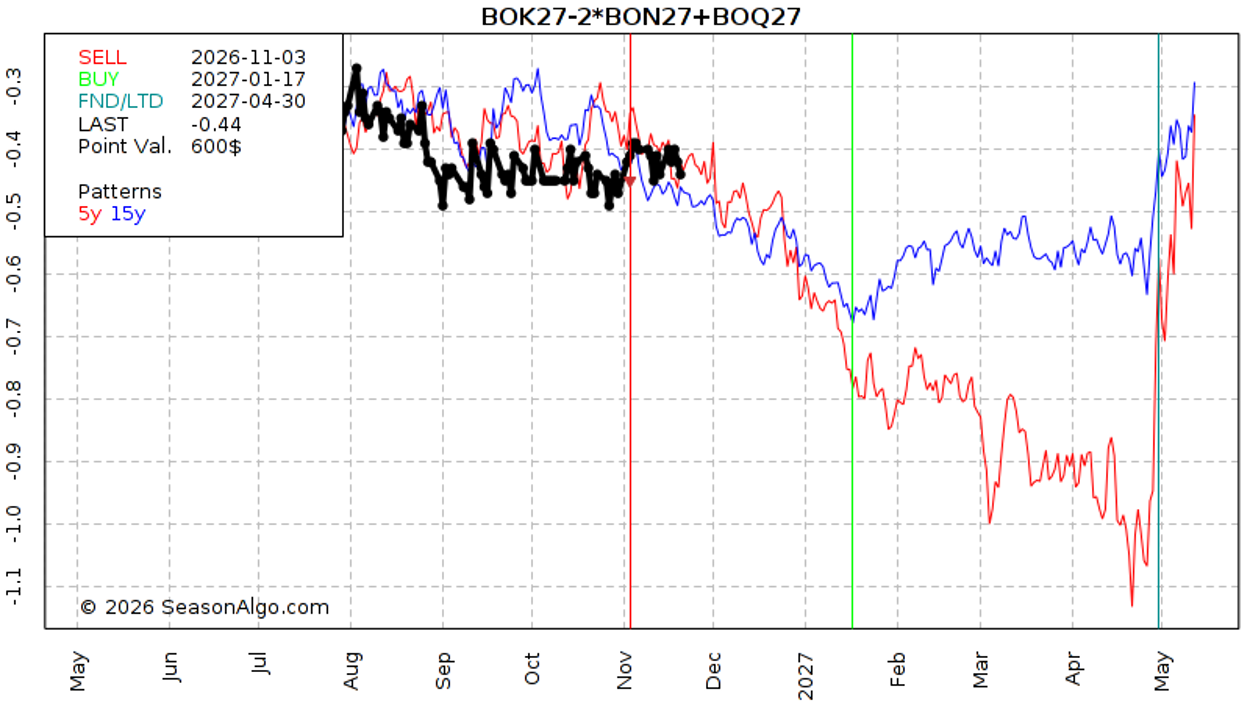
My existing trade is a short May–July–August soybean oil butterfly, expressed as a sale of BOK–2×BON+BOQ. Selling that structure leaves me short one May contract, long two July contracts, and short one August contract. The trade benefits when July strengthens relative to the average of May and August.
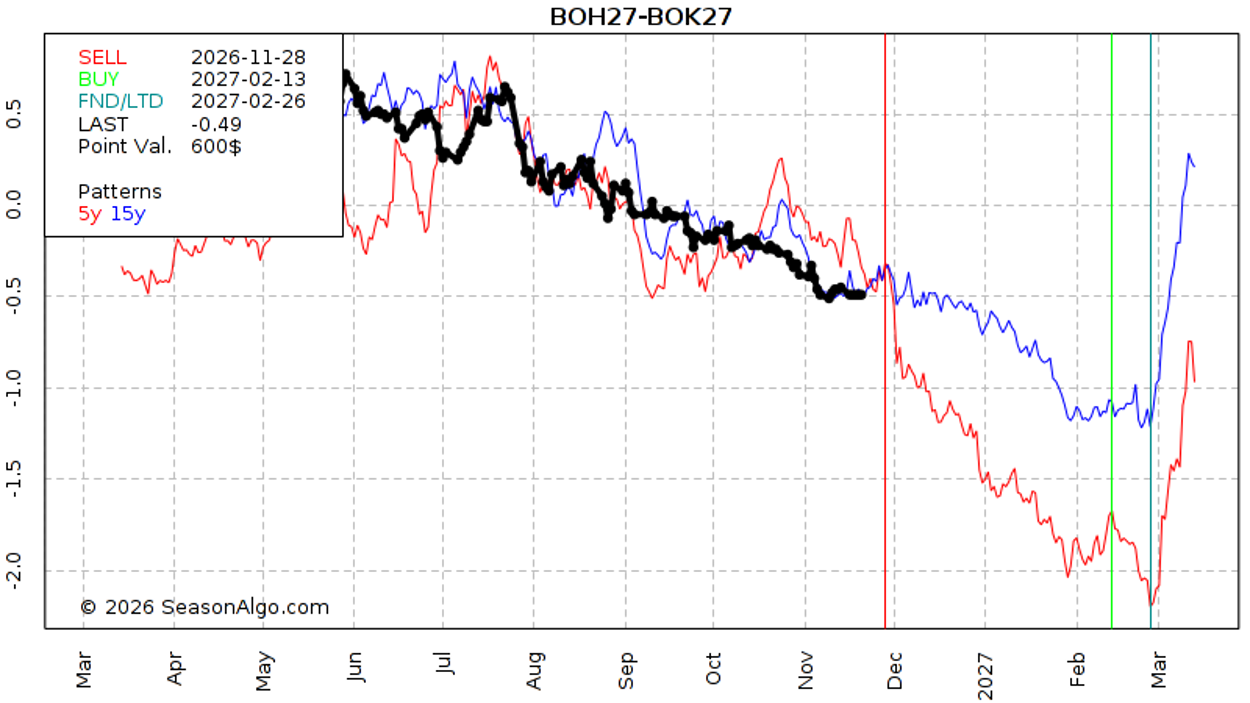
The trade I plan to add is a short March–May calendar spread, or a sale of BOH–BOK. That means selling one March contract and buying one May contract. The calendar spread benefits when March weakens relative to May. The SeasonAlgo chart shows both the five-year and 15-year patterns generally declining from late November into mid-February. That gives me a seasonal reason to consider the trade alongside the butterfly I already hold.
What Happens When May Offsets
Some traders hesitate to add a spread when one of its legs offsets an existing position. I find it helpful to write out the contracts by expiration and look at the combined position.
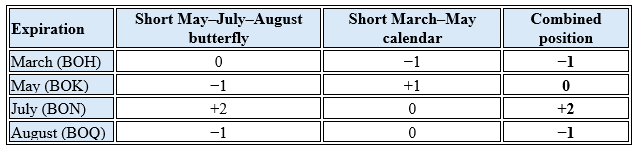
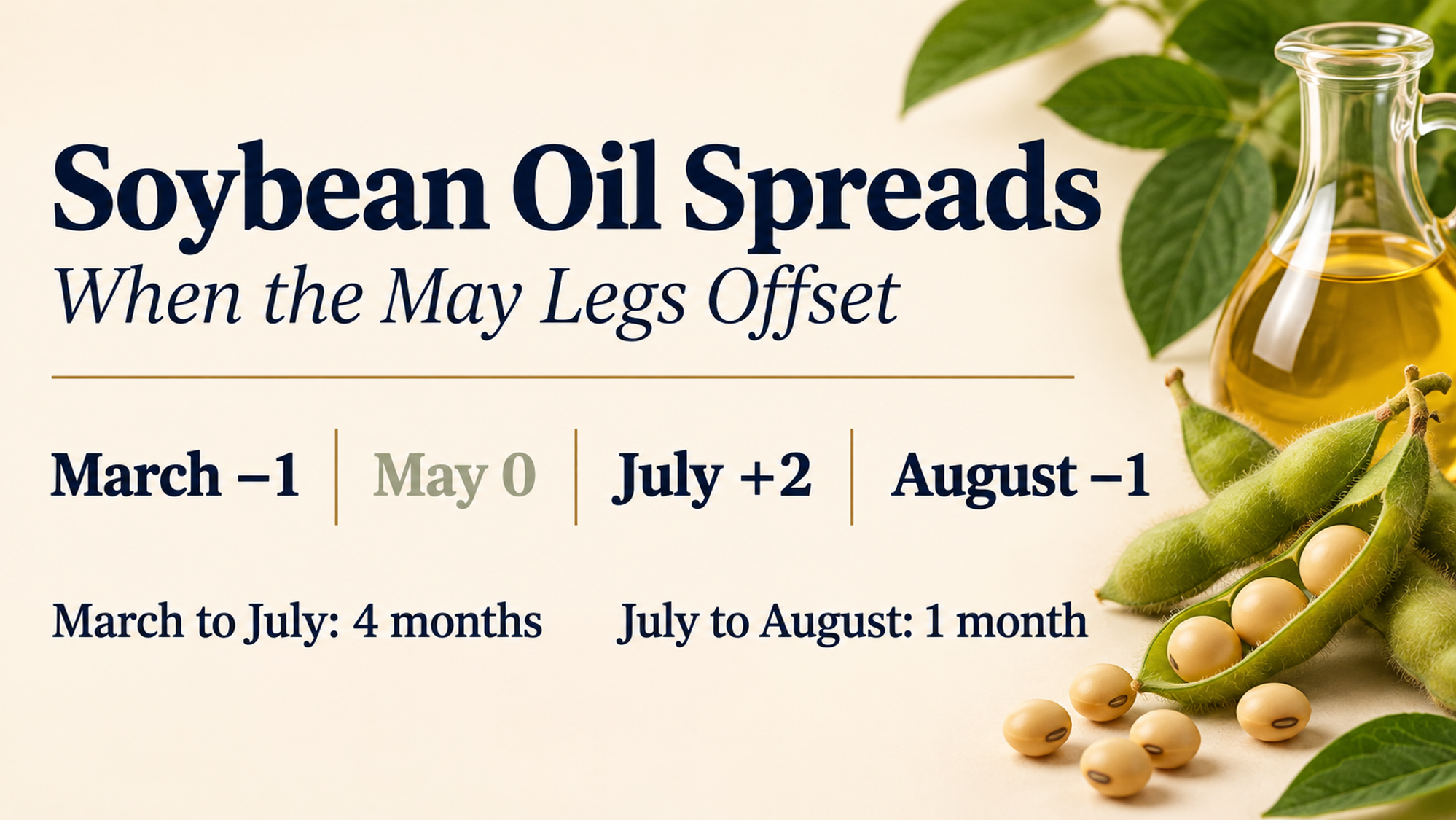
The long May contract in the new spread offsets the short May contract in the existing butterfly. The resulting position is short one March, long two July, and short one August. At the portfolio level, adding the calendar spread effectively moves the front short leg from May to March while leaving the July and August positions in place. One detail matters when I say I’m adding exposure. The combined position still has four contracts in absolute terms and zero net contracts, just like the original butterfly. A uniform price move across all the delivery months would offset in either position. What I’m adding is exposure to a different part of the soybean oil futures curve. A move in March alone previously had no direct effect on the position. After adding the calendar, that move would affect my P&L, while an isolated move in May would cancel across the two trades.
Why the Gap Between Contracts Matters
The resulting position has an uneven structure. March is four months ahead of July, while August is just one month beyond July. The original butterfly already had unequal spacing, with two months from May to July and one month from July to August. Adding the calendar spread extends the front interval by another two months. The contract weights are still one, two, and one, but the delivery months are spaced differently. The combined position can be viewed as short March–July and long July–August. That puts a four-month calendar spread on one side and a one-month calendar spread on the other. The wider front interval can respond differently to shifts in the curve, even though the number of contracts stays the same.
How I’m Evaluating the Addition
The seasonal research gives me a reason to consider selling March–May. Looking at the trades together shows what that decision would do to the portfolio. I’d be replacing my short May exposure with short March exposure and holding a wider soybean oil structure around July. That’s the practical lesson from this setup. When two spreads share an offsetting leg, start by netting the positions by delivery month. Here, May drops out, March comes in, and the distance between the front and middle contracts doubles. Those are the changes I want to understand before adding the trade.
Additional Details
Dual Edge Research publishes 2 weekly newsletters offered at one low price:
- The Bull Strangle Newsletter focuses on stocks and options, combining stock ownership with disciplined option-selling techniques designed to generate consistent income while managing risk.
- The Smart Spreads Newsletter focuses on seasonal commodity spreads, a historically proven approach that seeks opportunities across agricultural, energy, metal, and financial futures markets.
Each strategy is designed to stand on its own, but together they provide a diversified approach that can perform across a wide range of market environments. For traders looking to deepen their education, The Bull Strangle Strategy and Trading Commodity Spreads are both available on Amazon.
Visit BullStrangle.com to subscribe for just $1 for the first month.
For a video overview of the Bull Strangle Newsletter
For a video overview of the Smart Spreads Newsletter
Darren Carlat
Dual Edge Research
(214) 636-3133
DualEdgeResearch@gmail.com
Disclaimer
This information is for informational purposes only and should not be considered investment advice. Past performance is not indicative of future results, and all investments carry inherent risk. Consult with a financial advisor before making any investment decisions.