
The European bond market broke 2 trillion euros for the first time! The AI financing frenzy hit government borrowing, and issuance records were blown up
The Zhitong Finance App noticed that the amount of European bonds issued surpassed 2 trillion euros (2.2 trillion US dollars) for the first time. What is behind this is the government's continuous borrowing, which is compounded by the huge financing needs brought about by the artificial intelligence boom.
Technology companies are the biggest driver of this annual record. US hyperscale cloud service providers, including Alphabet Inc. (GOOGL.US) and Amazon (AMZN.US), are raising huge sums of money to finance the data centers and infrastructure needed for AI. As the tech race continues to accelerate, demand for borrowing will continue to keep European bankers busy.
“Much of the increase in non-financial sector borrowing is being driven by US companies seeking financing from numerous bond markets,” HSBC Holdings' team of strategists led by Song Jin Lee wrote in their 2027 outlook this week.
This surge comes at a time when rising global interest rates are driving up financing costs, and the yield on Euro high-grade corporate bonds has risen to the level since 2023. However, investors' preferences for corporate debt are still relatively strong, curbing the additional premiums paid by corporate debt.
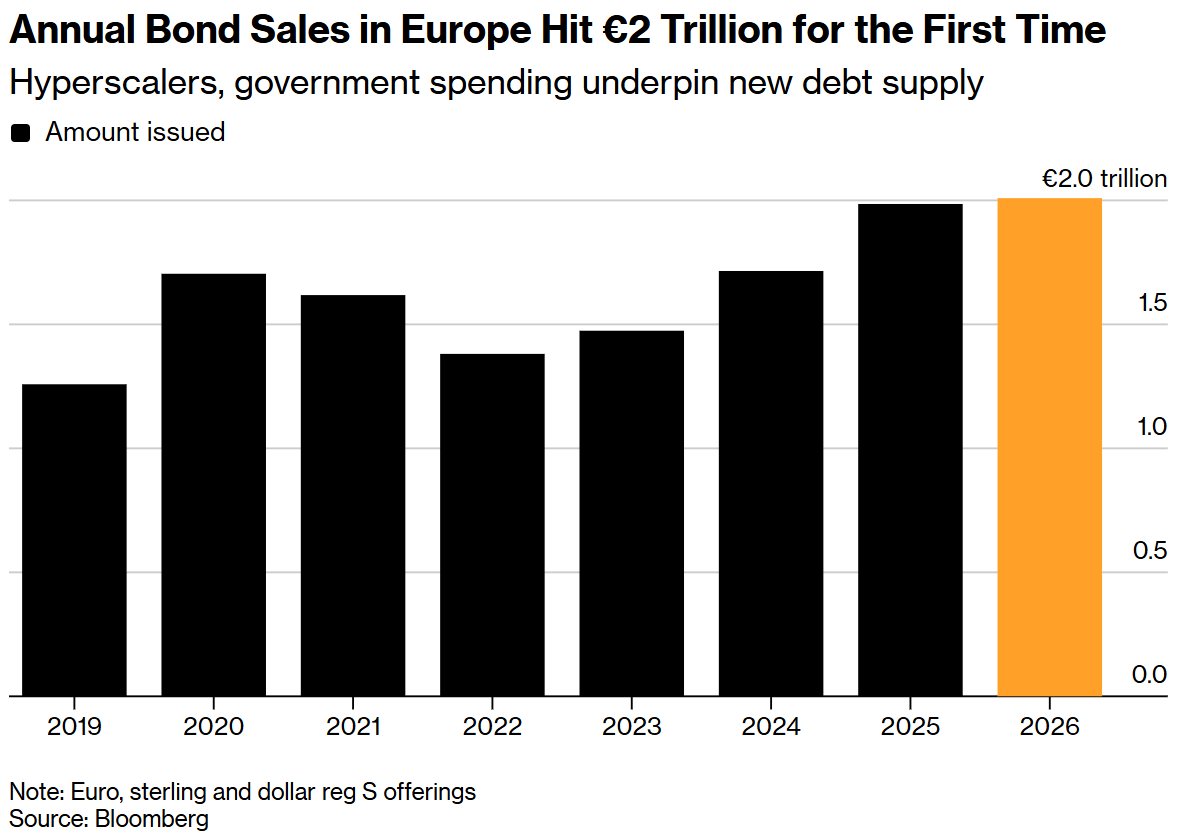
Europe's annual bond issuance surpasses 2 trillion euros for the first time
According to data, the publicly issued bond market broke through the €2 trillion milestone on Thursday. This record covers syndicated offerings in euros, pounds, and dollars issued under Regulation S rules — which allow securities to be sold outside the US without registration with the US Securities and Exchange Commission (SEC).
The amount of corporate debt increased by about 49 billion euros compared to 2025, of which about 37.5 billion euros came from hyperscale cloud service providers. Alphabet Amazon and Meta (META.US) are each among the top four issuers of non-financial bonds issued in European currencies this year.
Syndicated offerings by governments, multinational institutions, and government support agencies — accounting for around 40% of the overall market — are at record levels, but are generally close to last year's figures.
This borrowing frenzy also has its downsides. Continued large-scale transactions by hyperscale cloud service providers have caused investors to demand high premiums for new bond issues. The secondary market transaction level of Eurobonds from these cloud service providers is comparable to bonds rated several levels lower than they actually are.
Syndicated distribution is part of a larger trend in Europe. Governments, which also borrow through auctions, are using debt to finance defense and infrastructure expenses. The rise in circulation coincided with higher yields driven by rising energy costs.
France is facing increasing political and financial risks ahead of next year's presidential election (ahead of next year's presidential election). According to estimates by Commerzbank strategists, Germany will become the largest general issuer of bonds among the Eurozone countries next year, and the entire Eurozone may issue a record amount of more than 1.5 trillion euros next year.