
Elastic’s Q3 CY2026 sales beat estimates but stock drops on weak guidance

Search and artificial intelligence platform provider Elastic (NYSE:ESTC) reported calendar Q3 2026 [fiscal Q2 2027] results exceeding the market’s revenue expectations, with revenue up 17.1% year on year to $495.9 million. On the other hand, next quarter’s revenue guidance of $508 million was less impressive, coming in 1.8% below analysts’ consensus estimates. Its non-GAAP profit of $0.94 per share was 16.1% above analysts’ consensus estimates.
For more on Elastic, read the full research report for free.
Elastic Q3 CY2026 highlights:
- Revenue $495.9 million vs S&P consensus estimates of $486.9 million (17.1% year-on-year growth, 1.9% beat)
- Adjusted EPS $0.94 vs S&P consensus estimates of $0.81 (16.1% beat)
- Adjusted operating income $110.1 million vs analysts’ consensus estimates of $92.59 million (22.2% margin, 18.9% beat)
- Revenue guidance The company reconfirmed its revenue guidance for the full year of $2.00 billion at the midpoint
- Adjusted EPS guidance Management raised its full-year adjusted EPS guidance to $3.38 at the midpoint, a 1.5% increase
- Operating margin 4.4%, up from -1.9% in the same quarter last year
- Free cash flow margin 8.8%, down from 27.5% in the previous quarter
- Net revenue retention rate 111%, in line with the previous quarter
- Billings $478.3 million at quarter end, up 19.2% year on year
- Market capitalization $8.72 billion
“Elastic delivered another strong quarter, beating guidance across all key metrics,” said Ash Kulkarni, CEO of Elastic. “In Q2, we accelerated our AI innovation with new capabilities such as AlertZero, Elastic® nightshift, and Elastic Context Engine, and I’m personally very excited about our agreement to acquire HoneyHive, which will allow us to expand our business in the area of agent observability and evaluations. We are also pleased with the continued growth of our $1M+ customer cohort, similar to the solid net additions we saw during the first quarter. Our strong results reflect expanding customer adoption and position us well to continue our strong execution in the back half of fiscal 2027.”
Revenue growth
A company’s long-term revenue performance can indicate its overall quality. Any business can experience short-term success, but top-performing ones sustain growth for years. Elastic’s revenue grew at a solid 20.6% compounded annual growth rate over the last five years. Its growth was slightly above the average software company and shows its offerings resonate with customers.
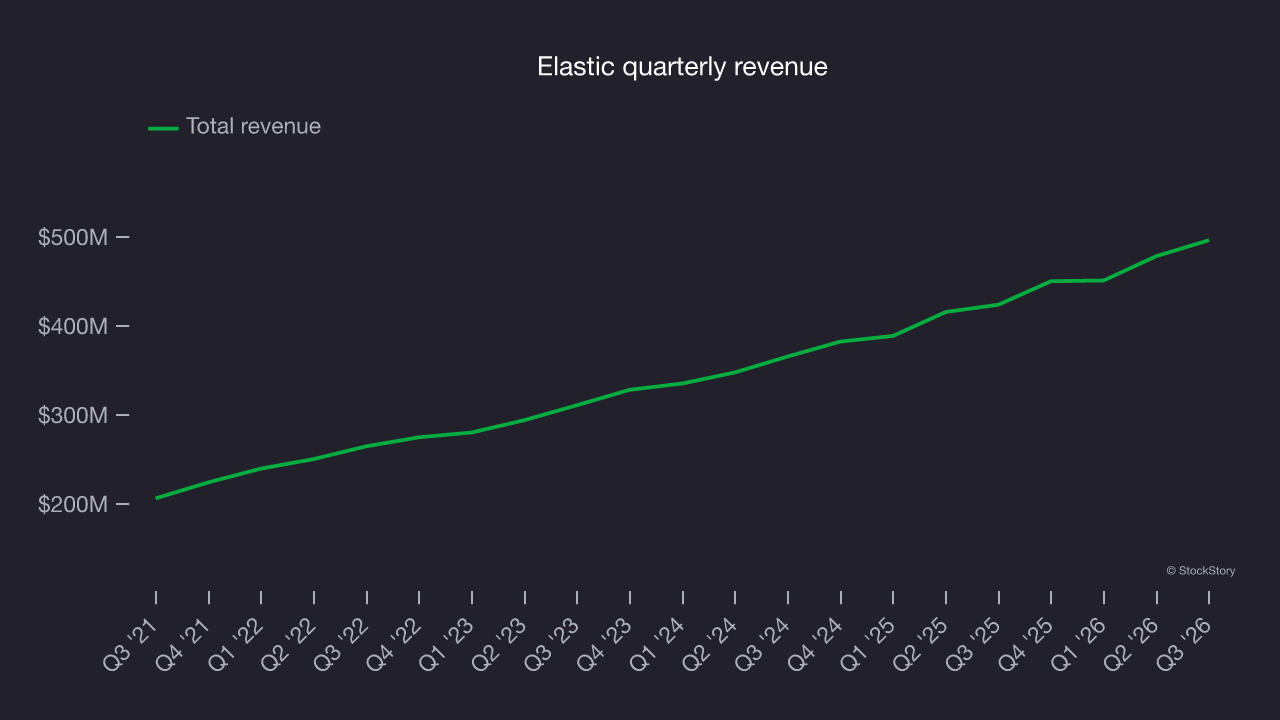
Long-term growth matters most, but within software, a half-decade historical view may miss recent innovations or disruptive industry trends. Elastic’s annualized revenue growth of 16.7% over the last two years is below its five-year trend, but the results were still respectable. 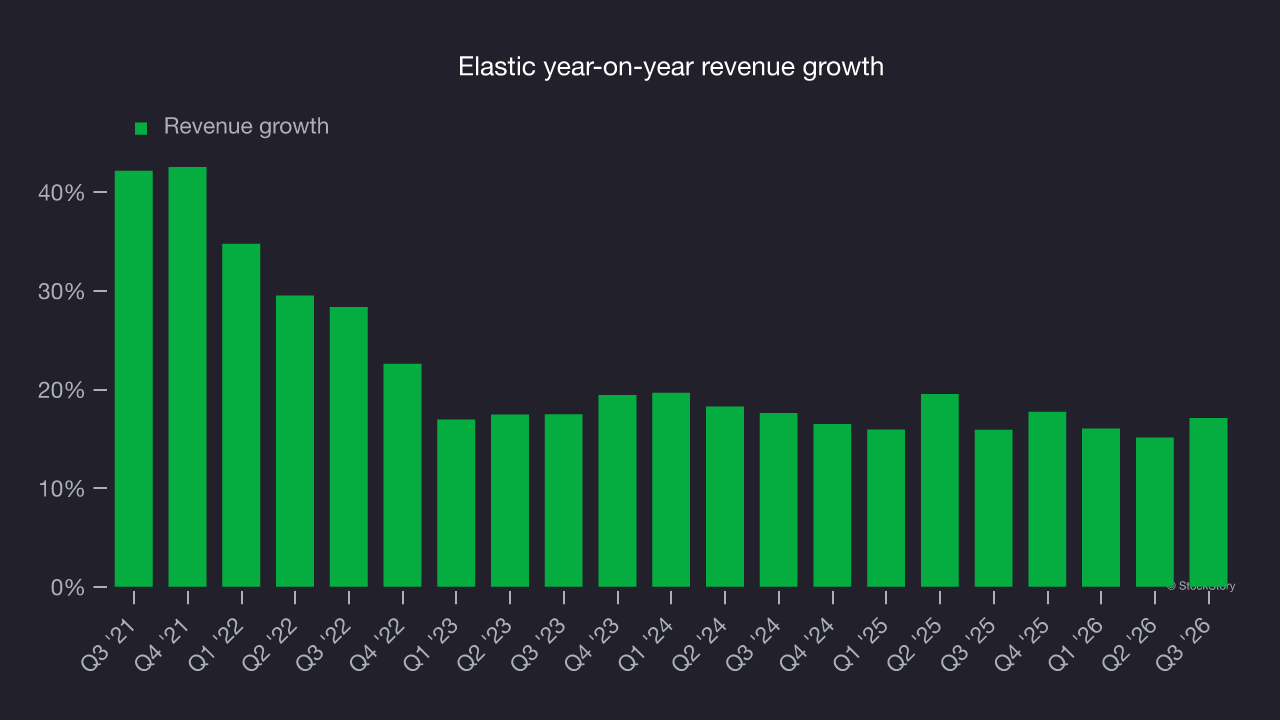
This quarter, Elastic reported year-on-year revenue growth of 17.1%, and its $495.9 million of revenue exceeded Wall Street’s consensus estimates by 1.9%. Management is guiding for a 12.9% year-on-year increase in revenue next quarter.
Looking further ahead, sell-side analysts expect revenue to grow 14.5% over the next 12 months, according to S&P, a slight deceleration versus the last two years. This uninspiring projection suggests its products and services will face some demand challenges.
Billings
Billings is a non-GAAP metric that is often called “cash revenue” because it shows how much money the company has collected from customers in a certain period. This is different from revenue, which must be recognized in pieces over the length of a contract.
Elastic’s billings came in at $478.3 million in Q3, and over the last four quarters, growth averaged a healthy 18.5% year over year. This performance aligned with its total revenue growth, indicating strong customer demand. The cash collected from customers also supports liquidity and capacity for future investment and growth. 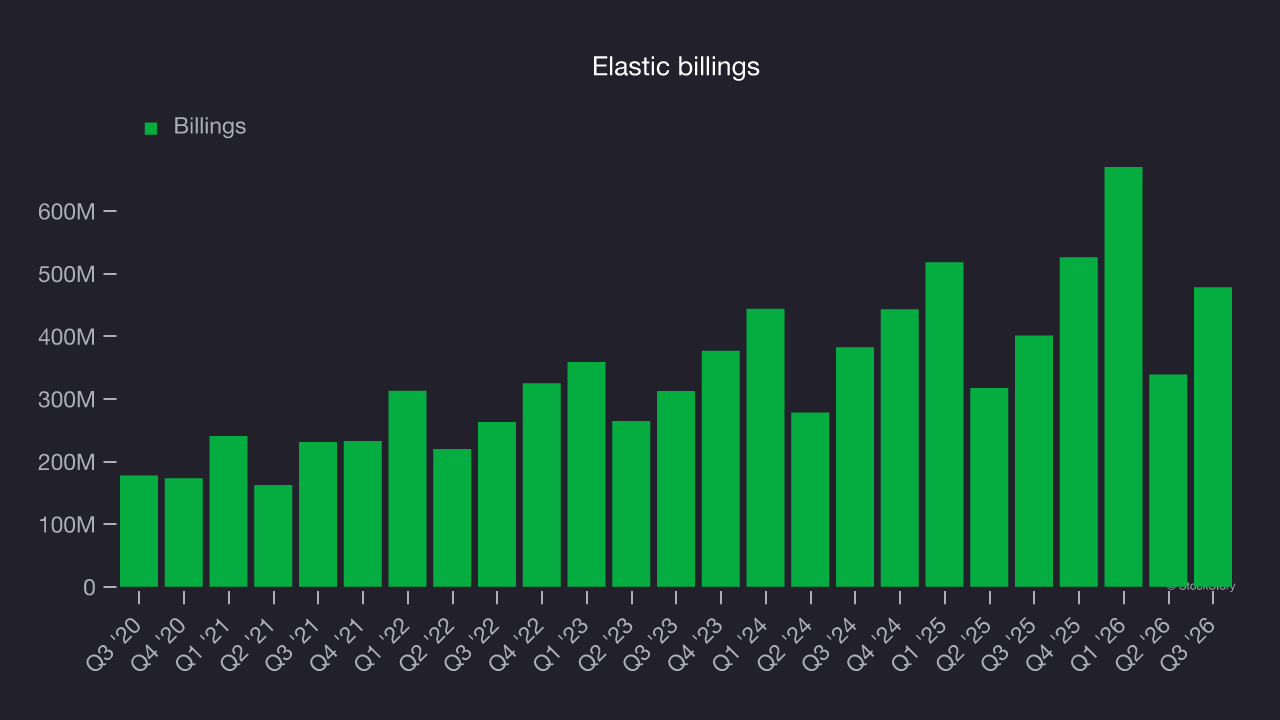
Enterprise customer base
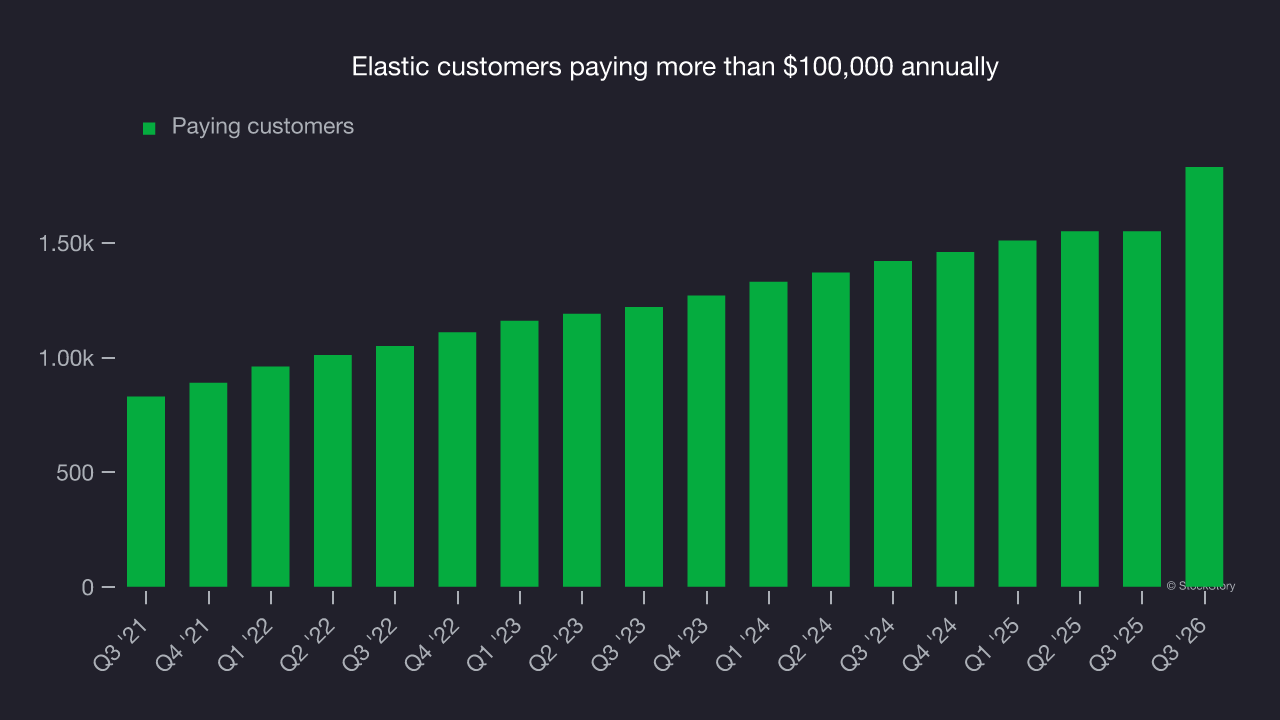
This quarter, Elastic reported 1,830 enterprise customers paying more than $100,000 annually,
Key takeaways from Elastic’s Q3 results
Guidance was the weak point in a softer quarter for Elastic: both revenue and EPS forecasts for next quarter fell short of Wall Street’s consensus estimates. The reported results had some positives, with adjusted operating income well ahead of analysts’ consensus estimates and billings narrowly topping Wall Street’s expectations. Shares tumbled 7.4% to $68.73 immediately after the results.
When evaluating Elastic as an investment, consider its valuation and business quality as well as its latest quarterly results. Read the full research report here (it’s free).