
Doomsday Deals: Mizuho Hikes Its Costco Stock Price Target as Panic-Buying Spikes on Apocalypse Fears
Mizuho analysts see recent tech outages lifting sales for Costco (COST) as consumers panic-buy emergency supplies. Based on this, Mizuho raised its price target on COST stock from $1,100 to $1,150 and kept a bullish “Outperform” rating.
Mizuho analyst David Bellinger said in a research note that after the Microsoft (MSFT) Outlook and Teams outage, the ground stoppage of U.S. flights, and posts urging people to stock up on supplies pop up across popular social media platforms like TikTok, emergency prep sales at Costco have increased. Mizuho estimates that Costco’s U.S. comparable sales, excluding gasoline, accelerated to 11%-12% in the final week of October, compared with a typical 6%-7% pace during the first three weeks of the month.
Beyond the tailwind from apocalyptic fears, Costco is also pursuing expansion through a nationwide deal with DoorDash (DASH) to deliver groceries, household goods, and electronics; Medicare Advantage plans carrying its name; and growth in its gas business. Costco is also expanding its warehouse footprint, with 30 new warehouses a year targeted over the next five to 10 years.
Against this backdrop, we take a closer look at Costco.
About Costco Stock
Costco Wholesale Corporation is a leading membership-based warehouse retailer headquartered in Issaquah, Washington. It sells a limited selection of groceries, electronics, household goods, and other products in bulk at competitive prices, alongside services such as pharmacies, gas stations, and tire centers. Its Kirkland Signature private label is central to its value-focused model.
Costco continues to expand its warehouse network across North America and international markets while strengthening its e-commerce presence. Its recent developments include ongoing store expansion, new warehouse openings, and continued investment in digital shopping and delivery services. The company has a market capitalization of $485.94 billion.
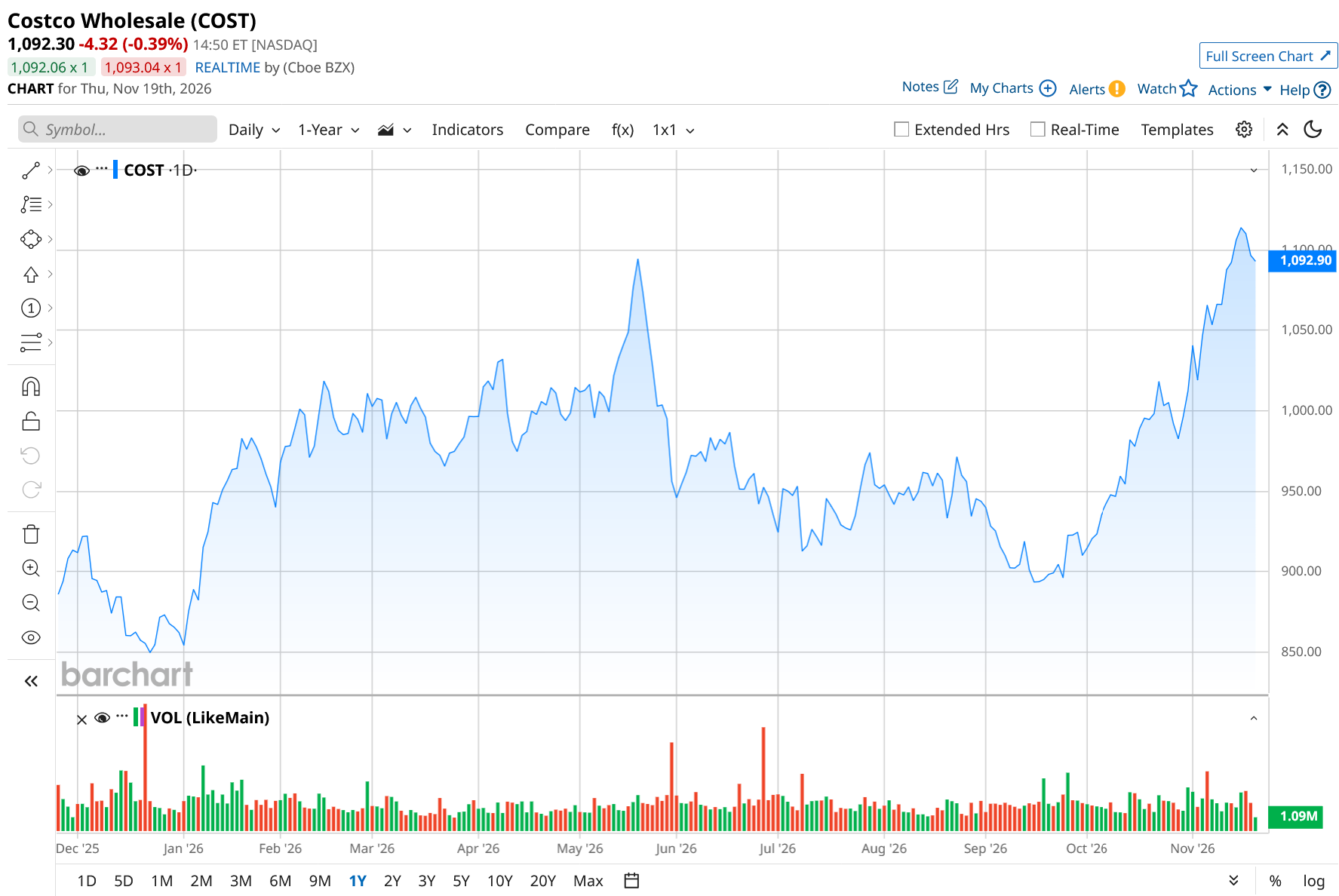
Costco’s stock has risen 23% over the past 52 weeks, mainly because investors see it as a resilient, high-quality retailer with dependable growth. The company’s membership-based business model provides recurring fee income, while strong sales, loyal customers, and continued warehouse expansion support confidence in its long-term outlook. While roughly flat over the past six months, it has gained 14% over the past three months. It reached a 52-week high of $1,123.67 on Nov. 17, but is down 2.75% from that level.
On a forward-adjusted basis, Costco’s price-to-earnings (non-GAAP) ratio of 48.12x is significantly higher than the industry average of 15.50x.
Strong Q4 Results as Membership Growth and Sales Momentum Continue
Costco’s fourth-quarter (quarter ended Aug. 30) revenue grew 11.1% year-over-year (YoY) to $95.72 billion, higher than the $94.85 billion Wall Street analysts expected. This was based on net sales rising 11.2% to $93.87 billion and membership fee revenue up 7.3% to $1.85 billion. Costco’s Q4 comparable sales grew 6.7%.
The company currently operates 939 warehouses, including 647 in the U.S. and Puerto Rico. For the 52 weeks ended Aug. 30, Costco incurred $6.44 billion in costs related to additions to property and equipment. Its fourth-quarter EPS was $6.75, up 15% YoY and higher than the $6.53 analysts expected.
Wall Street analysts expect EPS to climb 12.7% YoY to $4.89 for Q1 FY2027 (to be reported on Dec. 10, after the market closes). For fiscal 2027, EPS is projected to surge 11.2% YoY to $22.73, followed by 9.9% growth to $24.98 in fiscal 2028.
What Do Analysts Think About COST Stock?
In addition to Mizuho, multiple Wall Street analysts have recently reaffirmed or taken a bullish stance on Costco. This month, analysts at Stifel initiated coverage of COST stock with a “Buy” rating and a $1,220 price target, citing paid-member growth and executive membership conversion, which support recurring fee income. Stifel’s traffic analysis supports further expansion, with some cannibalization of nearby clubs considered manageable.
Evercore ISI analysts maintained an “Outperform” rating and raised the price target from $1,100 to $1,200, indicating bullish sentiment around COST. Bernstein analyst Zhihan Ma reiterated her “Buy” rating and raised the price target from $1,143 to $1,155, anticipating a relatively uneventful Q1 FY2027 report.
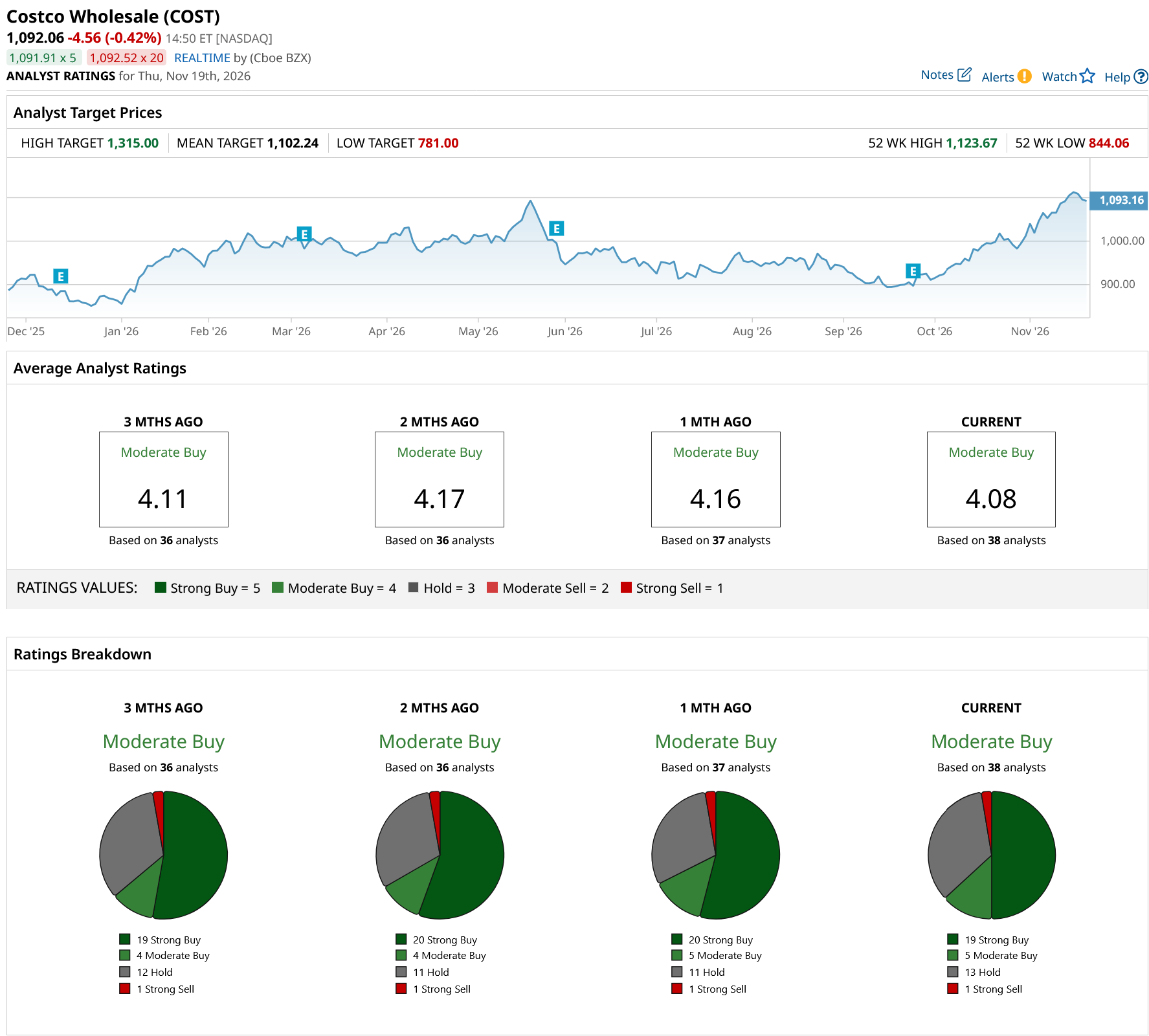
Costco remains a popular name on Wall Street, with analysts awarding it a consensus “Moderate Buy” rating overall. Of the 38 analysts rating COST stock, 19 have given it a “Strong Buy” rating; five gave a “Moderate Buy,” while 13 took a middle-of-the-road approach with a “Hold” rating, and one gave a “Strong Sell” rating. The consensus price target of $1,102.24 represents a marginal upside from current levels. The Street-high price target of $1,315 indicates a 20% upside.
On the date of publication, Anushka Dutta did not directly have a position in any of the securities mentioned in this article. All information and data in this article is solely for informational purposes. For more information please view the Barchart Disclosure Policy here.