
Yuanda Pharmaceutical (00512) dropped to treat RSV in the blue ocean, and its self-developed nebulized inhaler was approved, pointing to a potential market of 100 million
The Zhitong Finance App learned that on November 19, Hong Kong stock innovative pharmaceutical company Yuanda Pharmaceutical (00512) announced that GPN01564, a globally innovative nebulized inhaler developed independently by the company to treat respiratory syncytial virus (RSV), has been approved by the State Drug Administration to carry out phase I clinical research. This is another major milestone in the company's anti-infection direction in the field of respiratory and critical illness. The news also once again pushes the popular field of RSV into the spotlight of the industry.
According to public information, RSV is one of the main causes of lower respiratory infections, and there are no RSV-specific antiviral treatments approved for marketing worldwide. GPN01564 targets RSV fusion protein (F protein) and uses an atomized inhalation administration route. Its clinical approval indicates that Yuanda Pharmaceutical has achieved a major breakthrough in this circuit that does not meet clinical needs; at the same time, the company's self-research capabilities will be verified again, and major products will be added to the clinical research pipeline.
Targeted F protein superposition nebulization inhalation, GPN01564 directly points to RSV clinical treatment gaps
In recent years, respiratory syncytial virus (RSV) infection has become a popular race track in the field of respiratory infections worldwide. As one of the main causes of lower respiratory infections, RSV poses a particularly prominent threat to infants and the elderly. According to statistics, in 2019, there were about 33 million people worldwide with acute lower respiratory infections (ALRTIS) due to RSV; RSV caused more than 3.6 million hospitalized cases of children under 5 each year, including about 100,000 deaths. China is one of the countries with the highest number of cases of RSV infection in the world. In 2019, there were about 3.5 million cases of alRTIS caused by RSV among children under 5 in China, accounting for more than 10% of the world, and 620,000 to 950,000 hospitalizations, accounting for 17% to 24% of the world, ranking second in the world.
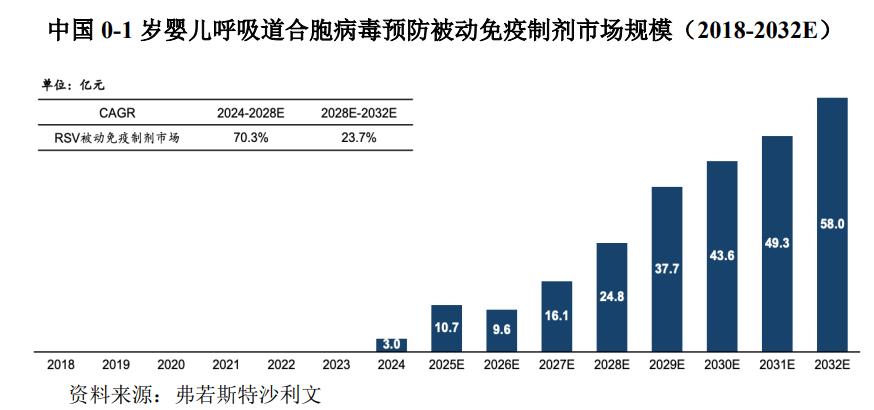
The huge burden of disease is being transformed into clear commercial expectations. According to Insight Consulting data, the global RSV drug market size (including therapeutic drugs and preventive drugs) is expected to grow from US$1.8 billion in 2020 to US$12.8 billion in 2030, with a compound annual growth rate of 21.4%; of these, RSV drugs for children are expected to reach US$11.7 billion in 2030, accounting for 91.1% of the overall market. Focusing on the domestic market, China's RSV drug market is expected to grow from 5.2 million US dollars in 2020 to 1.5 billion US dollars in 2030, with a compound annual growth rate of 75.8%, accounting for about 89.4% for children. Furthermore, according to Frost & Sullivan's previous estimates, the RSV infant vaccine market in China alone has reached 360 million yuan in 2024, and the potential market space in 2032 is as high as 5.8 billion yuan. The performance of preventive products has been the first to verify this commercialization expectation: the world's first approved long-acting monoclonal antibody for RSV prophylaxis has been on the market for only two years and has become a blockbuster drug.
However, the sharp contrast with rapid dosage on the prevention side is the long-term absence of treatment. According to the “Collaborative Expert Consensus on the Prevention and Control of Respiratory Syncytial Virus Infection”, there are currently no specific antiviral drugs for RSV infection. Clinically, symptomatic support such as oxygen therapy and rehydration are mainly given as appropriate according to the individual conditions of infected people. It can be seen from this that clinical needs in the field of treatment of RSV infections are far from being met.
The emergence of GPN01564 directly points to this clinical gap. This product is an RSV fusion protein (F protein) inhibitor with differentiated competitive advantages in target selection and administration methods. The target of this product, F protein, is a type I membrane fusion protein. It has become one of the most promising targets in the field of RSV prevention and treatment research due to its unique antigen epitope conformation and ability to efficiently neutralize antibodies before fusion.
In terms of administration methods, GPN01564 relies on an atomized inhalation route, and there is no need for systemic administration. The drug directly targets the lungs to achieve accurate and non-invasive administration, which can improve the medication experience and form a clear clinical advantage in dosage compliance. From the perspective of dosage methods, the atomized inhalation used in GPN01564 already has a mature clinical use basis in China. According to data from the Mi Intranet, in recent years, the sales scale of terminal inhalants (chemical+biochemical) in public medical institutions in China has exceeded 20 billion yuan, of which the market share for respiratory medication exceeds 80%. For GPN01564, which uses nebulization as the route of administration, mature domestic terminal usage habits will provide realistic support for its subsequent clinical and commercialization promotion.
It is worth mentioning that the clinical application potential of GPN01564 has been initially verified at the pre-clinical research stage. According to the announcement, GPN01564 preclinical study results show that it has good pharmacogenicity, safety and efficacy. This will also provide an important evidence-based basis for subsequent clinical development and further enhance the certainty of advancing phase I clinical research.
Product clusters create a systematic respiratory treatment system, and the platform-based layout is gradually becoming clear
For Yuanda Pharmaceutical, the advent of GPN01564 can not only enrich the company's existing product pipeline, but is also of great value for improving the integrated treatment layout in the respiratory and critical care sector and consolidating the company's differentiated competitive advantage in this field. As an important product reserve for an innovative anti-infection platform in the respiratory and critical care sector, GPN01564 and innovative products sold by the sector have jointly built a collaborative product portfolio to form a closed loop of full-airway and full-cycle management in the respiratory sector.
Specifically, Yuanda Pharmaceutical's innovative products on sale in the respiratory and critical care sector have covered many aspects of the airway: the novel compound nasal spray Liteling® targets upper airway inflammation such as allergic rhinitis, and innovative inhalation formulations to treat asthma, Enzhuorun® and Enmingrun® are deeply involved in long-term control of chronic airway diseases such as asthma, while GPN01564 fills the gap in RSV-specific antiviral treatment. The rich product pipeline together forms a collaborative combination of “full airway and full cycle management” in the respiratory sector to promote the upgrading of the platform from a product cluster for chronic airway diseases to a systemic respiratory treatment system.
According to reports, respiratory and critical care is one of Yuanda Pharmaceutical's core strategic areas. The products sold by the company cover various indications such as rhinitis, bronchitis, pneumonia, asthma, and chronic obstructive pulmonary disease, and cover a variety of medical insurance catalogue products. Notably, Lightling® was included in the “National Basic Medical Insurance, Maternity Insurance, and Work Injury Insurance Drug Catalogue (2026)” for the first time this year, and Enzhuorun® and Enmingrun® successfully renewed the national medical insurance drug catalogue, which helped improve patients' access to medication and accelerate market penetration.
Relying on the accumulation of products and commercialization on respiratory and critical care circuits, Yuanda Pharmaceutical is simultaneously laying out innovative anti-infection pipelines. GPN01564 is a candidate variety to focus on in this direction. The product is independently developed by the company's self-built anti-infection innovation platform. According to the company announcement, the innovation platform is centered on the Wuhan Optics Valley International R&D Center and has built a global anti-infective innovation R&D network covering the entire chain of “early detection - process development - clinical transformation”. The R&D center covers an area of more than 13,000 square meters and is equipped with international advanced scientific research equipment. It can carry out research and development of small molecule drugs, polypeptide drugs and high-end complex dosage forms, and has established special laboratories for pharmacodynamics evaluation, process thermal safety evaluation, crystallization technology, and continuous flow process research. The platform has the qualifications of a national enterprise technology center and an R&D and innovation technology platform at the provincial level or above, and has established a national postdoctoral research workstation.
Currently, the platform has laid out high-burden racetracks such as RSV, sepsis, acute respiratory distress syndrome (ARDS), influenza, herpes virus, novel coronavirus infections, and gram-negative bacteria, directly attacking unmet clinical needs, forming a continuous project echelon from candidate molecule discovery, preclinical research, registration and reporting to clinical development, and is progressing in an orderly manner.
Looking forward to the future, Yuanda Pharmaceutical said that the company will continue to strengthen its strategic investment in the platform, focusing on improving the level of source innovation, molecular discovery efficiency and clinical transformation capabilities, accelerating the upgrading of the platform to a systematic treatment system, comprehensively supporting the long-term high-quality development of the respiratory and critical care sector in the field of anti-infection, and providing more advanced and diverse treatment plans for patients around the world.