Qunzhi Consulting: The storage market is shifting from a “general boom cycle” to “structural differentiation”
The Zhitong Finance App learned that Qunzhi Consulting published an article stating that in the fourth quarter of 2026, the price trend in the global storage market was divided. The general rise in the storage market gradually changed to a structural mismatch between supply and demand. High-value categories maintained the momentum of price increases, while embedded flash memory for low-end consumption scenarios was the first to weaken under pressure. Sigmaintell (Sigmaintell) judged that the storage market is shifting from a “general boom cycle” to “structural differentiation.” Demand for AI computing power and servers continues to drive high-value storage categories, but the cost pressure on consumer electronics terminals is rapidly becoming apparent. Terminal vendors need to re-examine storage products' specification combinations, supply chain strategies, and cost risk management.
According to Sigmaintell (Sigmaintell) analysis, the price trends and driving logic of storage products in each segment this quarter are as follows:
DRAM: ups and downs are divided, and mobile gains are the first to stop
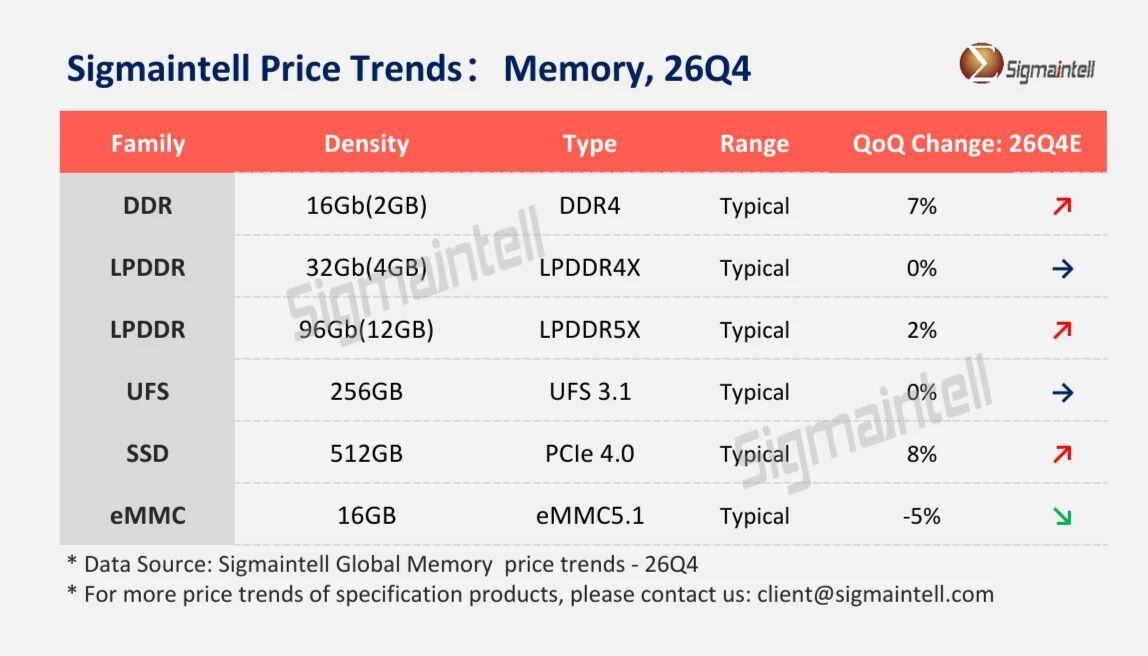
According to Sigmaintell (Sigmaintell) data, traditional DDR4 continued its upward trend in the fourth quarter, with 16GB DDR4 rising 9.0% month-on-month and 16Gb DDR4 rising 7.0% month-on-month. Supply-side contraction is the core factor supporting prices. The original manufacturer continues to favor advanced manufacturing processes and production capacity resources for products such as server DDR5 and HBM. DDR4 production capacity is limited, compounding the stable replacement demand for existing PCs, industrial control, and Netcom equipment, holding up the price level of this category.
In stark contrast to this is mobile memory. The price of LPDDR4X (4GB) remained flat month-on-month during the quarter, while LPDDR5X (12GB) rose only slightly by 1.9%. After many rounds of price increases, memory costs have reached the tolerance limit of mobile phone terminal BOM. The procurement requirements of major brands tend to be conservative, mainly consuming existing inventory and replenishing goods as needed. Buyers' bargaining power has increased, which in turn suppresses the room for LPDRAM to rise.
NAND Flash: Double ice and fire, consumer-grade embedded flash memory is under pressure
The NAND Flash differentiation was further amplified. According to Sigmaintell (Sigmaintell) data, 512GB PCIe 4.0 SSDs rose 8.0% month-on-month in the quarter, making them the strongest performing category among consumer-grade flash memory, and benefited from stable orders brought about by AI reasoning and data center expansion. The computing power business is less price sensitive, and Changxie orders are sufficient. The original manufacturer prioritizes the allocation of particles and encapsulation resources to supply this customer base to support the upward trend in SSD prices.
The price of the mainstream 256GB UFS 3.1 on mobile devices consolidated and remained flat from month to month, reflecting the strategy of smartphone manufacturers to carefully prepare goods; while the price of 16GB eMMC, which mainly focuses on the TV market, has begun to drop, and the month-on-month decline is expected to reach 5.0%, making it the only category at the inflection point of the current quarter. This type of terminal is extremely sensitive to cost. The superimposed UFS solution continues to replace small-capacity eMMC. Some storage factory inventory levels are raised, and the pressure to clear channel inventory increases, and price is exchanged for volume.